
Blog
Why Track Marketing ROI: A Restaurant Owner's Guide
Discover why track marketing ROI is essential for restaurant owners. Unlock the potential for profitable campaigns and smart budget decisions.

Why Track Marketing ROI: A Restaurant Owner’s Guide
TL;DR:
- Tracking marketing ROI reveals whether campaign spending generates actual revenue for restaurants. Accurate measurement requires connecting sales data to marketing activities and avoiding common attribution pitfalls. Consistent, comprehensive tracking helps optimize budgets, improve targeting, and make confident growth decisions.
Marketing ROI is defined as the revenue your marketing generates relative to what you spend to generate it. For restaurant owners and marketing managers, understanding why track marketing ROI is not optional. It is the difference between growing a profitable business and burning through a budget with nothing to show for it. Well-run campaigns can produce net returns up to 450%, but reaching that level requires knowing which channels drive real revenue, not just clicks. This guide explains the core reasons to measure marketing ROI, the pitfalls that distort your numbers, and the practical steps to get it right.
Why track marketing ROI in your restaurant business
Tracking marketing ROI gives you a factual answer to one question: is this spending making money? Without that answer, every budget decision is a guess. Restaurant margins are thin, and guessing is expensive.
Here are the four core reasons every restaurant marketer should track ROI:
- Justify your budget. Stakeholders, owners, and investors want proof that marketing spend produces revenue. ROI data turns a conversation about cost into a conversation about return.
- Identify what works. Not every channel performs equally. ROI tracking reveals which campaigns, platforms, and promotions actually drive table reservations and orders, so you can shift money toward what works.
- Improve customer targeting. When you connect marketing spend to actual customer revenue, you learn which segments spend the most. That insight sharpens your targeting and raises the quality of every future campaign.
- Scale with confidence. ROI tracking supports smarter annual planning and controlled experimentation. When you know a campaign returns $4 for every $1 spent, you can scale it with confidence instead of hesitation.
Pro Tip: Set a minimum acceptable ROI threshold before launching any campaign. For most restaurant promotions, a 3:1 return (revenue to spend) is a reasonable floor. Anything below that signals a channel or message problem worth fixing.
The importance of tracking ROI goes beyond finance. It creates a shared language between your marketing team, your general manager, and your accountant. Everyone reads from the same scorecard, which makes budget conversations faster and less political.

What common pitfalls make ROI tracking inaccurate?
Most restaurant marketers track ROI. Far fewer track it accurately. The gap between reported numbers and real business impact is larger than most owners realize.
The single biggest problem is platform-reported ROAS. Ad platforms attribute revenue to the last ad a customer clicked before buying. Platform-reported ROI can overstate actual impact by 2–4 times compared to true incremental results. That means a campaign your Facebook dashboard calls a winner may be doing far less work than it appears.
“Low observed ROI might reflect measurement error, not poor channel performance. Data-driven attribution is essential before cutting budgets.” Cutting a channel because its reported ROI looks weak is one of the most common and costly mistakes in restaurant marketing.
Here are the four most damaging pitfalls to watch for:
- Last-click attribution. Most ad platforms credit only the final touchpoint before a purchase. This undervalues awareness channels like Instagram or email newsletters that started the customer’s interest.
- Offline conversion gaps. A customer sees your ad, then walks in and pays cash. That sale never appears in your digital dashboard. Restaurants with high walk-in traffic are especially vulnerable to this blind spot.
- Vanity metrics. Clicks, impressions, and follower counts feel like progress. They are not revenue. Tracking marketing effectiveness requires connecting activity to actual dollars spent at your restaurant.
- Short measurement windows on brand campaigns. Brand-building campaigns often require 6–12 months before ROI becomes measurable. Evaluating them after two weeks produces misleading negative results and leads to premature cuts.
The timing problem deserves extra attention. A loyalty program or neighborhood awareness campaign builds slowly. Measuring it on a 30-day cycle will always look weak. Quarterly or semi-annual measurement windows give brand campaigns a fair evaluation and prevent you from killing something that would have paid off.
How can restaurant marketers measure ROI more accurately?
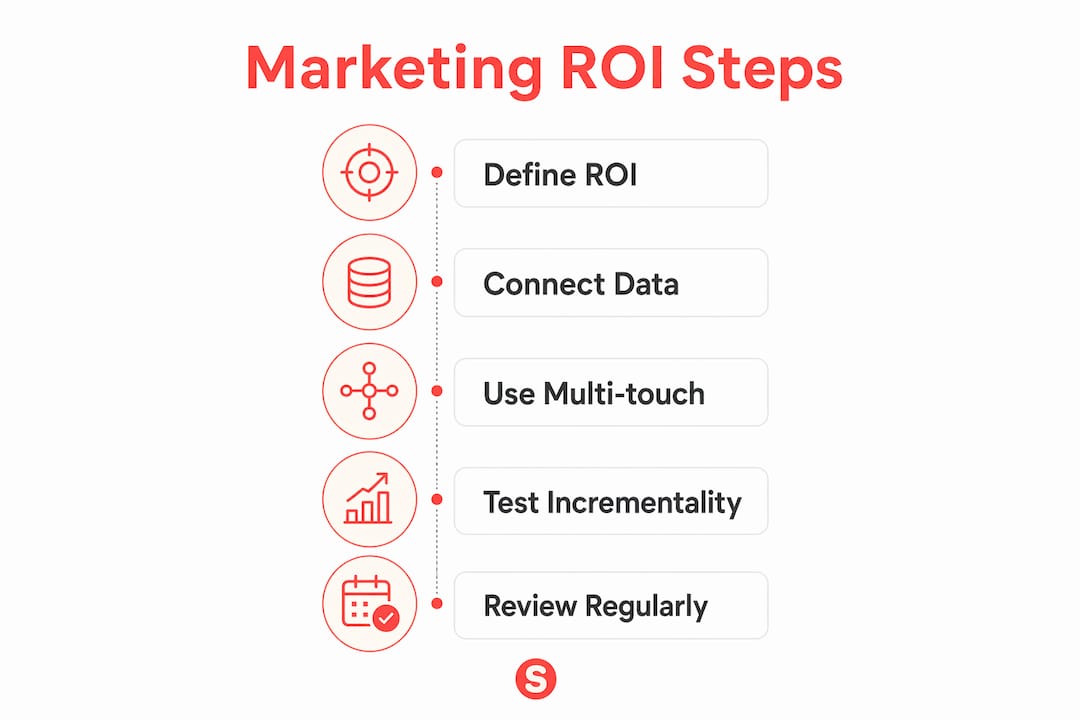
Accurate ROI measurement starts with connecting your marketing data to your point-of-sale revenue. That connection is the foundation everything else builds on.
Connect marketing to POS and CRM data
Tracking revenue linked to customer touchpoints within 30–90 days produces far more accurate results than relying on clicks or leads. For a restaurant, this means matching your email campaign sends, ad exposures, and loyalty program activity to actual transaction records in your POS system. When a customer redeems a promo code or checks in through your app, that sale becomes attributable. Without that connection, you are measuring activity instead of revenue.
Use multi-touch attribution models
Single-touch models (first click or last click) distort reality. Multi-touch attribution spreads credit across every interaction a customer had before visiting. A guest might have seen a Google ad, read your Instagram post, and then clicked an email offer before booking a table. Each of those touchpoints contributed. Multi-touch models reflect that reality. They are more complex to set up but produce far more honest ROI numbers.
Run incrementality tests
Incrementality testing is the most accurate ROI measurement method available. You divide your audience into two groups: one sees your campaign, one does not. The revenue difference between the groups is the true causal impact of your marketing. For restaurant chains or multi-location operators, holdout experiments by location work well. Run one location’s promotion and hold it back from a comparable location, then compare revenue over the same period.
Pro Tip: Pair your restaurant marketing analytics with your POS export at least once a month. Even a simple spreadsheet comparison between campaign spend and revenue during the same period will reveal patterns that platform dashboards hide.
The table below compares three attribution approaches by accuracy, complexity, and best use case for restaurant marketers.
| Approach | Accuracy | Complexity | Best for |
|---|---|---|---|
| Last-click attribution | Low | Low | Quick campaign checks only |
| Multi-touch attribution | Medium | Medium | Ongoing channel mix decisions |
| Incrementality testing | High | High | Budget scaling and channel cuts |
What are best practices for ongoing ROI tracking?
Measuring ROI once is useful. Measuring it consistently is what changes your business. These practices keep your tracking reliable over time.
- Integrate your data sources. Unified platforms connecting CRM, analytics, and finance data remove reconciliation errors and give you real-time ROI visibility across all channels. When your email platform, your POS, and your ad accounts feed into one dashboard, you stop losing revenue data in the gaps between systems.
- Build automated ROI dashboards. Manual reporting gets skipped when things get busy. An automated dashboard that updates weekly keeps ROI visible without adding work. Set it to flag any channel whose return drops below your minimum threshold.
- Capture offline conversions. Use promo codes, QR codes on printed materials, and loyalty check-ins to tie offline visits back to specific campaigns. This is especially critical for restaurants that run print, radio, or outdoor advertising alongside digital.
- Segment by channel and campaign type. A lunch special promotion and a brand awareness campaign have different ROI timelines and benchmarks. Mixing them into one number produces a misleading average. Track them separately.
- Review on the right schedule. Check direct response campaigns monthly. Review brand and content campaigns quarterly. Measuring short-cycle brand campaigns too frequently distorts results and leads to bad cuts.
The benefits of marketing ROI tracking compound over time. Each measurement cycle teaches you something about your customers and your channels. After six months of consistent tracking, most restaurant marketers find two or three channels that carry the majority of their real revenue. That clarity alone is worth the effort.
Pro Tip: Use your free ROI calculator to benchmark each campaign before you launch it. Setting a projected ROI target upfront makes post-campaign analysis faster and more honest.
Key Takeaways
Restaurants that track marketing ROI accurately spend less, earn more, and make faster decisions than those relying on platform dashboards alone.
| Point | Details |
|---|---|
| Define ROI before spending | Set a minimum return threshold for every campaign before it launches. |
| Platform dashboards overstate results | Ad platform ROAS can overstate true ROI by 2–4 times; cross-check with POS data. |
| Attribution model choice matters | Multi-touch and incrementality models produce more accurate results than last-click. |
| Brand campaigns need longer windows | Evaluate brand-building efforts quarterly or semi-annually, not monthly. |
| Unified data removes blind spots | Connecting CRM, analytics, and POS data gives you reliable, real-time ROI across all channels. |
The number that actually matters
Most restaurant owners I talk to check their ad platform dashboards and call it ROI tracking. I understand why. The dashboards are colorful, the numbers look good, and the reports arrive automatically. The problem is that those numbers are often fiction.
I have seen restaurant groups cut their email marketing because the platform showed weak returns, only to watch revenue drop the following quarter. The email was working. The measurement was broken. That mistake cost real money and took months to diagnose.
The insight that changed how I think about this: low observed ROI often reflects measurement error, not poor channel performance. Before you cut a channel, check whether your attribution model is giving it a fair reading. Nine times out of ten, the problem is the measurement, not the marketing.
The other misconception I see constantly is treating ROI as a short-term metric for every campaign type. Brand awareness, loyalty programs, and content marketing all build slowly. Expecting a 30-day payback on a neighborhood awareness campaign is like planting a tree and digging it up after a week to check the roots. Give long-cycle campaigns the time they need. Track mobile and digital campaigns on shorter cycles where the feedback loop is faster.
The restaurant marketers who win are not the ones with the biggest budgets. They are the ones who know exactly which dollar is working and which is not.
— Barthelemy
How Sorbey helps restaurants track marketing ROI
Restaurant marketing produces data across a dozen platforms at once. Pulling it together manually takes hours and still leaves gaps.
Sorbey is an all-in-one marketing platform built for local restaurants. It connects your campaigns, customer data, and revenue reporting into one place, so you can see which channels are actually driving covers and orders. Instead of toggling between your ad account, your email platform, and your POS export, you get one clear view of what your marketing is returning. Explore Sorbey’s restaurant marketing tools to see how unified reporting changes the way you make budget decisions.
FAQ
What is marketing ROI and why does it matter for restaurants?
Marketing ROI measures the revenue a campaign generates relative to its cost. For restaurants, it determines which promotions and channels actually drive covers and orders rather than just traffic.
Why do ad platform dashboards overstate marketing ROI?
Ad platforms typically use last-click attribution, which credits only the final touchpoint before a purchase. This approach can overstate true ROI by 2–4 times compared to actual incremental business impact.
How do I measure marketing ROI without a big analytics team?
Connect your campaign spend to POS revenue using promo codes, loyalty check-ins, or QR codes. A free ROI calculator can help you benchmark results without complex software.
How often should restaurant marketers review ROI?
Review direct response campaigns monthly and brand or content campaigns quarterly. Measuring brand campaigns too frequently produces misleading results because their returns build over 6–12 months.
What is the difference between ROAS and marketing ROI?
ROAS (return on ad spend) measures revenue per advertising dollar as reported by a platform. Marketing ROI measures net profit relative to total marketing investment and accounts for costs, attribution accuracy, and offline sales.
Recommended
También te puede interesar

Best Restaurant Loyalty Programs 2026: ROI Guide
Discover the best restaurant loyalty programs 2026 that boost repeat visits. Learn how Sorbey’s platform can transform your guest data strategy!

Why Mobile Marketing Matters for Business Growth
Discover why mobile marketing matters for business growth. Learn how optimizing for mobile drives traffic, conversions, and customer retention.

SF Dim Sum Restaurant Marketing Checklist for 2026
Transform your SF dim sum with our 2026 marketing checklist. Optimize your profile, showcase dishes, and attract customers fast!