
Blog
Creating Local Ads: A Practical Guide for Local Businesses
Unlock the secrets of effective local marketing with our creating local ads guide. Learn essential strategies to attract more customers today!
Creating Local Ads: A Practical Guide for Local Businesses
TL;DR:
- Local advertising targets customers within a specific geographic area, combining paid and organic messages. Success depends on proper setup, precise targeting, compelling creative, and accurate conversion tracking. Small businesses can improve results by testing variations, focusing on local relevance, and tracking campaign performance closely.
Local advertising is the practice of targeting paid and organic messages to customers within a defined geographic area, typically within a few miles of your business. Done right, it is one of the highest-return activities a local business owner can run. This creating local ads guide covers every stage: the tools you need, how to plan a local PPC campaign, how to write creative that converts, and how to fix the mistakes that drain budgets. Whether you run a restaurant, a salon, or a service business, these local advertising strategies apply directly to your situation.
What do you need before creating local ads?
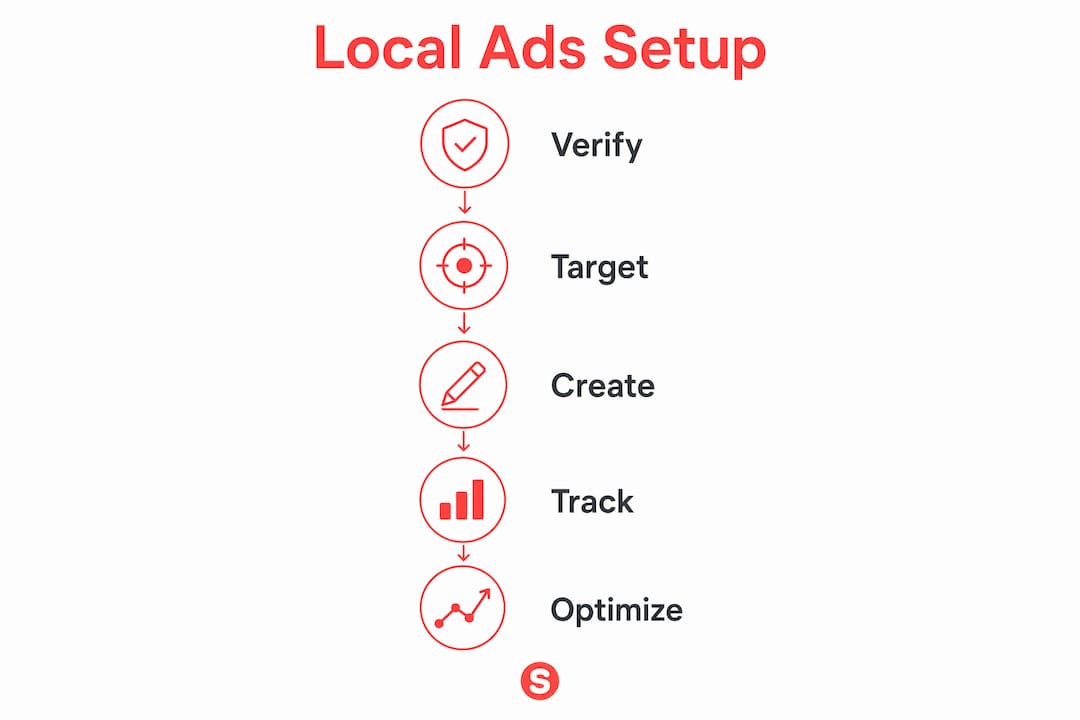
The right setup prevents wasted spend. Before you launch any campaign, you need three things in place: a verified Google Business Profile, a Meta Business account, and conversion tracking on your website or booking system.
Google Business Profile verification is not optional. It feeds directly into Google Local Services Ads, which charge per lead rather than per click and rank businesses by review score and responsiveness. That model rewards businesses that already have strong local reputations.
Meta’s ad platform gives you radius targeting down to one mile, which is useful for restaurants and retail. Google Ads covers intent-based searches like “pizza near me” or “plumber in [city name].” Both platforms require conversion tracking before you spend a dollar. Without it, you cannot tell which ad drove a phone call, a booking, or a form submission.
AI creative tools have changed the production side of local advertising. Platforms that generate ad copy and visuals from a business description now let small teams produce multiple ad variations in minutes instead of days.
| Tool category | Primary use | Key local feature |
|---|---|---|
| Google Ads | Search intent targeting | Location extensions, Local Services Ads |
| Meta Ads | Audience and radius targeting | Radius down to 1 mile, interest layering |
| Google Business Profile | Organic local presence | Reviews, map placement, Q&A |
| AI creative tools | Ad copy and visual generation | Fast variation testing |
| Conversion tracking | Measuring results | Call tracking, form fills, bookings |
Pro Tip: Set up call tracking before your first ad goes live. A tracked phone number tells you exactly which campaign drove each call, so you can cut what does not work and scale what does.
How do you plan and run a local PPC campaign?
Local PPC (pay-per-click) advertising is the fastest way to put your business in front of people searching for what you sell right now. The setup process has six clear steps.
-
Define your goal. Decide whether you want phone calls, form submissions, reservations, or foot traffic. Your goal determines every other decision, from the keywords you bid on to the landing page you send people to.
-
Set your geographic radius. Tight radius geo-targeting of 10–15 miles consistently outperforms broad metro targeting for service businesses. Start narrow and expand only if volume is too low.
-
Build your keyword list. Use city name modifiers and “near me” phrases. “Italian restaurant downtown Chicago” and “HVAC repair near me” both signal high purchase intent. Avoid broad match keywords at the start. They pull in irrelevant traffic and burn budget fast.
-
Write ad copy that matches local intent. Mention your city or neighborhood in the headline. Include your unique offer in the description. Location and call extensions on every ad display your address and phone number directly in search results, which lifts click-through rates.
-
Set your budget and bidding strategy. Start with a daily budget you can afford to lose while testing. For Facebook ads, $5–$10 per day is enough to gather meaningful data before scaling. On Google, use Target CPA bidding only after you have at least 30 conversions recorded. Before that, use Manual CPC so the algorithm has real data to learn from.
-
Track every conversion. A conversion is any action that signals business value: a call, a booking, a form fill, or a deposit payment. Charging a small deposit for bookings creates a trackable conversion event that directly ties ad spend to revenue.
Pro Tip: Exclude zip codes or neighborhoods outside your service area from day one. Broad location settings are the single most common cause of wasted local ad spend.
How do you create local ad creatives that actually convert?
Ad creative is where most local businesses underperform. Generic stock photos and vague copy do not build trust with a nearby audience. Local creative works when it feels familiar and specific.

The core principles of effective local ad creative are authenticity, relevance, and locality. Authenticity means using real photos of your team, your space, or your product. Relevance means the offer matches what the viewer needs right now. Locality means the ad references a specific neighborhood, street, or landmark the viewer recognizes.
AI tools accelerate creative production without sacrificing specificity. AI-generated ad creative for local campaigns has been shown to increase customer reservations by 20% in documented case studies. That result comes from faster iteration: AI lets you test five headline variations in the time it used to take to write one. For restaurants specifically, AI-powered creative has driven measurable gains in engagement, as detailed in Sorbey’s work on AI-driven restaurant marketing.
Strong local creative elements include:
- Neighborhood mentions in headlines (“Now serving the Wicker Park area”)
- Real photos or short videos of your actual location, staff, or food
- Time-sensitive offers tied to local events or seasons (“Valentine’s Day tasting menu — reserve by Friday”)
- Clear calls to action with a local phone number or a direct booking link
- Social proof from local customers, such as a short quote with a first name and neighborhood
Pro Tip: Run two versions of every ad with one variable changed, such as the headline or the image. After 200 impressions, pause the weaker version. Repeat this process every two weeks and your click-through rate will improve steadily.
What makes a local landing page convert visitors into customers?
The ad gets the click. The landing page closes the deal. Most local businesses send ad traffic to their homepage, which is a reliable way to lose leads.
A high-converting local landing page has the phone number above the fold, a simple contact form, and trust signals like reviews and certifications. Every element that does not support the conversion should be removed. Navigation menus, social media links, and unrelated offers all pull attention away from the one action you want the visitor to take.
The language on the landing page must match the language in the ad. If your ad says “Same-day plumbing repair in Austin,” your landing page headline should say the same thing. Mismatched messaging creates doubt and increases bounce rates.
Schedule your ads to run when your business can actually respond. An ad that runs at 2:00 AM for a business that opens at 8:00 AM wastes money and frustrates potential customers who call and get no answer.
| Landing page element | Why it matters |
|---|---|
| Phone number above the fold | Lets mobile visitors call without scrolling |
| Simple contact form | Reduces friction for non-phone leads |
| Customer reviews | Builds trust with first-time visitors |
| Address and map embed | Confirms local relevance and proximity |
| Single clear call to action | Removes decision fatigue |
What are the most common mistakes in local ad campaigns?
Most local ad campaigns fail for the same three reasons: targeting is too broad, conversion tracking is missing, or the creative is too generic. Fixing these three issues solves the majority of underperformance.
Broad targeting is the most expensive mistake. When your radius covers an entire metro area, you pay for clicks from people who will never drive to your location. Tight geo-targeting, combined with city-specific keywords, keeps your spend focused on people who can actually become customers.
Missing conversion tracking means you are flying blind. You cannot cut a bad keyword or scale a good ad if you do not know which actions each one drives. Set up tracking before the campaign starts, not after you notice the budget disappearing.
Weak creative is the quietest budget drain. An ad that looks like every other ad in the feed gets ignored. Use the A/B testing approach described earlier to identify which creative elements actually drive clicks and conversions.
- Identify underperforming keywords by sorting by cost per conversion after two weeks. Pause any keyword spending more than twice your target cost per acquisition with zero conversions.
- Scale gradually. Double your budget only after a campaign has run profitably for at least two weeks at the current spend level.
- Review ad performance weekly during the first month. After that, a biweekly review is sufficient for stable campaigns.
Pro Tip: Check your search terms report in Google Ads every week for the first month. You will find irrelevant queries triggering your ads that you can block with negative keywords, often cutting wasted spend by 20–30%.
Key Takeaways
Effective local advertising requires tight geographic targeting, conversion tracking, and creative that reflects the specific community you serve.
| Point | Details |
|---|---|
| Verify your setup first | A Google Business Profile and conversion tracking must be live before any ad spend begins. |
| Target a tight radius | A 10–15 mile radius outperforms broad metro targeting for most local service businesses. |
| Use AI for creative testing | AI tools speed up ad variation production and have been linked to a 20% lift in reservations. |
| Match ad copy to landing pages | Consistent messaging from ad to landing page reduces bounce rates and improves conversions. |
| Fix tracking before scaling | Pause underperforming keywords and scale budgets only after two weeks of profitable data. |
Why I think most local businesses are leaving money on the table
After watching hundreds of local businesses run ads, the pattern is clear. Owners invest in the ad itself and ignore everything around it. The landing page is an afterthought. The tracking is broken. The radius covers three counties. Then they conclude that local ads do not work.
The truth is that local advertising is one of the most measurable forms of marketing available. Every click, call, and booking can be traced back to a specific ad. That level of accountability is rare. The businesses that treat it seriously, testing one variable at a time and reading their data weekly, consistently outperform those that set campaigns and forget them.
AI has made the creative side genuinely accessible for small teams. A restaurant owner with no design background can now produce five ad variations in an afternoon. That matters because volume of testing is the actual driver of creative performance. The winning ad is rarely the first one you write.
Offline engagement still matters more than most digital-only marketers admit. Event sponsorships and local vendor partnerships build unstructured citations that reinforce your authority in local search. The businesses that combine offline community engagement with well-targeted digital ads consistently outperform those running digital campaigns alone. Local distribution partnerships, as explored in this analysis of local business wins, show the same pattern: physical presence in the community amplifies digital reach.
The businesses winning local advertising in 2026 are not spending the most. They are testing the most, tracking everything, and staying close to their neighborhoods.
— Barthelemy
How Sorbey helps local businesses run better ads
Running local ads across Google, Meta, and your own channels takes time most business owners do not have.
Sorbey is an all-in-one marketing platform built specifically for local businesses like restaurants, cafes, and bars. It brings ad creation, audience targeting, and performance tracking into a single place, so you spend less time switching between tools and more time serving customers. Sorbey’s AI-powered creative tools generate ad variations from your menu or service list, and the platform tracks which ads drive real bookings and calls. Business owners who want to see what this looks like in practice can explore local advertising examples that have worked for similar businesses, or go directly to Sorbey’s platform to get started.
FAQ
What is the best radius for local PPC ads?
A 10–15 mile radius consistently outperforms broad metro targeting for service businesses. Start tight and expand only if your campaign is not generating enough volume.
How much should I spend to start local ads?
A daily budget of $5–$10 is enough to gather meaningful data when testing new creatives. Scale your budget only after identifying which ads are converting profitably.
Do I need a separate landing page for local ads?
A dedicated landing page with your phone number above the fold, a contact form, and local trust signals converts significantly better than a homepage. Match the page headline to your ad copy exactly.
How does AI improve local ad performance?
AI tools generate multiple ad copy and visual variations quickly, enabling faster testing. Documented case studies show AI-generated local ad creative can increase customer reservations by 20%.
Should I run Google Ads or Meta Ads for my local business?
Use Google Ads to capture people actively searching for your service and Meta Ads to reach nearby audiences by interest and behavior. Most local businesses benefit from running both simultaneously with separate budgets.
Recommended
Vous pourriez aussi aimer

Best Restaurant Loyalty Programs 2026: ROI Guide
Discover the best restaurant loyalty programs 2026 that boost repeat visits. Learn how Sorbey’s platform can transform your guest data strategy!

Why Mobile Marketing Matters for Business Growth
Discover why mobile marketing matters for business growth. Learn how optimizing for mobile drives traffic, conversions, and customer retention.

SF Dim Sum Restaurant Marketing Checklist for 2026
Transform your SF dim sum with our 2026 marketing checklist. Optimize your profile, showcase dishes, and attract customers fast!