
Blog
Hyperlocal targeting for restaurants: drive more traffic
Discover what hyperlocal targeting means for restaurants. Learn to attract more customers with precise location-based marketing techniques.
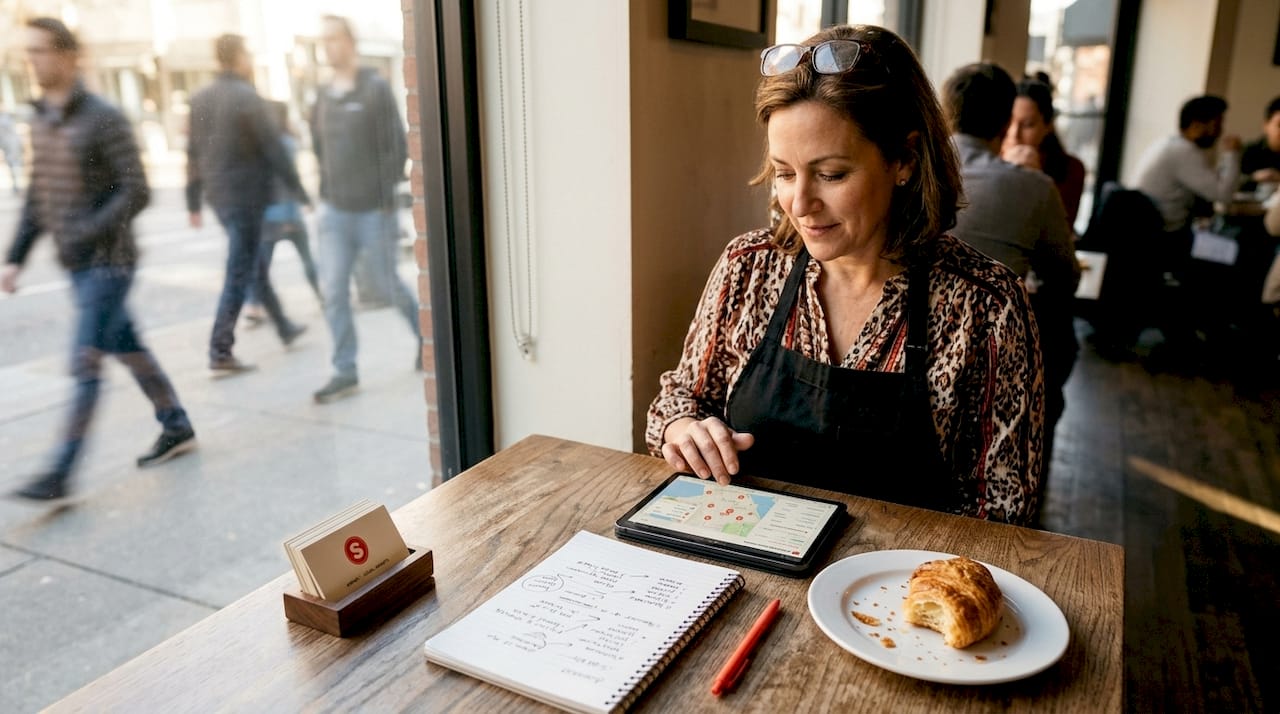
Hyperlocal targeting for restaurants: drive more traffic
TL;DR:
- Most restaurant owners mistake broad local marketing for true hyperlocal targeting, which focuses on precise geographic areas to reach nearby, high-intent customers. Hyperlocal campaigns use tools like GPS, Wi-Fi, Bluetooth, and geofencing to target individuals at specific moments and locations, significantly boosting engagement and foot traffic. Implementing these focused strategies is accessible, cost-effective, and can dramatically improve your restaurant’s marketing ROI.
Most restaurant owners believe they’re doing local marketing when they boost a post on Facebook or set their Google Ads to target their city. That’s not hyperlocal targeting. True hyperlocal targeting means reaching the right person on the right block at exactly the right moment, and the difference in results can be dramatic. Studies show location-based ads generate significantly higher engagement than broad local campaigns. This article breaks down what hyperlocal targeting actually is, which tools power it, and how your restaurant can start using it to fill more seats.
Table of Contents
- What is hyperlocal targeting?
- How hyperlocal targeting works: Tools and technology
- Benefits of hyperlocal targeting for restaurants
- Hyperlocal targeting in action: Restaurant use cases
- Why most restaurants underuse hyperlocal targeting
- Ready to boost your local presence?
- Frequently asked questions
Key Takeaways
| Point | Details |
|---|---|
| Hyperlocal is ultra-targeted | It focuses your marketing on people in small, walkable zones around your restaurant, not just anyone in the city. |
| Technology makes it easy | Modern tools use smartphones and location data to reach potential diners exactly where and when they’re nearby. |
| Big impact, smart spend | Hyperlocal campaigns drive more visits and orders while using less budget by targeting high-intent, close-proximity customers. |
| Start and scale simply | Begin with a small radius and focused offers, track conversion data, and expand based on what works best for your audience. |
What is hyperlocal targeting?
Most people lump “local” and “hyperlocal” together, but they are very different strategies with very different results. Local marketing means reaching people in your city or general area. Hyperlocal targeting means focusing on a tight, specific geography, like a six-block radius around your restaurant, and triggering ads or messages only when someone is physically present or nearby.
The core mechanics involve defining tight geographies using a radius, custom polygons, or ZIP codes, then using location technologies like GPS, Bluetooth, Wi-Fi, and cellular networks to serve ads or messages when someone enters that area. In practice, this could look like a pizza place sending a push notification to anyone who walks past their door on a Friday evening, or a lunch spot running a Google Ad that only shows for people within a 0.5-mile radius between 11 a.m. and 2 p.m.
Here is what separates hyperlocal from traditional local targeting:
- Local targeting reaches a broad city or region with little precision
- Hyperlocal targeting focuses on a neighborhood, block, or even a single building
- Local ads run all day to a general audience
- Hyperlocal ads run at specific times to people who are actually near your restaurant
- Local campaigns are easier to set up but waste budget on people far away
- Hyperlocal campaigns require more setup but deliver far better return on investment
You can learn more about proven hyperlocal marketing strategies that work specifically for restaurant owners looking to fill tables during slow periods.
“The narrower the geography, the higher the relevance. A 0.5-mile lunch ad speaks to someone already thinking about where to eat. A citywide ad speaks to everyone, including people who will never visit your block.”
Pro Tip: Start with a radius of 0.5 to 1 mile for your first hyperlocal campaign. This is close enough to catch foot traffic and drive-by customers, but broad enough to generate enough impressions to test your messaging.
Location signals are the backbone of this strategy. GPS is the most accurate for outdoor targeting. Wi-Fi signals can pinpoint someone inside a specific building or shopping center. Bluetooth beacons work well inside venues. Cellular data is the broadest of the four but still far more precise than targeting an entire city.
How hyperlocal targeting works: Tools and technology
Understanding the concept is one thing. Seeing how the technology fits together is the next step. Let’s walk through the tools and process behind hyperlocal targeting so you know exactly what you’re working with.
Hyperlocal campaigns use location signals from mobile devices, including Bluetooth, GPS, Wi-Fi, and cellular networks, combined with technologies like geofencing and beacons to reach people at the right moment. Geofencing creates an invisible digital boundary around a real-world location. When a smartphone crosses that boundary, it can trigger an ad, notification, or coupon. Beacons are small physical devices that use Bluetooth to communicate with nearby phones, typically within about 100 feet. They are popular in malls and large venues, but any restaurant could use them to engage customers who linger outside.
Here is a side-by-side look at the four core technologies:
| Technology | Accuracy | Best use for restaurants | Limitation |
|---|---|---|---|
| GPS | Very high | Outdoor radius targeting | Drains phone battery fast |
| Wi-Fi | High | Indoor location, mall targeting | Requires Wi-Fi connection |
| Bluetooth beacons | Very high (short range) | In-venue or doorstep messaging | Needs physical beacon hardware |
| Cellular network | Moderate | Broad neighborhood targeting | Less precise than GPS or Wi-Fi |
Setting up a hyperlocal campaign does not have to be complicated. Here is a simple step-by-step process you can follow:
- Choose your platform. Google Ads and Meta Ads both support geofencing. Google is better for search intent. Meta is better for social engagement and brand awareness.
- Set your radius. In Google Ads, you can draw a radius around your restaurant’s address. Start between 0.5 and 1 mile.
- Define your audience. Layer in demographics like age, device type, or interests if the platform allows.
- Build your offer. Create an ad that speaks directly to where and when your customer is. “Lunch special ending at 2 p.m., two blocks away” performs better than a generic menu ad.
- Set your schedule. Use dayparting (scheduling ads for specific times of day) to match your busiest hours or the hours you want to grow.
- Track and optimize. Monitor store visits, calls, direction requests, and conversions. Adjust radius, timing, or offer based on the data.
Combining this with a strong local restaurant advertising strategy makes hyperlocal campaigns dramatically more effective. Advertising channels and hyperlocal precision are a natural match.
Pro Tip: Run your hyperlocal ads 30 to 45 minutes before a meal period, not during it. People decide where to eat before they leave, not when they’re already walking past your window.
Benefits of hyperlocal targeting for restaurants
With the basics and tools established, it is time to get into what actually matters most: what your restaurant gains by embracing hyperlocal targeting over generic local marketing.
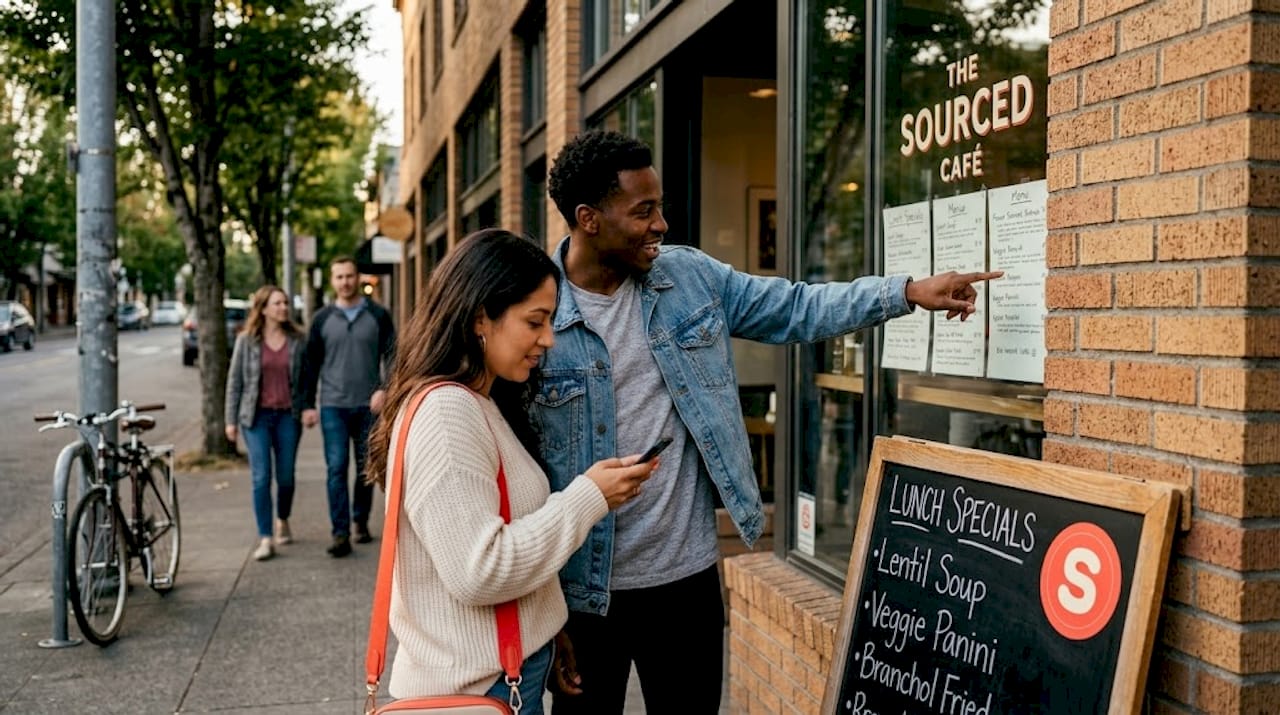
The clearest way to understand the difference is to look at them side by side.
| Factor | Local targeting | Hyperlocal targeting |
|---|---|---|
| Geographic focus | City or region | Block, radius, or neighborhood |
| Audience size | Large, mixed intent | Small, high intent |
| Ad relevance | General | Specific to location and time |
| Wasted budget | High (reaches far-away users) | Low (focuses on nearby users) |
| Engagement rate | Average | Significantly higher |
| Best for | Brand awareness | Driving foot traffic and immediate visits |
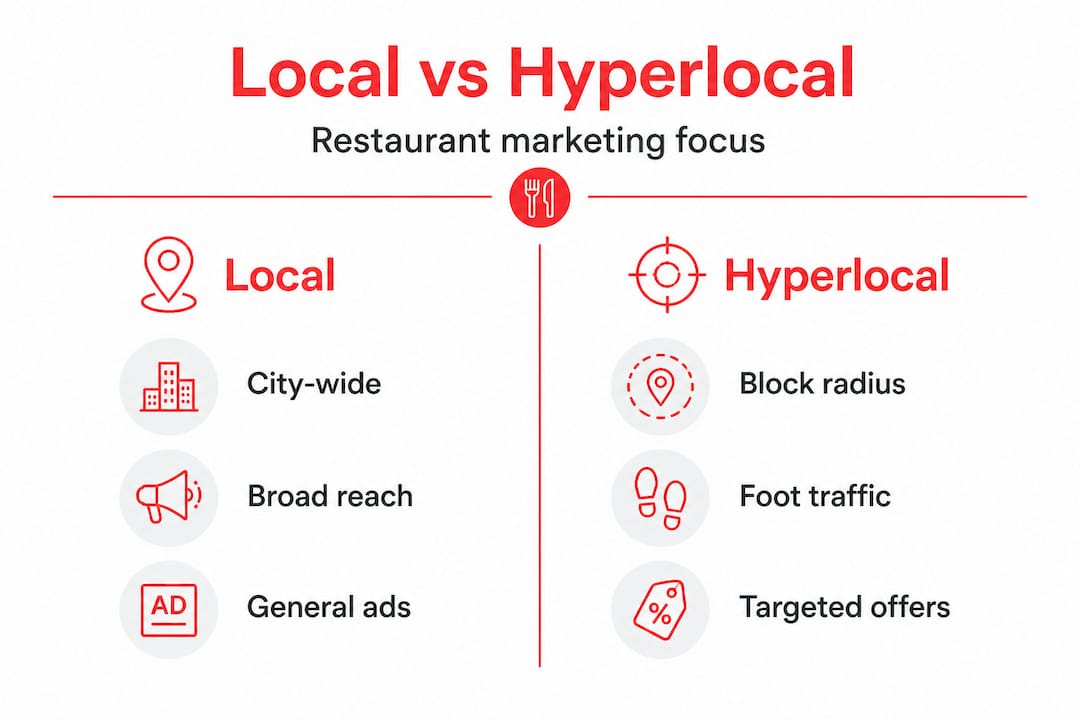
Restaurant Engine highlights that hyperlocal targeting within specific radii and time-sensitive ads, like happy hour specials or lunch combos, perform far better than general campaigns because they match the customer’s context perfectly. Someone two blocks away at noon is very different from someone across town at the same time.
Here are the core benefits that restaurants consistently see:
- More foot traffic. When your ad appears to someone who is already nearby and hungry, they are far more likely to visit than someone who just happened to see your ad on a general feed.
- Higher conversion rates. Hyperlocal campaigns turn impressions into visits because the audience is pre-qualified by their physical location.
- Reduced wasted ad spend. You stop paying to reach people in zip codes that will never come to your restaurant.
- Better time-sensitive promotions. A Tuesday afternoon slow period can be turned into a busy one with a 20-minute promotion targeting nearby office workers.
- Neighborhood loyalty. Consistently showing up for people who live or work near you builds recognition and repeat visits over time.
A great local advertising guide will help you understand how hyperlocal fits within a broader paid and organic strategy, and how to balance your budget across channels.
Think about the math for a moment. If you spend $500 on a local campaign that reaches 50,000 people across a whole city, you might get 20 visits. If you spend that same $500 on a hyperlocal campaign targeting 3,000 people within half a mile of your restaurant during dinner hours, you might get 80 visits. Better paid local advertising decisions come down to precision, not volume.
Hyperlocal targeting in action: Restaurant use cases
Now that the benefits are clear, let’s see how hyperlocal targeting plays out in real restaurant scenarios and how you can replicate the results.
A practical hyperlocal workflow for restaurant owners works like this: set a radius or geofence around the restaurant, tailor the offer and creative to that neighborhood and moment using dayparting for lunch or dinner, and measure conversions that reflect nearby intent such as store visits, calls, directions, and orders. This framework is simple enough for a single-location diner or complex enough to scale across multiple locations.
Here are four use cases that translate directly to more revenue:
- Happy hour push notifications. Set a geofence around your bar or restaurant and schedule push notifications through your loyalty app or Google Local Campaigns to fire between 3:30 and 5 p.m. on weekdays. Anyone in your zone during that window sees your happy hour offer before they make their plans.
- Lunch special for nearby offices. Create a Meta Ad with a 0.75-mile radius targeting people on their phones between 11 a.m. and 1 p.m. on weekdays. Feature a specific combo meal with a simple call to action like “Show this ad for $2 off.” The context (lunchtime, nearby, hungry) does most of the selling.
- Neighborhood coupon drops. Use direct-to-neighborhood digital coupons through platforms like Google Local Inventory Ads or neighborhood-specific apps. Target a single zip code or a custom polygon around a residential area near your restaurant. These work especially well on Sunday evenings when families are deciding where to order from.
- Event-based geofencing. When there is a concert, game, or festival near your restaurant, set a temporary geofence around the venue and run ads for pickup, delivery, or a pre-show special. You’re reaching people who are already in your neighborhood but may not know you exist.
Measuring success is straightforward once you know what to look for. Track Google Maps direction requests, call volume from your Google Business Profile, in-store visit conversions inside Google Ads, and order volume tied to specific campaign codes. A simple restaurant marketing checklist can help you stay on top of these metrics consistently. You should also track how your local SEO for restaurants improves alongside your paid hyperlocal efforts, since both reinforce each other.
Pro Tip: Start with one hyperlocal campaign for your single busiest slow period of the week. Run it for three weeks, track your metrics, and then adjust the radius, timing, or offer. After one month, you’ll have real data that tells you exactly how to scale up.
Why most restaurants underuse hyperlocal targeting
After seeing those use cases, you might be wondering why every restaurant in your city isn’t doing this already. The honest answer comes down to two myths: it’s too technical, and it’s too expensive.
Neither is true. Most hyperlocal campaigns run through tools you already have access to, like Google Ads or Meta Ads. Neither requires a developer or a tech team. Setting a radius, writing a simple offer, and scheduling an ad takes about 30 minutes once you know the steps. If you’ve ever boosted a social post, you already have most of the skills you need.
The cost myth is equally persistent. Restaurant owners often assume that precision targeting means premium pricing. In reality, hyperlocal campaigns frequently cost less than broad local ones because you’re reaching a smaller, more relevant audience. You’re not paying for impressions from people 40 miles away. Your budget goes further when it’s focused.
The deeper issue is mindset. Many owners think in terms of reach, meaning more people is always better. But a restaurant isn’t trying to reach a million people. It’s trying to get 30 more people through the door tonight. Hyperlocal targeting is built for that goal. Thinking about investing in local search with the same focused mindset, quality over quantity, is what separates restaurants that grow steadily from those that spin their wheels on expensive, unfocused campaigns.
The restaurants that see the best results don’t start big. They pick one neighborhood, one time slot, and one offer. They run it, measure it, and improve it. Then they repeat. Simple, targeted, and measurable beats broad and vague every single time.
Ready to boost your local presence?
Hyperlocal targeting sounds technical, but the impact is very practical: more people walking through your door, better use of your ad budget, and promotions that actually match how your neighbors live and eat.
If you’re ready to move past generic local marketing and put precision to work for your restaurant, Sorbey makes it straightforward. Our restaurant marketing services are built specifically for restaurant owners who want hands-on support setting up hyperlocal campaigns, crafting neighborhood-specific offers, and measuring what’s actually driving foot traffic. You don’t need a marketing team. You need a focused strategy and the right tools. We can help you build both.
Frequently asked questions
What is the difference between local and hyperlocal targeting?
Local targeting reaches people in a broad city or region, while hyperlocal targeting focuses on a very tight area, often within walking distance of your restaurant. The core mechanics of hyperlocal involve defining tight geographies and using specific location technologies to trigger ads at the right moment.
Do I need special hardware for hyperlocal targeting?
No, most hyperlocal tools rely on customers’ existing smartphones and platforms like Google Ads. Location signals from mobile devices and geofencing handle the heavy lifting without requiring you to purchase or install any special equipment.
How small an area can I target with hyperlocal strategies?
You can target an area as small as a single block or a one-mile radius around your location. Hyperlocal targeting within specific radii is particularly effective for restaurants running time-sensitive offers like lunch specials or happy hour promotions.
How can I measure the success of a hyperlocal campaign?
Focus on metrics that reflect nearby customer intent. Store visits, calls, directions, and orders are the most meaningful indicators that your hyperlocal campaign is reaching the right people and driving real results.
Recommended
- Local advertising guide for restaurants: boost visibility | Sorbey Blog | Sorbey
- Boost local restaurant success with strategic local advertising | Sorbey Blog | Sorbey
- What is hyperlocal marketing? Strategies for restaurants | Sorbey Blog | Sorbey
- Content marketing tips for restaurants: attract more local diners | Sorbey Blog | Sorbey
Vous pourriez aussi aimer
Best Restaurant Loyalty Programs 2026: ROI Guide
Discover the best restaurant loyalty programs 2026 that boost repeat visits. Learn how Sorbey’s platform can transform your guest data strategy!

Why Mobile Marketing Matters for Business Growth
Discover why mobile marketing matters for business growth. Learn how optimizing for mobile drives traffic, conversions, and customer retention.

SF Dim Sum Restaurant Marketing Checklist for 2026
Transform your SF dim sum with our 2026 marketing checklist. Optimize your profile, showcase dishes, and attract customers fast!