
Blog
Why Invest in Online Advertising for Restaurants
Discover why invest in online advertising for restaurants. Learn how targeted ads can fill your tables and boost your revenue effectively.
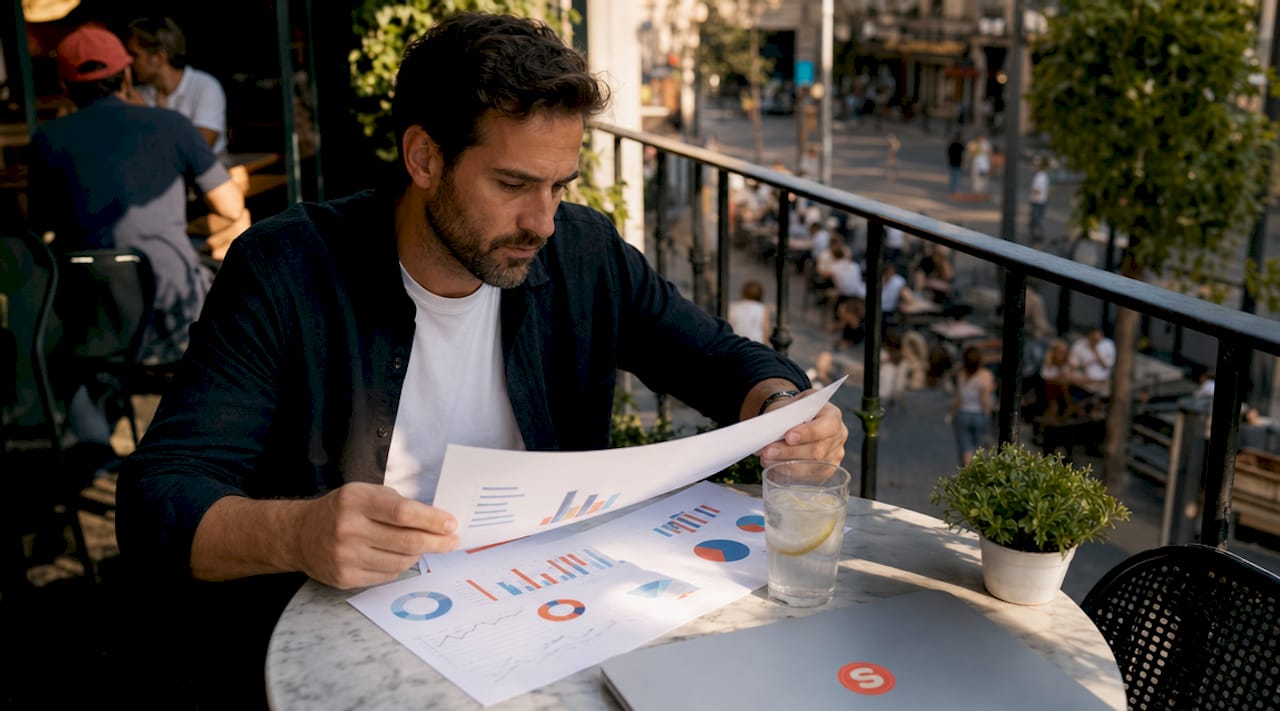
Why Invest in Online Advertising for Restaurants
TL;DR:
- Online advertising offers restaurants precise targeting, real-time performance data, and flexible budgets, outperforming traditional media. It enables quick campaign adjustments to match changing menus, events, and staffing, leading to higher return on investment. Small, well-focused budgets can generate measurable reservations and orders through strategic, data-driven campaigns.
Online advertising is the most measurable, targeted, and cost-effective way for restaurants to attract new customers and grow revenue. Unlike billboards or radio spots, platforms like Google Ads, Facebook, and Instagram let you reach the exact person searching for “best tacos near me” at the exact moment they’re hungry. This article breaks down why digital advertising outperforms traditional marketing for small and mid-sized restaurants, how to control your budget, and how to turn performance data into more tables filled every night.
Why invest in online advertising instead of traditional media
Digital advertising shifts marketing from a speculative expense to a quantifiable investment by using real-time conversion data. That single shift changes everything for a restaurant owner working with a tight budget. You stop guessing whether your flyer campaign worked and start knowing exactly how many people clicked your ad, visited your website, and made a reservation.
Traditional advertising, think print, radio, or local TV, operates on broad reach. You pay to get in front of thousands of people, most of whom have no interest in dining out that evening. Online ad revenues have already surpassed traditional TV and cable in the United States, a signal that advertisers across every industry have recognized where attention and results actually live.
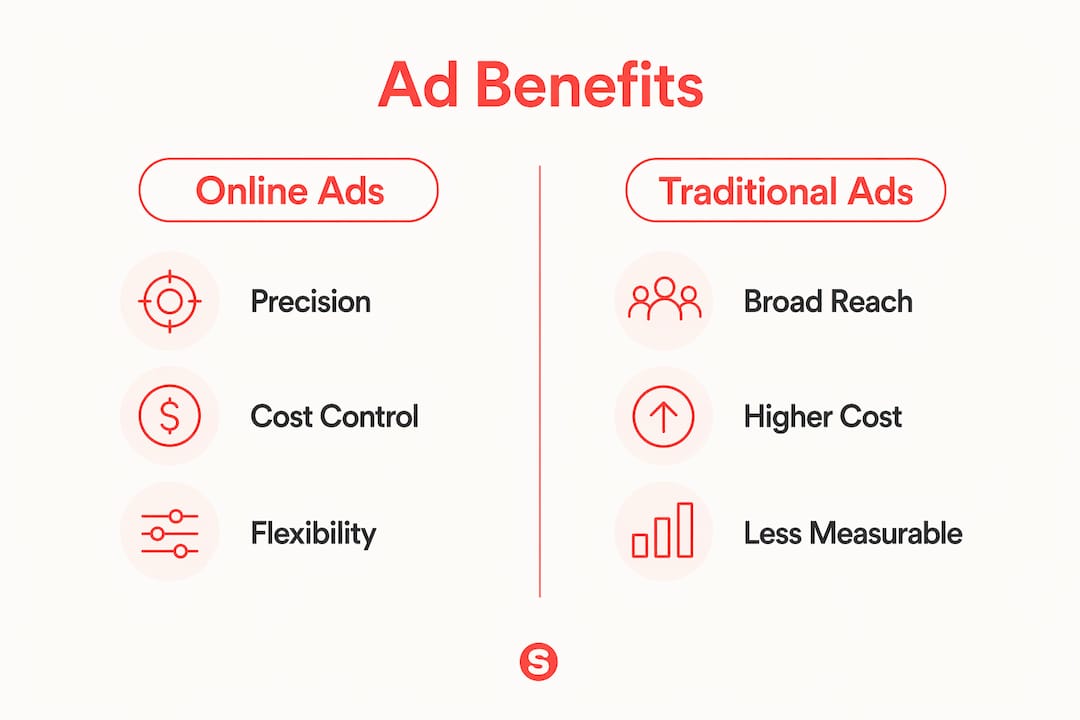
The advantages of digital marketing go beyond reach. They include precision, accountability, and speed. A restaurant in Austin running a Google Ads campaign for “best brunch downtown Austin” is only paying to appear in front of people actively searching for that experience. That is a fundamentally different kind of marketing spend.

Precision targeting vs. broad reach: a direct comparison
| Feature | Online Advertising | Traditional Advertising |
|---|---|---|
| Audience targeting | By location, age, interest, behavior | Broad geographic or demographic reach |
| Budget control | Daily caps, bid limits, real-time adjustments | Fixed contracts, limited flexibility |
| Performance tracking | Impressions, CTR, conversions, ROAS | Estimated reach, no direct attribution |
| Speed to launch | Hours | Days to weeks |
| Cost to start | As low as $5/day | Often hundreds to thousands upfront |
Key metrics to track in any restaurant campaign include:
- CTR (Click-Through Rate): How many people clicked your ad after seeing it
- Conversion rate: How many clicks turned into reservations or orders
- ROAS (Return on Ad Spend): Revenue generated per dollar spent on ads
- CPA (Cost Per Acquisition): What it costs to acquire one new customer
How operational flexibility gives restaurants a real edge
Digital ad campaigns can be adjusted instantly to respond to changing business needs, and for restaurants, that flexibility is not a nice-to-have. It is a necessity. Your menu changes seasonally. A chef calls in sick and you need to push a simpler special. A local event brings foot traffic to your neighborhood and you want to capitalize on it within hours, not weeks.
Traditional print or radio advertising locks you into a message weeks before it runs. By the time your radio spot airs promoting your summer patio menu, it might be raining for the third straight week. Online ads let you pause, edit, or redirect a campaign in minutes.
Here is what operational flexibility looks like in practice for a restaurant:
- Launch a Friday happy hour promotion on Thursday afternoon and have it live before dinner service
- Pause ads during a kitchen closure without losing your entire campaign setup
- Swap out a menu item in your ad creative the same day it sells out
- Increase your budget on a slow Tuesday when you need to fill tables fast
- Run event-specific campaigns around Valentine’s Day, Mother’s Day, or local festivals with precise start and end dates
Pro Tip: Set up a retargeting campaign on Facebook or Instagram that shows ads to people who visited your website but did not make a reservation. These warm audiences convert at significantly higher rates than cold traffic, and you can launch one in under an hour.
The ability to test and iterate quickly also means you learn faster. A restaurant that runs three different ad creatives in one week and measures which one drives the most reservations is building marketing knowledge that compounds over time.
Cost effectiveness and budget control for small restaurants
Flexible budgets and precise targeting reduce wasted ad spend, which is the core reason why small restaurants can compete with larger chains online. You do not need a $50,000 media buy to see results. You need a well-targeted $300 monthly campaign pointed at the right people.
Here is a practical framework for getting started with a modest budget:
- Start with search ads on Google Ads. A daily budget of $10 to $20 targeting local, high-intent keywords like “Italian restaurant near me” or “best sushi [your city]” puts you in front of people ready to spend money tonight.
- Add a social media awareness campaign on Facebook or Instagram. A $5 to $15 daily budget targeting users within a 5-mile radius of your restaurant builds brand recognition over time without breaking the bank.
- Use pay-per-click (PPC) models to control costs. With PPC, you only pay when someone actually clicks your ad. You are not paying for impressions from people who scroll past.
- Set daily and monthly caps. Both Google Ads and Meta Ads Manager let you set hard spending limits so you never accidentally overspend.
- Allocate 20% of your budget to retargeting. Retargeting past website visitors costs less per click and converts at higher rates because the audience already knows your restaurant.
The pay-per-click model is particularly powerful for restaurants because it aligns cost directly with customer interest. You pay only when someone demonstrates intent. A local advertising strategy built around PPC search ads and geo-targeted social ads can deliver measurable foot traffic even on a $500 monthly budget.
What types of online ads work best for restaurants
Search ads, social media ads, and display ads each serve a distinct purpose in a restaurant’s marketing mix, and understanding which format fits which goal prevents wasted spend.
| Ad Type | Best For | Platform Examples |
|---|---|---|
| Search ads | High-intent customers ready to book or order | Google Ads, Microsoft Advertising |
| Social media ads | Brand awareness, promotions, visual storytelling | Facebook, Instagram, TikTok |
| Display ads | Retargeting website visitors | Google Display Network |
| Local service ads | Appearing at the top of local search results | Google Local |
Search ads capture demand that already exists. When someone types “best pizza downtown Chicago,” they are not browsing. They are deciding. Appearing at the top of that result with a compelling offer is the digital equivalent of having the best sign on the busiest street.
Social media ads on Instagram and TikTok are where food visuals do the heavy lifting. A 15-second video of your signature dish being plated, targeted at users within 3 miles who follow food accounts, builds appetite and brand recognition simultaneously. TikTok in particular has become a discovery platform for restaurants, with organic and paid content driving real foot traffic.
Display ads work best as a follow-up tool. Someone visits your website, looks at your menu, and leaves without booking. A display ad showing your weekend special follows them across the web and brings them back. This retargeting approach is one of the highest-ROI tactics available to restaurants because you are spending money on people who already showed interest.
For restaurants exploring additional channels, email marketing complements paid advertising by nurturing existing customers at a fraction of the cost.
How to use data and tracking to improve your ad results
Advertisers collect detailed data to optimize targeting and ad effectiveness, and for restaurants, this data loop is what separates a profitable campaign from a money pit. The goal is not just to run ads. It is to run ads that get measurably better every week.
Proper conversion tracking is pivotal because it directly influences automated bidding and campaign optimization effectiveness. When Google Ads knows that a “Reserve a Table” button click is your most valuable conversion, its algorithm automatically shifts budget toward the audiences and keywords most likely to produce that action. Without that signal, you are paying for clicks that go nowhere.
Key tracking actions to set up for a restaurant:
- Reservation completions via your booking system (OpenTable, Resy, or a direct form)
- Online order completions if you use a platform like Toast or Square Online
- Phone call tracking for customers who call directly from a search ad
- Menu page views as a secondary engagement signal
Marketing attribution is critical to allocate budget effectively across channels and avoid misallocation based on incomplete data. Last-click attribution, the default in many platforms, gives all credit to the final ad a customer clicked before converting. A customer who saw your Instagram ad on Monday, your Google search ad on Wednesday, and booked on Thursday tells a more complex story. Using data-driven attribution in Google Ads gives a more accurate picture of which channels are actually driving reservations.
Pro Tip: Connect your Google Ads account to Google Analytics 4 and set up a conversion goal for reservation completions. This gives you a full view of the customer journey from first click to confirmed booking, and it feeds better data into your automated bidding strategy.
A digital marketing checklist for restaurants is a practical starting point for making sure your tracking setup is complete before you spend a dollar on ads.
Key takeaways
Online advertising delivers measurable, targeted, and cost-controlled results that traditional media cannot match, making it the highest-ROI marketing investment available to small and mid-sized restaurants.
| Point | Details |
|---|---|
| Precision targeting beats broad reach | Online ads reach local, high-intent customers instead of paying for uninterested audiences. |
| Operational flexibility is a restaurant advantage | Campaigns can be launched, paused, or edited in hours to match menus, events, and staffing. |
| Small budgets can produce real results | A $300 to $500 monthly budget on Google Ads or Meta can drive measurable reservations. |
| Conversion tracking drives optimization | Setting up tracking for reservations and orders lets platforms automatically improve your results. |
| Multi-channel strategy compounds returns | Combining search, social, and retargeting ads creates a full-funnel approach that outperforms any single channel. |
What I have learned working with restaurant owners on online ads
Restaurant owners often come to me after spending money on ads that “didn’t work.” Nine times out of ten, the ads were not the problem. The targeting was too broad, the conversion tracking was not set up, or the goal was vague. “Get more customers” is not a campaign objective. “Generate 50 reservation completions this month at a cost under $8 each” is.
The most common mistake I see is treating online advertising as a one-time experiment rather than an ongoing practice. You run ads for two weeks, see mixed results, and conclude that digital marketing does not work for your restaurant. What actually happened is that you did not give the algorithm enough data to optimize, and you did not test enough variables to know what resonates with your audience.
The restaurants that win with online advertising are the ones that commit to a 90-day learning cycle. They set clear conversion goals, track every meaningful action, test two or three creative variations at a time, and make decisions based on data rather than gut feel. A $15-per-day Google Ads campaign run with discipline for three months will outperform a $1,500 one-time campaign every time.
Small budgets are not a disadvantage if they are focused. A restaurant targeting a 3-mile radius with a specific offer for a specific audience will always outperform a restaurant broadcasting to an entire city with a generic message. The benefits of online advertising only materialize when the fundamentals are right.
— Barthelemy
How Sorbey helps restaurants get more from online advertising
Sorbey is built specifically for restaurant owners who want the impact of online advertising without the complexity of managing it alone. From campaign setup and audience targeting to weekly performance reporting and creative testing, Sorbey handles the full marketing operation so you can focus on running your restaurant. The platform connects search ads, social media campaigns, and retargeting into one coordinated strategy, with every decision backed by real conversion data. If you are ready to turn your ad spend into a predictable source of new customers, explore Sorbey’s restaurant marketing services and see what a focused, data-driven approach looks like for your specific market.
FAQ
Why should restaurants invest in online advertising?
Online advertising lets restaurants reach high-intent local customers at the exact moment they are searching for a place to eat, with full visibility into what the spend produces. Unlike traditional media, every dollar is tracked from impression to reservation.
How much should a small restaurant spend on online ads?
A starting budget of $300 to $500 per month, split between Google Ads search campaigns and geo-targeted social media ads, is enough to generate measurable results for most small restaurants. The key is precise targeting, not high spend.
What is the best online advertising platform for restaurants?
Google Ads captures high-intent search traffic, making it the strongest platform for driving immediate reservations and orders. Instagram and TikTok complement search ads by building visual brand awareness with local audiences.
How do I measure the return on investment from restaurant ads?
Track conversion actions tied to real business outcomes: reservation completions, online orders, and phone calls. Use ROAS and CPA as your primary metrics, and connect Google Ads to Google Analytics 4 for a complete view of the customer journey.
What is the impact of online advertising compared to print or radio?
Online advertising provides real-time performance data, flexible budgets, and precise audience targeting that print and radio cannot offer. The ability to pause, edit, and optimize campaigns in hours makes digital ads far more responsive to a restaurant’s daily needs.
Recommended
- Boost local restaurant success with strategic local advertising | Sorbey Blog | Sorbey
- Local advertising guide for restaurants: boost visibility | Sorbey Blog | Sorbey
- Digital marketing checklist for restaurants: boost visibility | Sorbey Blog | Sorbey
- Why use paid ads locally? Boost restaurant sales | Sorbey Blog | Sorbey
Vous pourriez aussi aimer
Best Restaurant Loyalty Programs 2026: ROI Guide
Discover the best restaurant loyalty programs 2026 that boost repeat visits. Learn how Sorbey’s platform can transform your guest data strategy!

Why Mobile Marketing Matters for Business Growth
Discover why mobile marketing matters for business growth. Learn how optimizing for mobile drives traffic, conversions, and customer retention.

SF Dim Sum Restaurant Marketing Checklist for 2026
Transform your SF dim sum with our 2026 marketing checklist. Optimize your profile, showcase dishes, and attract customers fast!