
Blog
Content Marketing for Miami Restaurants: 2026 Guide
Unlock the secret to thriving in Miami's dining scene with our ultimate guide on content marketing for Miami restaurants. Drive customers today!
Content Marketing for Miami Restaurants: 2026 Guide
TL;DR:
- Miami restaurants must leverage content marketing to stand out in a crowded market driven by digital presence and cultural relevance. Consistent, authentic posts on Google, TikTok, and Instagram, tailored to Miami’s diverse demographics, significantly increase foot traffic and customer loyalty. Measuring metrics aligned with revenue, such as reservations and local search engagement, ensures marketing efforts translate into actual business growth.
Miami’s restaurant scene is one of the most crowded and visually driven markets in the country. You could be serving the best croquetas in Little Havana or the most Instagrammable brunch in Wynwood and still lose customers to a competitor with a weaker menu but a stronger digital presence. Content marketing for Miami restaurants is no longer optional. It is the difference between a packed dining room and a half-empty one. This guide gives you a step-by-step plan built specifically for Miami’s demographics, competitive heat, and the platforms your customers actually use.
Table of Contents
- Key Takeaways
- Content marketing for Miami restaurants: the foundation
- Executing your content strategy step by step
- Common mistakes that kill content marketing results
- Measuring what actually matters
- My honest take on Miami restaurant marketing
- How Sorbey helps Miami restaurants grow faster
- FAQ
Key Takeaways
| Point | Details |
|---|---|
| Local search drives walk-ins | 76% of Miami diners who search for a nearby restaurant visit one within 24 hours. |
| Google Business Profile is non-negotiable | Optimized profiles with weekly posts and 100+ photos see dramatically higher calls and direction requests. |
| Video content outperforms static posts | Moving visuals like cheese pulls and drink reveals earn more engagement and favor social media algorithms. |
| Cultural relevance wins in Miami | Content tailored to Hispanic and Gen Z consumers builds deeper loyalty than generic restaurant posts. |
| Metrics must tie to revenue | Track foot traffic, return rate, and acquisition cost. Avoid vanity metrics like raw follower count. |
Content marketing for Miami restaurants: the foundation
Before you post a single reel or write a single caption, you need to understand who you are talking to. Miami is not a monolith. You have Cuban families in Hialeah who want to see familiar flavors celebrated on screen. You have young professionals in Brickell scrolling TikTok at lunch. You have international tourists in South Beach looking for a “Miami experience” they can post about. A Miami dining content strategy that ignores these segments will always underperform.
Start with your digital presence basics. Your website should load fast on mobile, display your menu clearly, and list your address, phone number, and hours in plain text. Your Google Business Profile needs to match your website exactly, including the business name format, address, and phone number. This is called NAP consistency, and inconsistency across platforms hurts your local search rankings more than most restaurant owners realize. You can get a deeper look at local SEO best practices to see how this plays out in practice.
Here is a quick checklist of the tools and materials you need in place before executing any content strategy:
- Google Business Profile claimed, verified, and fully filled out with menu, hours, photos, and categories
- Instagram and TikTok accounts with your restaurant name as the handle, profile photo, and bio linking to your website
- Facebook Business Page connected to your Instagram for cross-posting and ad retargeting
- A content calendar tool such as Meta Business Suite or a third-party scheduler
- A short-form video setup: even a modern smartphone with good lighting is enough to start
| Tool | Purpose | Cost |
|---|---|---|
| Google Business Profile | Local search visibility and reviews | Free |
| Meta Business Suite | Scheduling Instagram and Facebook posts | Free |
| Canva | Branded graphics and story templates | Free / Pro |
| CapCut | Short-form video editing for TikTok/Reels | Free |
| Sorbey | All-in-one marketing management for restaurants | Subscription |
Pro Tip: Set up your Google Business Profile categories carefully. “Restaurant” is not specific enough. Add secondary categories like “Cuban restaurant,” “seafood restaurant,” or “brunch restaurant” to appear in more targeted searches.
Executing your content strategy step by step
This is where most Miami restaurant owners either win or lose. The tactics below are sequenced deliberately, starting with Google and moving outward.
Step 1: Maximize your Google Business Profile
A complete Google Business Profile receives 70% more visits than an incomplete one. That is not a small edge. That is the difference between showing up and being invisible. Upload a minimum of 100 photos covering your food, drinks, interior, exterior, and team. Restaurants that hit 100+ profile photos receive 520% more calls than average. Add your full menu with descriptions and prices. Write a business description that mentions your neighborhood, your cuisine type, and what makes you distinct.
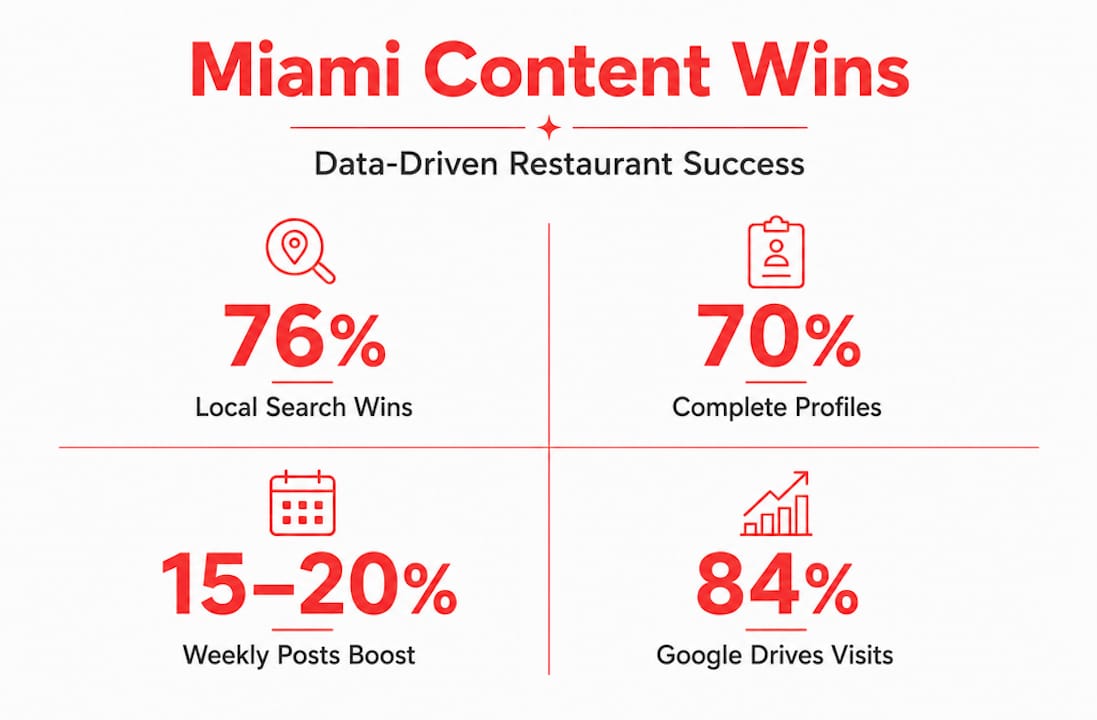
Post on your Google Business Profile at least once per week. Weekly Google Posts correlate with a 15 to 20% increase in profile interactions. Share a new dish, a weekend special, or a behind-the-scenes photo. It takes five minutes and compounds over time.
Do not overlook user-generated content either. When guests tag you in their food photos, encourage them to upload those images directly to your Google profile. Customer-uploaded photos add authenticity and social proof that your own polished shots cannot replicate.
Step 2: Build a social media rhythm that fits Miami
Social media for Miami restaurants requires more cultural sensitivity than most national guides acknowledge. Content ideas for restaurants in Miami should reflect the city’s bilingual character, its love of nightlife and events, and its appetite for visual spectacle.
Here is a proven posting framework:
- Monday: Behind-the-scenes video. Show your chef prepping a signature dish or your team setting up for service.
- Wednesday: A short-form video of a food moment. Think cheese pull, sauce pour, or cocktail build. Moving food content drives higher algorithmic reach because it satisfies Gen Z’s demand for social currency.
- Friday: Promotional post with a call to action. Weekend specials, happy hour, or a reservation link.
- Saturday or Sunday: User-generated content repost. Sharing a customer’s photo builds community and loyalty.
- TikTok separately: Aim to post at least five times per week on TikTok. Posting TikToks five times weekly is one of the strongest signals for consistent growth in restaurant discovery.
| Platform | Best content format | Ideal posting frequency |
|---|---|---|
| Instagram Reels | Short videos, behind-the-scenes | 4 to 5 times per week |
| TikTok | Food visuals, trending sounds, chef content | 5 to 7 times per week |
| Events, promotions, community posts | 3 to 4 times per week | |
| Google Business Profile | Specials, photos, announcements | Once per week minimum |
For local influencer collaboration, you do not need celebrities. Miami has a rich ecosystem of food creators with 5,000 to 50,000 followers who drive real reservations. Offer a comp meal in exchange for honest content. Track the posts with a unique reservation code or landing page to measure the actual impact.
Pro Tip: Post Instagram Reels and TikToks between 6 PM and 9 PM on weekdays and between 11 AM and 1 PM on weekends. Miami diners scroll heavily during meal-adjacent hours, which is exactly when you want to appear.
Common mistakes that kill content marketing results
Even with the right tools and a clear plan, certain habits will undercut everything you build. Here are the most common traps Miami restaurant owners fall into:
- Ignoring your Google Business Profile after setup. Claiming your profile is step one, not the finish line. Profiles with no recent activity lose ground to competitors who post weekly.
- Posting at random times with no pattern. Algorithms reward consistency. Sporadic posting tells the platform you are not a reliable content source, which shrinks your reach.
- Not responding to reviews. Responding to reviews within 2 hours improves local rankings and customer trust. Ignoring negative reviews is even more damaging in Miami, where word spreads fast in tight-knit communities.
- Over-investing in paid ads before organic content works. Paid ads amplify what already performs. If your organic posts get no engagement, ads will not save you. Build the organic foundation first.
- Creating content that ignores Hispanic culture or speaks only in English. Miami’s Hispanic consumer base is large and loyal. Bilingual captions, culturally relevant dish highlights, and acknowledgment of local traditions like Noche Buena or Calle Ocho Festival can dramatically expand your reach.
Pro Tip: When you get a negative review, respond publicly within a few hours, acknowledge the experience, and offer to make it right. Never argue. This response is read by hundreds of potential customers, not just the reviewer.
Measuring what actually matters
Most restaurant owners track follower counts and likes. Neither of those pays rent. A real Miami dining content strategy ties every effort back to measurable business outcomes. Marketing KPIs that link directly to foot traffic and revenue are the only ones worth watching consistently.
Here are the metrics that actually tell you something useful:
| KPI | What it measures | How to track it |
|---|---|---|
| Google Business Profile views | How many people found you via local search | GBP Insights dashboard |
| Direction requests | Intent to visit your physical location | GBP Insights dashboard |
| Website clicks from social | Traffic driven by content efforts | UTM parameters in bio link |
| Reservation conversion rate | How many visitors book a table | Reservation platform analytics |
| Customer return rate | Loyalty and retention | POS system data |
| Review volume and rating trend | Reputation growth over time | Google and Yelp dashboards |
- Set a monthly review cycle. Look at which posts drove the most profile views and website clicks, and make more of that content.
- Use UTM tracking links in your Instagram bio and Facebook posts to see exactly which platforms drive the most reservation traffic.
- Compare your customer acquisition cost against average lifetime value. A customer who visits four times a year and spends $60 per visit is worth $240 annually. If a piece of content costs $20 to produce and brings in three new regulars, that is a return worth scaling.
AI tools built for bilingual markets can help you optimize posting times, generate caption variations, and surface keyword opportunities in both English and Spanish. AI-powered tools for Miami’s market improve visibility and reduce the manual workload significantly, which matters when you are also running a kitchen.
Pro Tip: Create a simple weekly dashboard in Google Sheets that pulls your top five KPIs. Reviewing it every Monday takes 10 minutes and keeps your strategy from drifting based on gut feeling alone.
My honest take on Miami restaurant marketing
I have worked with restaurant owners across Miami who produce genuinely extraordinary food and still struggle to fill tables on Tuesday nights. The issue is almost never the food. It is the assumption that quality alone creates discovery.
What I have learned is that Miami rewards restaurants that treat content as a reflection of identity, not just promotion. The places that win are not necessarily posting more. They are posting with specificity. They show the abuela who taught the chef her arroz con pollo recipe. They caption in Spanglish because that is how their customers actually talk. They respond to every review like it is a conversation, not a chore. That specificity is what separates the restaurants people bookmark from the ones they scroll past.
I also think there is a misconception that you need a big budget to do this well. A smartphone, a consistent posting schedule, and a genuine voice will outperform expensive production with no soul every single time in this market. The tech tools matter for efficiency, but they cannot manufacture authenticity.
If you have been waiting for the right moment to get serious about how to market a restaurant online in Miami, that moment was about two years ago. The second best time is right now.
— Barthelemy
How Sorbey helps Miami restaurants grow faster
Running a restaurant leaves almost no time for building a content calendar, responding to every review, and optimizing a Google Business Profile every week. That is exactly the gap Sorbey was built to fill.
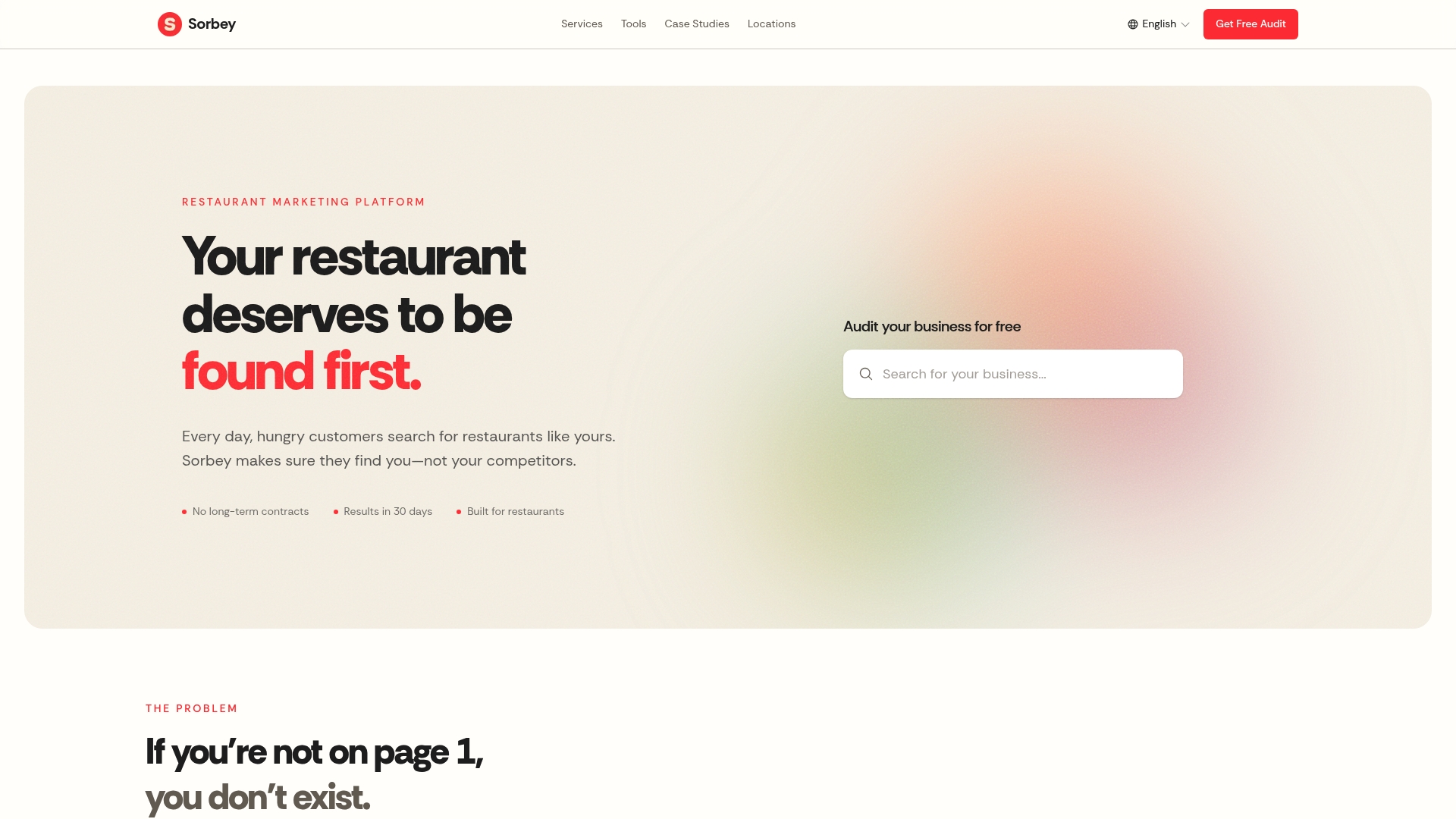
Sorbey is an all-in-one marketing platform built for local restaurants. It handles Google Business Profile optimization, social media scheduling, review management, and performance reporting in one place, so you spend less time on marketing logistics and more time on your guests. Miami restaurant owners using Sorbey get consistent content output without needing to hire a full marketing team. If the strategies in this guide are the blueprint, Sorbey is the tool that executes them without burning out your staff. Explore Sorbey’s restaurant marketing services to see how it fits your operation.
FAQ
What is content marketing for restaurants?
Content marketing for restaurants means creating and sharing photos, videos, posts, and written content that attracts new customers and keeps existing ones engaged, without relying solely on paid advertising.
How often should Miami restaurants post on social media?
Aim for four to five posts per week on Instagram and at least five times per week on TikTok. Consistency matters more than volume.
Does Google Business Profile really drive foot traffic?
Yes. 84% of people who search for a restaurant on Google visit one within 24 hours, making an optimized profile one of your highest-impact marketing assets.
What content works best for Miami’s Hispanic and Gen Z audiences?
Culturally relevant content, bilingual captions, and moving visuals like food videos and drink reveals perform strongly. Gen Z responds to content that offers social currency and feels authentic rather than scripted.
How do I know if my content marketing is working?
Track direction requests and profile views in Google Business Profile, reservation conversion rates, and customer return frequency. These metrics connect directly to revenue, unlike follower counts or likes.
Recommended
También te puede interesar

Best Restaurant Loyalty Programs 2026: ROI Guide
Discover the best restaurant loyalty programs 2026 that boost repeat visits. Learn how Sorbey’s platform can transform your guest data strategy!

Why Mobile Marketing Matters for Business Growth
Discover why mobile marketing matters for business growth. Learn how optimizing for mobile drives traffic, conversions, and customer retention.

SF Dim Sum Restaurant Marketing Checklist for 2026
Transform your SF dim sum with our 2026 marketing checklist. Optimize your profile, showcase dishes, and attract customers fast!