
Blog
Why Digital Presence Matters for Your Restaurant
Discover why digital presence matters for your restaurant. Boost visibility, attract diners, and ensure your restaurant thrives online.

Why Digital Presence Matters for Your Restaurant
TL;DR:
- A restaurant’s online presence includes website, reviews, and profiles that influence customer discovery and trust. Consistently managing and updating these assets greatly improves visibility, credibility, and customer choice. Neglecting digital assets causes missed opportunities and decreases competitive advantage over time.
A restaurant’s digital presence is the full collection of online assets, listings, reviews, and profiles that make it discoverable and credible to potential diners. 99% of consumers use the internet to find local businesses, and 80% of U.S. consumers search for local businesses every week. That means your restaurant is being looked up right now by people who have never walked through your door. If what they find is incomplete, outdated, or unconvincing, they will choose someone else. Why digital presence matters is not a theoretical question. It is the difference between a full dining room and empty tables.
Why does digital presence matter for restaurant customer decisions?
Customer decisions start online, long before anyone picks up a fork. A potential diner searches “best tacos near me,” scans the top results, checks photos, reads a few reviews, and makes a choice in under two minutes. Your restaurant either shows up and earns their trust, or it does not.

75% of consumers judge a business’s credibility based solely on website design quality. That is a significant number. A blurry logo, a menu that hasn’t been updated since 2022, or a site that breaks on mobile tells a potential customer that your restaurant is not worth their time.
Reviews carry equal weight. Responding to customer reviews increases the likelihood of a customer choosing your business by 41%. That single habit, replying professionally to both praise and complaints, has a measurable impact on revenue. Most restaurant owners underestimate how much a thoughtful response to a one-star review can win back trust.
The role of AI search tools adds another layer. Platforms like ChatGPT and Google Gemini synthesize reviews, structured data, and web content to generate restaurant recommendations. If your data is incomplete or inconsistent, AI tools will skip your restaurant entirely and recommend a competitor with cleaner information.
Key signals that drive customer decisions:
- Website design and mobile experience
- Google Business Profile completeness and accuracy
- Volume and recency of online reviews
- Speed and tone of review responses
- Consistent name, address, and phone number across all listings
What components build an effective restaurant digital presence?
A strong online footprint is not one thing. It is a system of interconnected assets that work together to signal credibility and drive discovery.
Owned assets
Your website is the foundation. It should load fast, display correctly on a phone, and show your menu, hours, location, and a way to make a reservation or place an order. A blog that covers local food events or seasonal specials adds fresh content that search engines reward. An email list gives you a direct line to loyal customers that no algorithm can cut off.
Outposts
Social media profiles on Facebook, Instagram, and TikTok function as discovery channels. A new diner might find your restaurant through a reel of your kitchen team plating a dish, not through Google. These platforms also signal to search engines that your business is active and legitimate. Consistency matters more than volume. Posting three times a week with quality photos beats posting daily with blurry snapshots.
Reputation
Online reputation management covers your reviews on Google, Yelp, and TripAdvisor. These platforms are where trust is built or destroyed. A restaurant with 200 reviews averaging 4.3 stars will almost always outperform one with 20 reviews averaging 4.8 stars. Volume signals longevity and consistency to both customers and search algorithms.
Structured data and listings
Google Business Profile is the single most important free tool available to restaurant owners. Accurate hours, photos, a menu link, and a response to every review all feed into local search rankings. Directory listings on Apple Maps, Bing Places, and Foursquare extend that reach. Structured data markup on your website tells search engines exactly what your restaurant is, where it is, and what it serves.
| Component | Primary function |
|---|---|
| Website | Credibility and conversion |
| Google Business Profile | Local search discovery |
| Social media profiles | Brand awareness and engagement |
| Review platforms | Trust and social proof |
| Directory listings | Consistency and reach |
How can restaurants improve their digital presence in practice?
Improvement does not require a large budget. It requires consistency and attention to the right priorities.
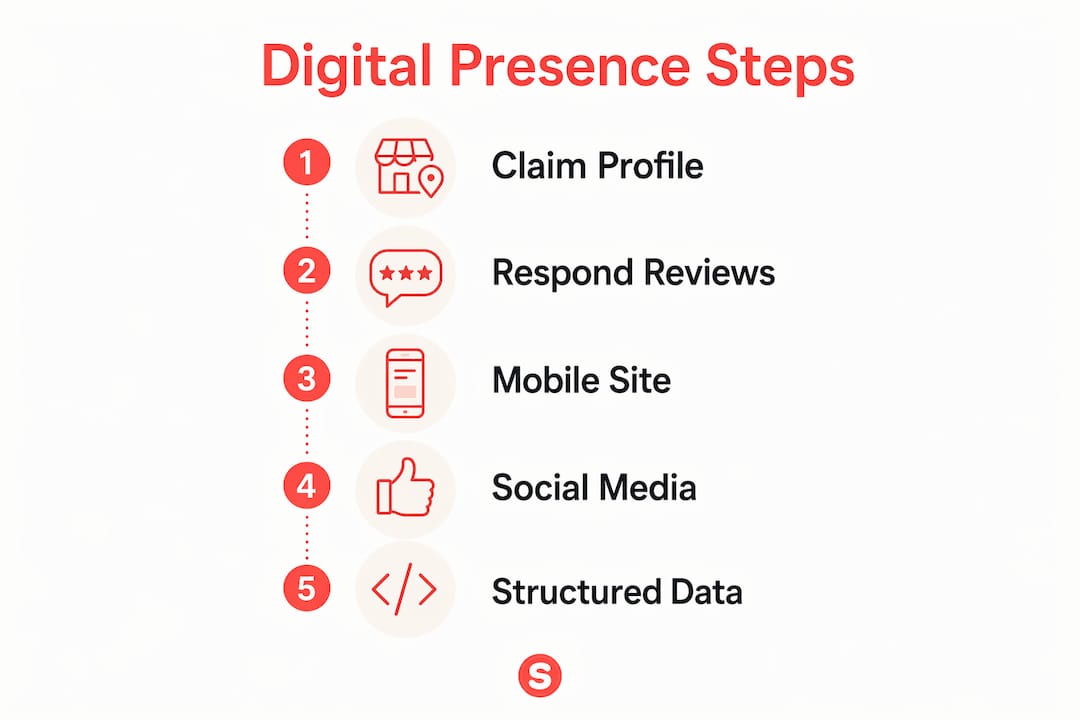
1. Claim and complete your Google Business Profile. Add your hours, phone number, website link, menu, and at least 10 high-quality photos. Update your hours for holidays. This single step has the highest return of any digital action a restaurant owner can take. Sorbey’s guide on Google Business Profile optimization walks through every field worth filling out.
2. Respond to every review within 48 hours. Thank positive reviewers by name. Address negative reviews calmly and offer a resolution. This practice directly increases customer choice likelihood and signals to Google that your business is actively managed.
3. Build a mobile-first website. Over half of all restaurant searches happen on a phone. If your site takes more than three seconds to load or requires pinching and zooming to read the menu, you are losing customers before they even see your food.
4. Post consistently on social media. Choose two platforms where your target diners spend time. Instagram works well for food photography. TikTok reaches a younger audience. Facebook still drives significant local discovery for neighborhood restaurants. Batch your content creation once a week to stay consistent without burning out.
5. Feed accurate structured data to AI search tools. AI-powered platforms pull from your website schema, Google Business Profile, and review content to generate recommendations. Accurate, structured information across all channels makes your restaurant recommendable by AI, not just findable by humans.
Pro Tip: Use the same business name, address, and phone number format across every platform. Even small differences, like “St.” versus “Street,” can confuse search algorithms and hurt your local rankings.
What are common pitfalls restaurants make with digital presence?
The biggest misconception is that digital presence equals social media. Social media is one channel. Digital presence is the entire ecosystem, including your website, reviews, listings, structured data, and email list. Restaurants that focus only on Instagram while ignoring their Google Business Profile or letting their website go stale are building on an incomplete foundation.
A second common mistake is treating digital presence as a cost rather than an asset. Digital presence compounds value over time, unlike paid ads that stop delivering the moment the budget runs out. A well-optimized Google Business Profile and a library of positive reviews keep working for your restaurant every day, without ongoing spend.
Ignoring AI-driven search is a growing blind spot. Diners increasingly ask ChatGPT or Google Gemini for restaurant recommendations. Digital visibility in 2026 functions as a proxy for trust. If your restaurant does not appear in AI-generated results, you are invisible to a fast-growing segment of potential customers.
Common pitfalls to avoid:
- Treating social media as the whole strategy
- Letting website content go stale for months at a time
- Ignoring or deleting negative reviews instead of responding
- Using inconsistent business information across platforms
- Skipping structured data markup on your website
Pro Tip: Run a quick audit every quarter. Search your restaurant’s name on Google, check your Business Profile, and read your five most recent reviews. This 20-minute habit catches problems before they cost you customers.
Key Takeaways
A restaurant’s digital presence is its most durable marketing asset, and neglecting it costs real customers every single week.
| Point | Details |
|---|---|
| Digital presence drives discovery | 80% of U.S. consumers search for local businesses weekly, making online visibility non-negotiable. |
| Website design builds credibility | 75% of consumers judge a business’s trustworthiness by website quality alone. |
| Review responses increase revenue | Responding to reviews raises the likelihood of a customer choosing your restaurant by 41%. |
| Consistency across channels is critical | Mismatched business information across platforms confuses search engines and drives customers away. |
| Digital presence compounds over time | Unlike paid ads, a well-built online footprint keeps delivering results without ongoing spend. |
The compounding advantage most restaurant owners overlook
I have worked with restaurant owners who spend thousands of dollars a month on paid ads and almost nothing on their organic digital footprint. The ads stop the moment the budget runs out. The Google Business Profile, the review library, the optimized website, those keep working at 2 a.m. on a Tuesday when no one is running a campaign.
The data point that sticks with me is this: 95% of buyers are out of market at any given time. That means most people who will eventually eat at your restaurant are not looking for you today. They are living their lives. But when they do start looking, the restaurant they remember seeing consistently, the one with the great photos, the thoughtful review responses, and the accurate hours, is the one they call first. Digital presence builds that familiarity before the customer is even ready to decide.
The restaurants I see winning in 2026 are not the ones with the biggest ad budgets. They are the ones that show up consistently across every channel, respond to every review, and treat their online footprint as seriously as they treat their dining room. A dirty dining room loses customers. An inconsistent or outdated digital presence does the same thing, just quietly and at scale.
Small investments made consistently compound into a real competitive advantage. A restaurant that spends two hours a week on its digital presence for a full year will be dramatically more visible than one that runs a single expensive campaign and then goes dark.
— Barthelemy
How Sorbey helps restaurants build lasting digital visibility
Sorbey is an all-in-one marketing platform built specifically for local restaurants. It handles the work that most restaurant owners know they should be doing but never have time for: keeping listings accurate, managing review responses, and building the kind of consistent digital footprint that drives real foot traffic.
The Crème Restaurant Paris 18 case study shows what that looks like in practice. Sorbey helped Crème achieve a 162% increase in Google Maps views, turning digital visibility into a measurable surge in customer discovery. For restaurant owners ready to build that kind of presence, Sorbey’s restaurant marketing solutions cover every channel that matters, from Google Business Profile to social media to reputation management.
FAQ
Why does digital presence matter more than paid ads for restaurants?
Digital presence builds compounding value over time. Paid ads stop delivering the moment the budget runs out, while a well-managed Google Business Profile and review library keep attracting customers indefinitely.
How does website design affect a restaurant’s credibility?
75% of consumers judge a business’s credibility based on website design quality alone. A slow, outdated, or hard-to-read site signals to potential diners that the restaurant is not worth their trust.
How often should restaurant owners update their digital presence?
A quarterly audit of your Google Business Profile, website, and review responses is the minimum. High-traffic periods like holidays require more frequent updates to keep hours and information accurate.
What is the impact of responding to online reviews?
Responding to reviews increases the likelihood of a customer choosing your restaurant by 41%. Both positive and negative reviews deserve a timely, professional response.
How do AI search tools affect restaurant discovery?
AI platforms like ChatGPT and Google Gemini pull from structured data, reviews, and web content to generate recommendations. Restaurants with accurate, consistent information across all channels are far more likely to appear in those results.
Recommended
- How to Improve Digital Presence for Your Restaurant | Sorbey Blog | Sorbey
- Top restaurant digital trends: boost success in 2026 | Sorbey Blog | Sorbey
- Digital marketing checklist for restaurants: boost local visibility | Sorbey Blog | Sorbey
- Digital marketing checklist for restaurants: boost visibility | Sorbey Blog | Sorbey
También te puede interesar

Best Restaurant Loyalty Programs 2026: ROI Guide
Discover the best restaurant loyalty programs 2026 that boost repeat visits. Learn how Sorbey’s platform can transform your guest data strategy!

Why Mobile Marketing Matters for Business Growth
Discover why mobile marketing matters for business growth. Learn how optimizing for mobile drives traffic, conversions, and customer retention.

SF Dim Sum Restaurant Marketing Checklist for 2026
Transform your SF dim sum with our 2026 marketing checklist. Optimize your profile, showcase dishes, and attract customers fast!