
Blog
Why Local Partnerships Drive Real Business Growth
Discover why local partnerships are essential for business growth. Learn how collaborating can enhance trust, reduce costs, and drive success.

Why Local Partnerships Drive Real Business Growth
TL;DR:
- Local business collaborations share costs and build trust, leading to sustainable growth without large advertising budgets.
- They strengthen community resilience, increase customer loyalty, and promote local spending through mutual support.
Local partnerships are mutually beneficial collaborations between businesses that share customers, costs, and community trust to grow faster together than either could alone. For urban business owners and marketing managers, understanding why local partnerships work is not optional. It is one of the clearest paths to sustainable growth that does not require a massive advertising budget. A systematic review of 89 research papers confirmed that community collaboration is a more effective protective factor for resilience than individual organizational strength. That finding applies directly to businesses: the ones embedded in local networks outlast those operating in isolation.
Why local partnerships outperform solo marketing
The core advantage of local partnerships is cost efficiency combined with trust transfer. When two businesses split the cost of a joint campaign or event, each gets double the exposure for the same spend. Expense splitting doubles reach while cutting individual budget pressure in half. That math alone makes the case for collaboration before you factor in anything else.
Trust transfer is the less obvious benefit. When a business your customers already love recommends you, that recommendation carries far more weight than any paid ad. Trusted referrals accelerate acquisition because the new customer arrives with warm confidence rather than skepticism. Cold advertising asks people to trust a stranger. A partner referral asks them to trust someone their friend already trusts.
The third advantage is peer learning. Small business owners solve real operational problems, from cash flow gaps to permit confusion, through informal peer conversations that no online search can replicate. A coffee shop owner who just navigated a health inspection can save a neighboring restaurant owner hours of stress with a 10-minute conversation. That knowledge transfer happens naturally inside local business networks.
The benefits of local partnerships also include brand credibility. Being associated with respected local businesses signals to customers that you belong to the community. That signal builds loyalty faster than any loyalty program.
Pro Tip: Start by listing five businesses within a half-mile radius that serve your same customer but do not compete with you directly. Those are your first partnership candidates.
How do local partnerships strengthen community connections?
Local partnerships do more than help individual businesses. They build the kind of community resilience that makes entire neighborhoods economically durable. The Springer Nature 2026 review found that integrated, trust-based local networks are the defining feature of communities that recover quickly from economic disruption. Businesses that collaborate create that network.

The importance of community collaboration goes beyond goodwill. When local businesses co-host events, share customers, and refer each other, they reinforce a shared local identity. Customers who feel that identity are more likely to spend locally rather than defaulting to national chains. That spending stays in the neighborhood and circulates through the same businesses that created the network.
Research on community-academic partnerships found that shared leadership and co-design align initiatives with community priorities and increase long-term sustainability. The same principle applies to business partnerships. When both parties have equal input into a joint campaign or event, the result reflects both audiences and serves both communities. One-sided arrangements collapse. Equitable ones compound.
Large corporations spend heavily trying to manufacture the authentic community trust that local businesses already possess naturally. Local businesses hold embedded advantages that no national brand can replicate with a marketing budget. That is the competitive edge worth protecting and building on.
| Community benefit | Business outcome |
|---|---|
| Shared local identity | Higher customer loyalty and repeat visits |
| Trust-based referral networks | Lower customer acquisition cost |
| Collaborative events | Increased foot traffic for all participants |
| Peer knowledge exchange | Faster problem-solving and reduced operational errors |
| Economic circulation | Stronger neighborhood spending patterns |
What strategies help build and sustain successful local partnerships?
Building a local alliance that lasts requires more than a handshake and a shared Instagram post. The foundation is compatibility. Start with businesses that already serve your customer base and carry a reputation you respect. A restaurant pairing with a local wine shop makes sense. A gym pairing with a nearby smoothie bar makes sense. Mismatched partnerships confuse customers and dilute both brands.
A scoping review published in 2026 identified six key drivers of successful community-level collaboration: shared purpose, clear operationalization, relational dynamics, structural support, adequate resources, and leadership. Every durable business partnership reflects at least four of those six. The ones that collapse usually lack shared purpose or clear structure from the start.
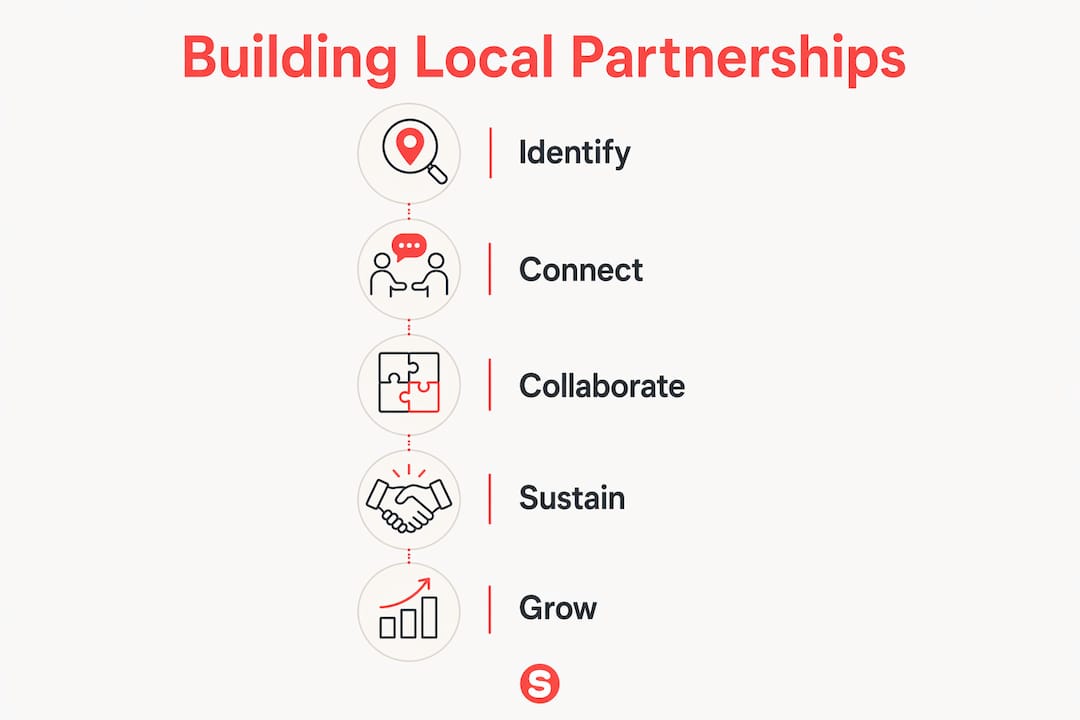
Here is a practical sequence for building a local alliance that holds:
- Identify the right fit. Choose a business with overlapping customers and a complementary, not competing, offer.
- Make the first contact in person. Attend a local business association meeting, a neighborhood event, or a shared supplier’s open house. Cold email rarely works.
- Start small. Propose a single joint social media post or a one-day cross-promotion before committing to a co-hosted event.
- Define what success looks like. Agree on a simple metric: new email sign-ups, foot traffic on a specific day, or coupon redemptions. Shared measurement keeps both parties accountable.
- Follow up consistently. One interaction is not a partnership. Schedule a monthly check-in, even a 15-minute coffee, to keep the relationship active.
- Build toward shared assets. A joint landing page, a co-branded loyalty offer, or a recurring quarterly event creates infrastructure that outlasts any single campaign.
Authentic partnerships form in relaxed social settings rather than through cold outreach. A wine tasting, an art walk, or a neighborhood cleanup gives you a natural reason to talk to another business owner as a person, not a prospect. That human connection is what makes the professional relationship durable.
The most common pitfall is treating a partnership as a one-time transaction. A business that only reaches out when it needs something will not keep partners for long. Consistency and reciprocity are the two non-negotiable rules.
Pro Tip: Create a simple shared landing page with your partner that captures email addresses from both audiences. It costs almost nothing and gives both businesses a measurable asset from day one.
What do successful local partnerships look like in practice?
Real-world examples make the concept concrete. A café and an independent bookstore in the same block can cross-promote through a “read and sip” campaign: the café offers a discount to customers who show a recent bookstore receipt, and the bookstore displays the café’s menu near the register. Both businesses reach each other’s loyal customers without spending anything beyond the cost of printing a small sign.
A gym and a nutrition coach operating out of a nearby studio can co-host a free Saturday workshop. The gym provides the space and the audience. The coach provides the content and the credibility. Both collect contact information from attendees. Both gain new clients from the other’s existing base. The event costs each party a few hours of time and zero advertising dollars.
The local partnerships advantages in these examples are not theoretical. They include:
- Warm customer introductions that convert at a higher rate than cold advertising
- Shared event costs that make programming affordable for businesses that could not fund it alone
- Brand credibility by association, where each business benefits from the other’s reputation
- Faster market entry for newer businesses that attach themselves to an established local name
- Non-transactional referral relationships that generate leads continuously without ongoing cost
A restaurant that partners with a local food tour company gains exposure to visitors who are actively looking for authentic dining experiences. That partnership requires no paid promotion. The digital presence built through partnerships also compounds over time as co-tagged social content reaches both audiences simultaneously.
The businesses that build the strongest local networks treat every partner as a long-term relationship, not a campaign. They show up at each other’s events, promote each other without being asked, and refer customers even when there is no immediate reciprocal benefit. That generosity is what makes the network self-sustaining.
Key Takeaways
Local partnerships work because they combine cost efficiency, trust transfer, and community credibility into a single growth mechanism that paid advertising cannot replicate.
| Point | Details |
|---|---|
| Cost efficiency is immediate | Splitting marketing and event costs doubles reach without doubling spend. |
| Trust transfer beats cold ads | Partner referrals deliver warm leads that convert faster than any paid campaign. |
| Community resilience is a business asset | Businesses embedded in local networks recover from disruption faster than isolated ones. |
| Shared purpose sustains partnerships | Partnerships without aligned goals and clear structure collapse quickly. |
| Social settings build real trust | Authentic connections form in relaxed environments, not through cold outreach. |
The part most business owners get wrong about local partnerships
I have watched business owners approach local partnerships the same way they approach vendor negotiations: transactional, formal, and focused entirely on what they will get. That approach fails almost every time. The partnerships I have seen last for years, and actually generate consistent business, started with genuine curiosity about another owner’s challenges, not a pitch about mutual benefit.
The uncomfortable truth is that most people can tell when you are networking versus when you are connecting. A conversation at a neighborhood art walk where you ask a fellow business owner how they handled their busiest season is worth more than ten cold emails offering a “mutually beneficial collaboration.” Social settings lower the friction that makes trust-building slow in formal contexts. Use them.
The other mistake I see constantly is expecting immediate returns. A partnership that generates one referral in the first month is not failing. It is starting. The businesses that build real local alliances treat the first six months as relationship investment, not revenue generation. The payoff comes later, and it compounds in ways that are hard to attribute to any single interaction. That is exactly why most business owners undervalue it. They cannot track it on a spreadsheet, so they stop before it works.
If you are a marketing manager pushing for measurable ROI from every initiative, build a simple tracking system: ask every new customer how they heard about you, and tag partner referrals separately. Within three months, you will have data that makes the case internally. The local reviews and referrals that come through genuine partnerships show up in ways that paid campaigns simply do not.
— Barthelemy
How Sorbey helps you put local partnerships to work
Building local alliances is one part of the equation. Making sure those partnerships translate into visible growth is the other.
Sorbey is an all-in-one marketing platform built for local businesses like restaurants that want to turn community relationships into measurable results. From local advertising strategy to managing your digital presence, Sorbey gives you the tools to amplify what your partnerships generate. When a partner sends customers your way, Sorbey helps you capture, convert, and retain them. Visit Sorbey to see how local marketing works when everything runs in one place.
FAQ
What are local partnerships in business?
Local partnerships are formal or informal collaborations between two or more businesses in the same geographic area that share customers, costs, or promotional efforts for mutual benefit. They differ from vendor relationships because both parties contribute and gain roughly equally.
What are the main benefits of local partnerships?
The primary benefits include reduced marketing costs through expense sharing, higher-converting customer referrals through trust transfer, and stronger brand credibility through community association. Research shows these collaborations also build the kind of local resilience that helps businesses survive economic disruption.
How do I start building local alliances?
Start by identifying businesses within your area that serve your customer base without competing directly with you. Make contact in person at a local event or business association meeting, propose a small joint promotion first, and build toward shared assets like co-hosted events or a joint landing page.
Why do local partnerships fail?
Most local partnerships fail because one or both parties treat them as one-time transactions rather than ongoing relationships. A scoping review of collaboration drivers found that shared purpose and relational consistency are the two factors most predictive of long-term success.
How do local partnerships help with customer loyalty?
Partners refer customers who arrive with built-in trust, which means they are more likely to return and spend more over time. Combining partnership referrals with a restaurant loyalty program creates a compounding effect that paid advertising alone cannot produce.
Recommended
También te puede interesar

Best Restaurant Loyalty Programs 2026: ROI Guide
Discover the best restaurant loyalty programs 2026 that boost repeat visits. Learn how Sorbey’s platform can transform your guest data strategy!

Why Mobile Marketing Matters for Business Growth
Discover why mobile marketing matters for business growth. Learn how optimizing for mobile drives traffic, conversions, and customer retention.

SF Dim Sum Restaurant Marketing Checklist for 2026
Transform your SF dim sum with our 2026 marketing checklist. Optimize your profile, showcase dishes, and attract customers fast!