
Blog
Why Online Reviews Matter for Urban Restaurants
Discover why online reviews matter for urban restaurants. Learn how they shape consumer trust and influence dining decisions.

Why Online Reviews Matter for Urban Restaurants
TL;DR:
- Online reviews influence nearly all customer decisions and trust in restaurants, especially in urban areas. Managing reviews through consistent, daily effort improves reputation, search visibility, and long-term loyalty. Responding professionally to feedback and acting on suggestions build credibility and sustainable growth.
Online reviews are the single most powerful factor shaping whether a new customer walks through your restaurant’s door or keeps scrolling. 97% of consumers rely on reviews to guide purchasing decisions, and restaurants sit at the center of that behavior. Your star rating, review volume, and how you respond to feedback all signal trustworthiness before a diner ever reads your menu. Understanding why online reviews matter is no longer optional for urban restaurant owners. It is the foundation of your customer acquisition strategy.
Why online reviews matter for customer trust and decisions
Online reviews function as social proof, and social proof is the primary mechanism consumers use to reduce risk before trying a new restaurant. When someone searches for dinner options in a competitive city neighborhood, they are not just looking for food. They are looking for confirmation that your restaurant is worth their time and money.
The numbers make this concrete. 85% of consumers are more likely to visit a business after reading positive reviews, while 77% are actively deterred by negative ones. That gap represents real revenue walking in or out of your door every week.
“Consumers do not just read reviews after they have already decided where to eat. Reviews influence every stage of the decision, from initial discovery to the final choice between two similar restaurants on the same block.”
The decision-making process does not stop at the first review either. 66% of consumers do additional research after reading reviews, 37% read more reviews, and 24% check social media before making a final call. This means your review profile needs to hold up under scrutiny, not just pass a quick glance.
Star ratings, review volume, and recency all work together as diagnostic anchors. A restaurant with 400 reviews averaging 4.2 stars reads as more credible than one with 12 reviews averaging 4.9. Consumers instinctively understand that more data means a more reliable signal. The impact of customer feedback on first-time visitor decisions is direct and measurable.

What review attributes matter most to urban restaurant customers?
Urban diners are more review-savvy than the average consumer. They live in markets with dozens of comparable options within walking distance, so they apply sharper filters when evaluating review profiles.
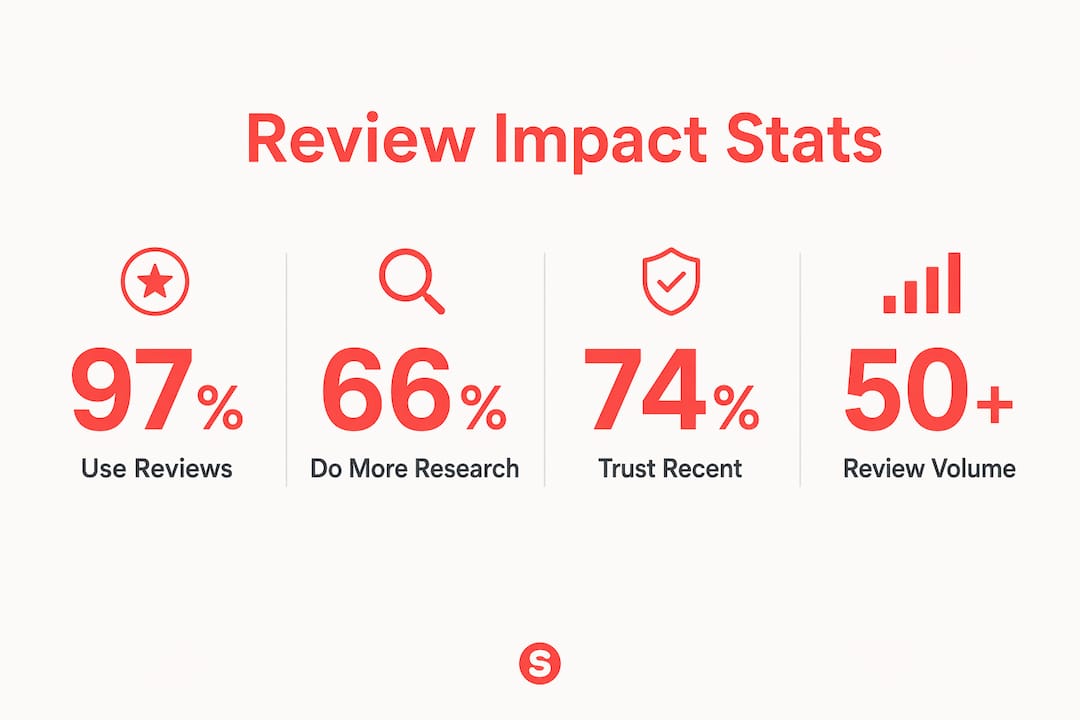
Recency is the most underestimated factor. 74% of consumers only consider reviews written in the last three months. A restaurant that earned strong reviews two years ago but has gone quiet since then looks stale and potentially unreliable. Fresh reviews signal that your operation is active, consistent, and still worth visiting.
| Review attribute | Why it matters | What to aim for |
|---|---|---|
| Recency | 74% of consumers only trust reviews from the last 3 months | Consistent new reviews every month |
| Volume | Higher volume increases consumer confidence | 50+ reviews as a baseline for credibility |
| Star rating | Ratings below 4.0 deter most urban diners | Maintain 4.2 or above across platforms |
| Verified details | Specific mentions of dishes, service, and atmosphere reduce uncertainty | Encourage detailed, descriptive feedback |
| Balanced profile | 100% positive ratings trigger skepticism | A few handled negatives build authenticity |
Verified purchase badges and detailed reviews carry extra weight in dense urban markets where perceived risk is higher. A reviewer who names a specific dish, describes the ambiance, and mentions their server gives future diners a much richer picture than a generic five-star comment with no text.
Counterintuitively, a perfect rating can hurt you. Consumers often find that profiles with 100% positive ratings feel manufactured. A few negative reviews, handled professionally and publicly, actually build more trust than an unblemished record. Urban diners are skeptical by default. Show them you are real.
Pro Tip: Ask your most loyal regulars to describe a specific dish or experience in their review. Detailed, specific reviews outperform generic five-star ratings in both credibility and search visibility.
How can restaurant owners manage reviews to build reputation?
Review management is an operational discipline, not a marketing task you check off once a month. The restaurants that win in competitive urban markets treat their review profiles the way they treat their kitchens: with daily attention and clear standards.
The most effective framework is the closed-loop feedback method. Closed-loop feedback involves four steps: collect feedback, analyze it for patterns, act on what you find, and communicate those changes back to customers. Each step builds on the last, and skipping any one of them breaks the chain.
Here is how to apply it in a restaurant context:
- Collect continuously. Ask for reviews at the point of highest satisfaction, which is typically right after a great meal. A simple card, a QR code on the receipt, or a follow-up text message all work. Timing matters more than the channel.
- Analyze for patterns. One complaint about slow service is noise. Ten complaints about slow service on Friday nights is a staffing problem. Read your reviews as operational data, not just reputation scores.
- Act visibly. If customers consistently mention that the noise level is too high, add acoustic panels and say so publicly. If they love a seasonal dish, bring it back and announce it. Visible changes based on feedback prove you are listening.
- Communicate the loop. When you respond to a review that flagged a problem, mention what you changed. “We heard this feedback and adjusted our reservation system” is far more powerful than a generic apology.
Failing to act on feedback creates what researchers call a “survey graveyard.” Customers who took the time to leave detailed feedback and saw no response or change feel more dismissed than if you had never asked at all. That feeling damages loyalty faster than the original complaint.
Response speed and authenticity also matter. Prompt, personalized responses to all reviews, positive and negative, directly correlate with improved retention and reputation scores. A response that references the reviewer’s specific comment shows you read it. A copy-pasted template shows you did not.
Pro Tip: Set a 48-hour response window for all reviews. Respond to negative reviews first, since those carry the highest reputational risk and the highest potential to recover a lost customer.
What are the indirect benefits of positive reviews beyond new customers?
The direct benefit of reviews is clear: more positive reviews bring in more first-time diners. The indirect benefits are just as significant, and most restaurant owners underestimate them.
- Customer retention and profit. A 5% increase in retention can increase profits by 25–95%. Reviews that prompt you to fix recurring service issues do not just attract new customers. They keep existing ones coming back longer.
- Search visibility. Reviews generate fresh user-generated content on a continuous basis. Google’s local search algorithm rewards active review profiles with higher rankings in local map results. More reviews, updated regularly, means more visibility for searches like “best Italian restaurant near me.”
- Word-of-mouth amplification. Positive reviews create social proof that turns satisfied customers into advocates. A diner who reads a glowing review, has a great experience, and then leaves their own review has become part of your marketing engine without any additional cost to you.
- Competitive differentiation. In urban markets where three similar restaurants may operate on the same block, a stronger review profile is often the deciding factor. Reviews are one of the few marketing assets that compound over time.
The role of reviews in marketing extends well beyond acquisition. They shape how your brand is perceived, how often you appear in search results, and how much your loyal customers advocate for you organically.
Key Takeaways
Online reviews are the primary trust signal urban restaurant customers use at every stage of their decision, from discovery to the final choice between two comparable options.
| Point | Details |
|---|---|
| Reviews drive decisions | 97% of consumers rely on reviews, and 85% are more likely to visit after positive ones. |
| Recency is critical | 74% of consumers only trust reviews from the last three months, so keep new reviews coming. |
| Balanced profiles build trust | A few professionally handled negative reviews increase credibility more than a perfect rating. |
| Closed-loop feedback converts reviews into loyalty | Collect, analyze, act, and communicate changes to turn feedback into operational improvement. |
| Indirect benefits compound | Reviews boost SEO, retention, and word-of-mouth, all of which grow your revenue over time. |
The discipline most restaurant owners skip
I have worked with enough restaurant owners to know that most treat reviews as something that happens to them rather than something they manage. They check their rating when a bad review stings and ignore it when things are going well. That is the wrong posture entirely.
The restaurants that consistently outperform their competition in urban markets share one habit: they treat their review profile as a live operational dashboard. They read every review the day it posts. They respond within 48 hours. They track which complaints repeat across months and fix the underlying problem. They ask for reviews at the right moment, not randomly or desperately.
What surprises most owners is how much a negative review, handled well, can actually help them. I have seen restaurants turn a scathing one-star review into a five-star follow-up simply by responding with genuine accountability and a specific fix. That exchange, visible to every future reader, signals more trustworthiness than a hundred generic five-star ratings.
The other thing I push hard on is visibility of change. Responding to feedback is not enough. You need to make the change obvious. Update your menu. Post about it. Put a small note on the table. When customers see that their feedback produced a real result, they become advocates. That is the closed-loop feedback principle in action, and it is the most underused tool in restaurant reputation management.
Reviews are not a marketing channel. They are a mirror. The restaurants that look honestly at that mirror and act on what they see are the ones that build lasting reputations in competitive urban markets.
— Barthelemy
How Sorbey helps restaurants turn reviews into real growth
Managing your review profile across multiple platforms, responding consistently, and tracking feedback patterns is a full-time job on top of running a restaurant. Sorbey is built specifically for local restaurants that need all of that handled without adding headcount.
Sorbey’s restaurant marketing solutions bring review management, customer feedback analysis, and local visibility tools into one place. You get alerts when new reviews post, response templates you can personalize in seconds, and reporting that shows which feedback themes are hurting or helping your reputation. Sorbey also helps you close the feedback loop by surfacing patterns that point to specific operational fixes. For urban restaurant owners who want to grow through trust rather than ad spend, Sorbey gives you the tools to make that happen consistently.
FAQ
Why do online reviews matter more for urban restaurants?
Urban diners have more options within walking distance and apply sharper filters before choosing. A strong, recent review profile is often the deciding factor between two comparable restaurants on the same block.
How many reviews does a restaurant need to build credibility?
Volume and recency both matter. A baseline of 50 or more reviews, updated consistently each month, signals an active and trustworthy operation to both consumers and local search algorithms.
Should I respond to negative reviews publicly?
Yes. Professionally handled negative reviews build more trust than a perfect rating. Responding with accountability and a specific fix shows future readers that you take quality seriously.
How do reviews affect my restaurant’s search ranking?
Reviews generate fresh user-generated content that Google’s local search algorithm rewards with higher map rankings. More recent, detailed reviews improve your visibility for searches like “best restaurant near me.”
What is the closed-loop feedback method for restaurants?
The closed-loop feedback method means collecting reviews, analyzing them for patterns, acting on what you find, and communicating those changes back to customers. Skipping the final step, where you tell customers what changed, is the most common mistake restaurant owners make.
Recommended
Vous pourriez aussi aimer

Best Restaurant Loyalty Programs 2026: ROI Guide
Discover the best restaurant loyalty programs 2026 that boost repeat visits. Learn how Sorbey’s platform can transform your guest data strategy!

Why Mobile Marketing Matters for Business Growth
Discover why mobile marketing matters for business growth. Learn how optimizing for mobile drives traffic, conversions, and customer retention.

SF Dim Sum Restaurant Marketing Checklist for 2026
Transform your SF dim sum with our 2026 marketing checklist. Optimize your profile, showcase dishes, and attract customers fast!