
Blog
The Real Role of Event Marketing for Growth in 2026
Discover the vital role of event marketing for growth in 2026! Unlock measurable strategies to boost customer retention and revenue.

The Real Role of Event Marketing for Growth in 2026
TL;DR:
- Event marketing has shifted from a branding activity to a measurable growth channel that influences pipeline, retention, and customer behavior. Proper data collection, CRM integration, and long-term attribution are essential for demonstrating ROI and securing ongoing budgets. Effective systems enable local businesses to turn events into revenue by capturing participation, follow-ups, and influence over time.
Most marketing professionals treat events as a nice-to-have, a moment of goodwill sandwiched between email campaigns and paid ads. That framing is costing them real revenue. The role of event marketing has shifted from feel-good brand activity to a measurable growth channel, one that influences pipeline, retention, and customer behavior in ways most digital tactics cannot replicate. This article breaks down what event marketing actually is, why the data behind it is more compelling than most marketers realize, and how to build measurement systems that earn sustained budget support.
Table of Contents
- Key takeaways
- The role of event marketing defined
- What the data actually says about impact
- Setting objectives that executives will fund
- Tools and tracking that turn events into revenue
- My honest take after years of watching this play out
- How Sorbey helps you get real results from every event
- FAQ
Key takeaways
| Point | Details |
|---|---|
| Events drive purchase decisions | 89% of attendees say an event was their primary reason for making a purchase. |
| Halo effect is real and measurable | Live experiences lift performance of all other marketing channels by an average of 47%. |
| ROI measurement is getting easier | Difficulty proving event ROI dropped from 70% to 40% between 2025 and 2026. |
| Objectives need specifics | Measurable event goals require a number, a timeline, and a defined audience segment. |
| CRM integration prevents data loss | Connecting event contacts to CRM records is the difference between pipeline visibility and a data black hole. |
The role of event marketing defined
Event marketing, often called experiential marketing in industry practice, is the practice of creating real-time brand engagements that generate direct emotional and behavioral responses. Unlike a display ad or a social post, an event places your brand inside an experience the audience chooses to participate in. That distinction matters more than most people appreciate.
What is event marketing in 2026? It covers a wider spectrum than ever:
- In-person events: Conferences, product launches, trade shows, community dinners, and pop-ups where physical presence creates memorable contact.
- Virtual events: Webinars, live-streamed product demonstrations, and online summits that extend geographic reach without sacrificing real-time interaction.
- Hybrid events: Combinations that serve both live and remote audiences simultaneously, typically with dedicated engagement tracks for each group.
- Experiential activations: Brand installations, tasting events, and immersive experiences designed to generate emotional memory rather than just awareness.
Modern event marketing is also defined by three expectations that did not exist a decade ago: personalization at scale, technology integration for real-time data capture, and a measurement foundation built into the event design from day one. If you are planning events without a data capture strategy in place before the first attendee walks in, you are creating a gap that cannot be filled retroactively.
Pro Tip: Treat your event not as a campaign but as a data collection point. Every touchpoint, registration, session attendance, and post-event survey, should feed directly into your CRM and be tied to a contact record.
The clearest difference between event marketing and traditional marketing is participation. A billboard tells. An event involves. When a restaurant hosts a cooking class or a neighborhood tasting night, guests are not consuming your brand message. They are living inside it. That is why event marketing emphasizes memory and participation over impressions and reach.
What the data actually says about impact
The benefits of event marketing are not anecdotal anymore. The numbers in 2026 make a compelling case that events deserve a central spot in any serious marketing mix.
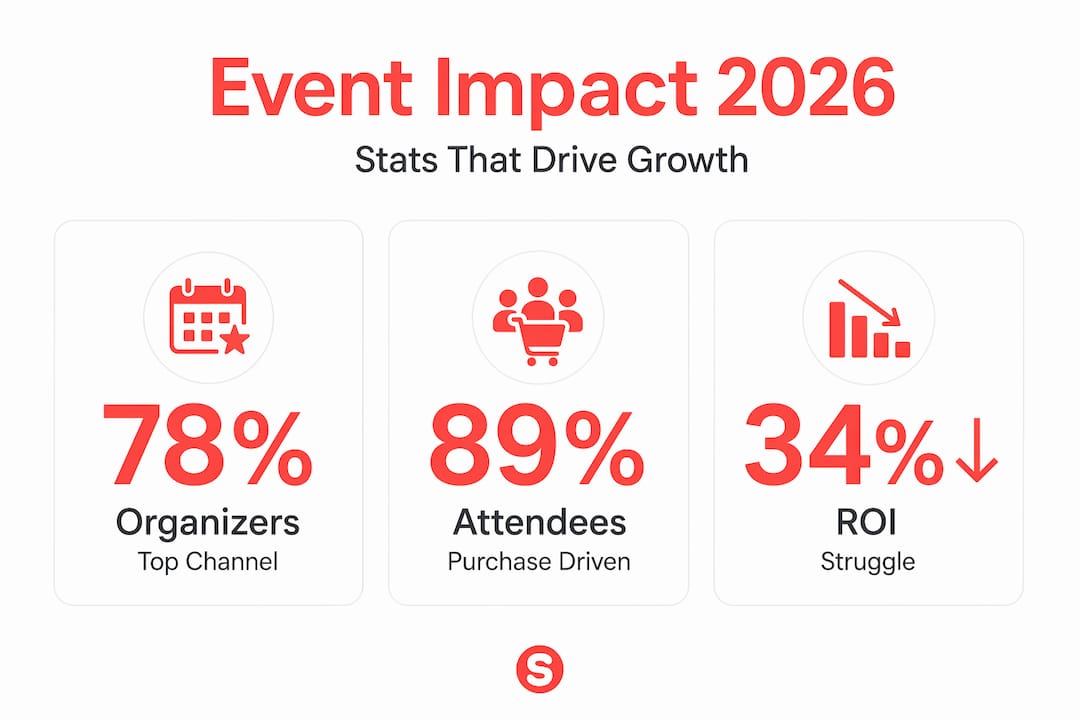
78% of organizers rate in-person conferences as their most impactful marketing channel today. On the attendee side, 71% say in-person B2B events are the best place to learn about new products and services. These are not soft engagement metrics. They reflect where purchasing consideration actually forms.

The revenue connection is even more direct. 89% of event attendees report that an event was the primary factor in their decision to purchase. Live experiences also produce what researchers call a halo effect: they amplify other channel performance by an average of 47%. That means the email you send two weeks after a tasting event performs better than the same email sent to someone who never attended. The event primes the relationship.
The measurement story is improving rapidly as well. The percentage of marketers who struggle to prove event ROI dropped from 70% to 40% between 2025 and 2026. That shift reflects better tooling, more structured event data workflows, and a growing acceptance that attribution windows for events are longer than for a paid click.
| Metric | 2025 | 2026 |
|---|---|---|
| Organizers rating events as top channel | ~72% | 78% |
| Marketers struggling to prove ROI | 70% | 40% |
| Organizers planning budget increases | Not tracked | 40% |
| Attendees citing events as purchase driver | ~84% | 89% |
One factor that still trips up even experienced teams: most influenced pipeline emerges over a six-month window after an event. Teams that measure ROI at 30 days consistently undercount the impact. Budget decisions made on that short-window data lead to chronic underfunding of what is actually a high-performing channel.
Setting objectives that executives will fund
The importance of event marketing is not self-evident to a CFO. You have to show the business case, and that starts before the event happens, not after.
Measurable event objectives require three components every time: a specific number, a defined timeline, and a clearly named audience segment. “Increase brand awareness” is not an objective. “Generate 150 qualified pipeline contacts from regional restaurant owners within 45 days of the spring trade show” is.
Here is a practical framework for building objectives that connect to real business outcomes:
- Start with the business question your executives are asking. Are they concerned about retention? New market penetration? Customer adoption of a new product? Your event objective should answer that question directly.
- Identify the behavioral signal that proves success. Pipeline created, meetings booked, contracts renewed, and product adoption rates are all behaviors that follow events and can be tracked. Pick the one that maps to your business question.
- Set the number before the event. Decide what “good” looks like in advance. Salesforce Dreamforce, for example, measures success by pipeline generated and customer retention rates, not attendance headcount.
- Build the measurement system into the event design. If you want to track post-event meetings, your registration process needs to capture data fields that your CRM can act on. Design backward from the metric.
Pro Tip: Present your event objectives to at least one executive before the event. Their questions will sharpen your metrics and create internal alignment that protects your budget when results take time to materialize.
Executives expect event marketing to function as a business growth engine, not a branding exercise. The sooner you frame your objectives in their language, the pipeline, retention, and adoption, the easier it becomes to secure ongoing investment.
Tools and tracking that turn events into revenue
Knowing event marketing best practices is one thing. Building the systems that make them work is another, and this is where most teams fall short.
The most common failure is what practitioners call the event data black hole. Leads are collected at a trade show, entered into a spreadsheet, and never tied back to a CRM contact or deal. Six months later, no one can prove whether the event influenced any revenue. Unmanaged event contacts in disconnected systems are the single biggest obstacle to proving event ROI over time.
The solution is structured event records inside your CRM, connected to individual contact timelines. Here is what that looks like in practice:
- Create a dedicated event record for each marketing event in your CRM. This becomes the anchor point for all associated data.
- Associate contacts to the event record at registration or check-in. Every attendee should have their CRM contact linked to the event before the event ends.
- Log post-event touchpoints to the same record. Emails sent, calls made, meetings booked, and deals created should all trace back to the originating event.
- Run pipeline influence reports at 30, 90, and 180 days. This captures the full attribution window and gives you the complete revenue picture.
Platforms like HubSpot Marketing Studio support this with native marketing event records that connect directly to CRM pipelines and revenue reports. The structured event records in CRM approach enables tracking of post-event emails, meetings, deals, and revenue attribution with a level of precision that spreadsheets simply cannot provide.
For local businesses like restaurants, the same principles apply at a smaller scale. A wine pairing dinner tracked in a CRM with 40 attendee records and a 90-day follow-up workflow will tell you more about event marketing effectiveness than 500 business cards sitting in a drawer. You can explore how this works in food and beverage settings through Sorbey’s event marketing ROI guide built specifically for hospitality contexts.
My honest take after years of watching this play out
I have watched marketing teams spend significant budgets on events and walk away with nothing more than photos and a vague sense that “it went well.” I have also seen lean, focused event programs at small restaurants generate more attributable revenue per dollar than any paid campaign the same business ran that year.
The difference was never the event itself. It was the intention behind the measurement.
What I have learned is that the biggest mistake is conflating a good experience with a good result. Guests can love your event and still never buy again, because no one followed up in the right window, or the lead data lived in someone’s personal inbox. The emotional impact of event marketing is real, but it is fragile. Without a system that captures and acts on that emotional momentum, you are renting attention, not building equity.
My other strong conviction: teams that build internal reporting on event pipeline influence earn budget protection that no pitch deck can buy. When your CFO can see that the spring tasting event influenced 18% of Q3 new customer revenue, the conversation about next year’s event budget becomes easy. Integrated event data systems build internal trust in ways that attendance numbers never will.
Be patient with your attribution windows. Give your data 180 days before you draw conclusions. The revenue is there. You just have to build the system that makes it visible.
— Barthelemy
How Sorbey helps you get real results from every event
If the measurement frameworks in this article feel like a lot to build from scratch, that is exactly where Sorbey comes in. Sorbey is an all-in-one marketing platform built for local businesses, including restaurants and hospitality operators, who need practical tools without the complexity of enterprise software.
From tracking event attendance to understanding which campaigns actually drive repeat visits, Sorbey’s marketing services are designed to connect your event activity to measurable business outcomes. You can also use Sorbey’s free marketing ROI calculator to model the potential return before you commit your next event budget. For teams planning ahead, the marketing budget calculator helps you allocate spend across channels with confidence. Stop guessing what your events are worth. Start measuring it.
FAQ
What is the role of event marketing in brand growth?
Event marketing builds brand awareness and trust through direct experience rather than passive exposure. It creates the emotional memory that drives purchase decisions and strengthens the performance of every other marketing channel you run.
How do you measure event marketing effectiveness?
Track pipeline influenced, meetings booked, and revenue generated at 30, 90, and 180 days post-event using CRM-associated event records. Most pipeline influence surfaces within a six-month window, so short-interval measurement will undercount your results.
What are the main benefits of event marketing for local businesses?
Events create direct customer relationships, generate qualified leads, and build community loyalty that digital ads cannot replicate. For restaurants and local businesses, a well-tracked event can deliver measurable repeat visit rates and word-of-mouth referrals.
How do event marketing strategies differ from traditional marketing?
Traditional marketing pushes a message at an audience. Event marketing invites participation, placing customers inside the brand experience. That shift from passive to active engagement is why event attendees are significantly more likely to convert to paying customers.
Why is CRM integration critical for event marketing best practices?
Without CRM integration, event contacts become untracked leads with no follow-up path and no revenue attribution. Connecting attendee records to your CRM turns every event into a trackable revenue channel instead of an isolated moment.
Recommended
Potrebbe interessarti anche

Best Restaurant Loyalty Programs 2026: ROI Guide
Discover the best restaurant loyalty programs 2026 that boost repeat visits. Learn how Sorbey’s platform can transform your guest data strategy!

Why Mobile Marketing Matters for Business Growth
Discover why mobile marketing matters for business growth. Learn how optimizing for mobile drives traffic, conversions, and customer retention.

SF Dim Sum Restaurant Marketing Checklist for 2026
Transform your SF dim sum with our 2026 marketing checklist. Optimize your profile, showcase dishes, and attract customers fast!