
Blog
The Role of Analytics in Marketing: 2026 Guide
Discover the role of analytics in marketing and learn how data insights drive revenue growth and enhance campaign effectiveness in 2026.

The Role of Analytics in Marketing: 2026 Guide
TL;DR:
- Marketing analytics turns data into actionable insights that improve marketing performance and drive revenue growth.
- AI accelerates decision-making by providing real-time, automated insights for budget allocation and personalization.
Marketing analytics is the process of collecting, analyzing, and applying data insights to improve marketing performance and decision-making. The role of analytics in marketing has shifted from a reporting function to a core business driver. AI-driven analytics now delivers measurable revenue growth, with 43% of organizations reporting revenue increases of 6%–10% within 12 months of adoption. That number signals a fundamental change: analytics is no longer optional for competitive marketing. For restaurant owners and marketing professionals, understanding how data insights connect to campaign outcomes is the difference between growing and guessing.
What is the role of analytics in marketing performance?
Marketing analytics covers four distinct types of analysis, each serving a different purpose. Descriptive analytics tells you what happened. Diagnostic analytics explains why it happened. Predictive analytics forecasts what will happen next. Prescriptive analytics recommends what you should do about it. Most marketing teams use descriptive analytics daily but leave the higher-value types untouched.

The real power comes from linking customer behavior to business outcomes. When you connect engagement metrics, purchase history, and channel data into one view, patterns emerge that single-channel reporting misses entirely. 83% of marketers identify translating data into insight at the right moment as very important for campaign success. That stat reflects a shift from gut-feel planning to evidence-based execution.
Multi-channel attribution is where analytics earns its keep. A customer might see your Instagram ad, read a Google review, and then walk through your door. Without tracking all three touchpoints, you credit the wrong channel and misallocate your budget. Tracking offline events like phone calls and in-store visits is critical to completing that picture.
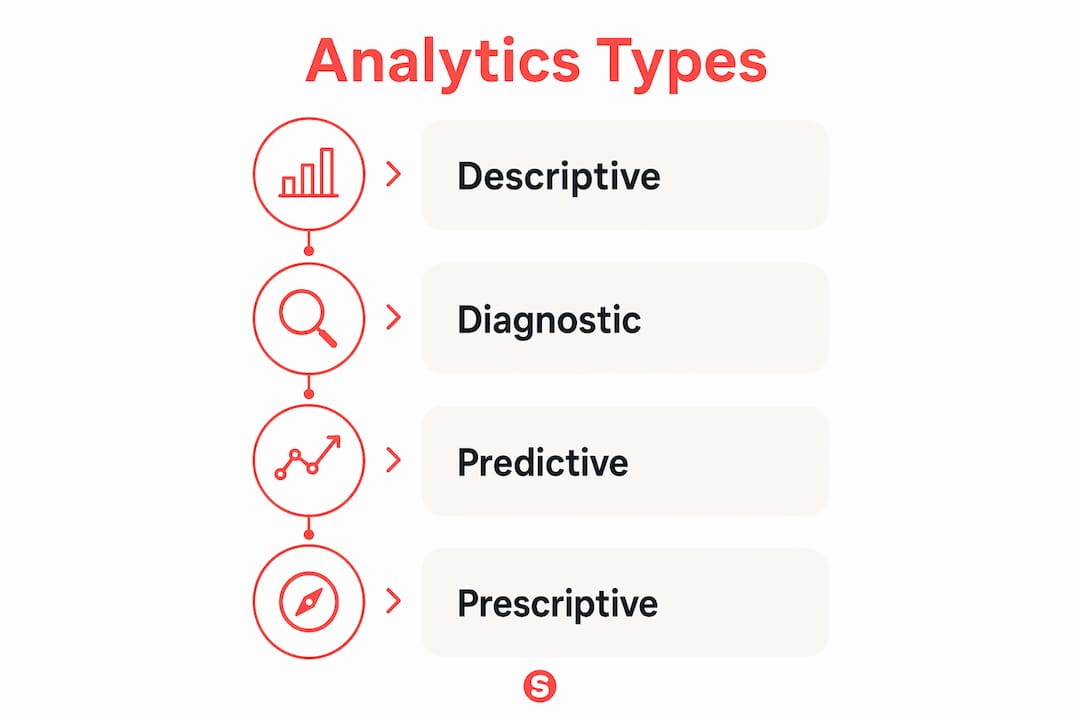
| Analytics type | Primary question | Common use case |
|---|---|---|
| Descriptive | What happened? | Monthly sales reports, campaign reach |
| Diagnostic | Why did it happen? | Drop in email open rates, churn analysis |
| Predictive | What will happen? | Demand forecasting, customer lifetime value |
| Prescriptive | What should we do? | Budget reallocation, offer personalization |
Key channels to track across the customer journey:
- Paid social and display ads
- Organic search and content performance
- Email open, click, and conversion rates
- Phone calls and reservation inquiries
- In-store foot traffic and transaction data
How is AI transforming marketing analytics in 2026?
AI compresses the insight-to-action cycle from days or weeks to minutes. That speed matters because customer behavior does not wait for your weekly reporting cycle. Real-time, sub-second data processing now triggers automated personalization based on what a customer is doing right now, not what they did last month. Batch reporting cycles are no longer sufficient for competitive marketing.
AI is most commonly applied to three areas: campaign optimization at 45%, performance analysis at 37%, and personalization at scale at 29%. Each application reduces manual work and increases the precision of marketing decisions. For a restaurant owner running promotions across email, social, and Google, AI can automatically shift budget toward the channel producing the best return in real time.
Practical AI applications in marketing analytics include:
- Copy variation testing: AI generates and tests multiple ad headlines simultaneously, selecting the best performer without waiting for a human review cycle.
- Audience segmentation: AI identifies micro-segments within your customer base based on behavior patterns, not just demographics.
- Automated budget allocation: Spend shifts dynamically toward top-performing channels based on live conversion data.
- Triggered messaging: A customer who abandons an online reservation receives a follow-up offer within minutes, not days.
Pro Tip: Never let AI outputs run without a human review layer. AI excels at pattern recognition and speed, but it cannot evaluate brand tone, ethical implications, or strategic fit. Set a weekly review cadence to audit AI-generated decisions and adjust parameters before small errors compound.
For restaurant marketers specifically, AI-driven engagement strategies show how these tools translate into real customer interactions and repeat visits.
What challenges exist in implementing marketing analytics?
Fragmented data is the most common reason marketing analytics fails to deliver results. When your CRM, ad platform, and website analytics tool do not communicate, you end up with three different versions of the truth. Disconnected tools cause inaccurate attribution and unreliable predictive models. You cannot make confident budget decisions when your data contradicts itself.
The solution is a Customer Data Platform, or CDP. A CDP pulls data from every source into a single, unified customer profile. It cleans duplicate records, resolves identity across devices, and creates a persistent view of each customer. CDPs are crucial for enabling accurate attribution, lifetime value modeling, and predictive analytics across campaigns.
| Data architecture | Attribution accuracy | Personalization capability | Budget efficiency |
|---|---|---|---|
| Fragmented (siloed tools) | Low, conflicting signals | Limited, demographic-based | Poor, budget misallocated |
| Unified (CDP-based) | High, cross-channel clarity | High, behavior-based | Strong, spend follows performance |
A second challenge is the analyst bottleneck. Analytics insights only create value when they are accessible to all marketing stakeholders, not just the data team. If your campaign manager has to submit a ticket to get a report, decisions slow down and opportunities pass. Self-service dashboards and shared data access solve this problem directly.
Pro Tip: Before investing in any analytics tool, audit your existing data sources. List every platform that collects customer data and check whether they share a common identifier like email address or phone number. If they do not, unification is your first priority, not adding more tools.
How can marketing teams apply analytics to improve decisions?
Start by defining your marketing goals in measurable terms. “Increase brand awareness” is not a goal analytics can support. “Increase first-time reservation bookings by 15% over 90 days” is. Every KPI you track should connect directly to a business outcome, not just a marketing metric.
Follow these steps to build an analytics-driven decision process:
- Define goals and KPIs. Set specific, time-bound targets for each campaign. Tie every metric to revenue, retention, or acquisition.
- Identify your best channels. Use historical data to rank channels by cost per acquisition and customer lifetime value. Invest more in what works, less in what does not.
- Optimize messaging and timing. Analytics reveals when your audience is most likely to engage. Send emails on Tuesday morning if that is when your open rates peak, not when it is convenient for your team.
- Personalize at the individual level. Use behavioral data to tailor offers. A customer who orders vegetarian dishes every visit should not receive a promotion for a meat-heavy special.
- Build a feedback loop. After every campaign, review what the data shows. Apply those findings to the next campaign. Advanced analytics improves decision-making accuracy when it is treated as a continuous learning system, not a one-time report.
The gap between organizations using real-time analytics and those still running batch processes is widening fast. Restaurants and local businesses that act on data within hours outperform those that review reports weekly. Analytics transforms restaurant marketing results when it moves from a reporting tool to a daily decision input.
Key Takeaways
Marketing analytics drives measurable revenue growth when it unifies data, applies AI-driven insights, and connects every campaign decision to a defined business outcome.
| Point | Details |
|---|---|
| Analytics types matter | Use descriptive, diagnostic, predictive, and prescriptive analytics together for full campaign insight. |
| AI accelerates decisions | AI compresses insight-to-action from days to minutes, enabling real-time personalization and budget shifts. |
| Unified data is non-negotiable | A CDP eliminates fragmented attribution and gives every team member a single, accurate customer view. |
| Offline data closes the gap | Tracking phone calls and in-store visits completes attribution that online metrics alone cannot provide. |
| Feedback loops compound gains | Applying analytics findings to each new campaign builds compounding improvement in ROI over time. |
The case for treating analytics as a strategic asset
I have watched marketing teams invest heavily in analytics tools and still make decisions based on instinct. The tools were not the problem. The problem was that data lived in analyst reports nobody else read. The moment analytics became a shared resource, accessible to campaign managers and business owners in real time, the quality of decisions changed overnight.
The hybrid decision architecture argument resonates with me because I have seen both extremes fail. Full AI automation without human oversight produces campaigns that are technically optimized but strategically wrong. Pure intuition without data produces campaigns that feel right but miss the mark on ROI. The winning approach combines AI precision with managerial judgment on brand, ethics, and long-term positioning.
Data paralysis is a real risk. When every metric is visible, it is tempting to keep analyzing instead of acting. My advice: pick three to five KPIs that directly reflect your business goals, trust your unified data, and move. Continuous optimization beats perfect planning every time. The organizations winning in 2026 are not the ones with the most data. They are the ones acting on it fastest.
— Barthelemy
How Sorbey puts analytics to work for your business
Running a restaurant means making dozens of marketing decisions every week, often without clear data to back them up. Sorbey changes that.
Sorbey’s marketing analytics services are built for local businesses that need clear, unified data without a dedicated analytics team. From tracking campaign performance across channels to identifying your highest-value customers, Sorbey connects the data dots so you can act with confidence. You can also start with Sorbey’s free marketing tools to calculate key metrics and test data-driven decisions before committing to a full strategy. Analytics should work for your business, not the other way around.
FAQ
What is marketing analytics?
Marketing analytics is the practice of collecting and analyzing data from marketing activities to measure performance and guide decisions. It covers channels, customer behavior, campaign ROI, and attribution across online and offline touchpoints.
How does analytics improve marketing ROI?
Analytics identifies which channels, messages, and timing produce the best results, so budget moves toward what works. Organizations using AI-driven analytics report revenue increases of 6%–10% within 12 months of adoption.
What is a Customer Data Platform and why does it matter?
A Customer Data Platform unifies data from CRM, ad platforms, and analytics tools into a single customer profile. It eliminates conflicting data signals and enables accurate attribution and personalization across every marketing channel.
How does real-time analytics differ from traditional reporting?
Real-time analytics processes data in sub-second intervals and triggers automated actions based on current customer behavior. Traditional batch reporting cycles of days or weeks cannot support the speed that competitive marketing now requires.
How can a restaurant use marketing analytics?
A restaurant can use analytics to track which promotions drive reservations, identify peak engagement times for email and social campaigns, and personalize offers based on individual order history and visit frequency.
Recommended
Potrebbe interessarti anche

Best Restaurant Loyalty Programs 2026: ROI Guide
Discover the best restaurant loyalty programs 2026 that boost repeat visits. Learn how Sorbey’s platform can transform your guest data strategy!

Why Mobile Marketing Matters for Business Growth
Discover why mobile marketing matters for business growth. Learn how optimizing for mobile drives traffic, conversions, and customer retention.

SF Dim Sum Restaurant Marketing Checklist for 2026
Transform your SF dim sum with our 2026 marketing checklist. Optimize your profile, showcase dishes, and attract customers fast!