
Blog
What Is Automated Marketing? Your 2026 Strategy Guide
Discover what automated marketing truly means and how it can boost your revenue. Explore our 2026 strategy guide for actionable insights!

What Is Automated Marketing? Your 2026 Strategy Guide
TL;DR:
- Automated marketing is a technology-driven system that personalizes and optimizes customer outreach across multiple channels without manual effort. It significantly increases revenue, improves lead management, and reduces marketing overhead through precise triggering and AI-driven adaptation. Successful implementation requires focused workflows, ongoing maintenance, and strategic oversight to ensure sustained performance.
Most business owners think automated marketing means scheduling a few emails and calling it a day. That’s a bit like thinking a commercial kitchen is just a microwave. What is automated marketing, really? It’s a technology-driven system that executes, personalizes, and optimizes your marketing across every channel without requiring your manual involvement at each step. And when done right, it doesn’t just save time. It compounds revenue. This guide breaks down how the technology works, what the 2026 numbers actually show, and how to implement it in a way that produces measurable results.
Table of Contents
- Key takeaways
- What is automated marketing, exactly
- The measurable business impact in 2026
- How automated marketing actually works
- Building an effective automated marketing strategy
- Real-world applications that deliver results
- My take on where automated marketing is actually headed
- How Sorbey helps your restaurant automate and grow
- FAQ
Key takeaways
| Point | Details |
|---|---|
| More than bulk email | Automated marketing covers email, SMS, social, web, and CRM workflows triggered by customer behavior. |
| Proven financial returns | Marketing automation delivers an average of $6.71 per $1 spent over three years. |
| AI changes the rules | Modern systems use behavioral signals to adapt content in real time, far beyond static drip sequences. |
| Start focused, not broad | High-impact workflows like welcome flows and cart recovery beat trying to automate everything at once. |
| Maintenance is non-negotiable | Database hygiene and workflow audits determine whether your automation performs or silently fails. |
What is automated marketing, exactly
Automated marketing is the use of software to execute marketing actions based on predefined rules, behavioral triggers, or AI-driven decisions, without a human manually initiating each action. Think of it as building a system that watches what your customers do and responds at exactly the right moment.
The core difference from manual marketing is timing and scale. A restaurant owner sending a birthday offer to every loyalty member by hand would take hours. An automated system does it for thousands of customers simultaneously, each triggered on their individual birthday, with no additional effort after setup.
The technology stack behind automated marketing typically includes four layers:
- Automated marketing tools such as email platforms, CRM systems, SMS gateways, and social schedulers
- Workflow automation engines that connect triggers (a customer views a page) to actions (send a follow-up SMS)
- Segmentation and lead scoring logic that sorts contacts by behavior, demographics, or engagement level
- Analytics and reporting that feed performance data back into the system for optimization
The types of automated marketing span nearly every channel. Email remains the highest-volume channel, but modern programs also cover SMS, push notifications, paid ad retargeting, website personalization, and social media sequences. The unifying principle across all of them is the same: your marketing responds to customer behavior instead of running on a fixed broadcast schedule.
Pro Tip: Don’t confuse automation with volume. The goal isn’t to send more messages. It’s to send the right message at the moment your customer is most receptive.
The measurable business impact in 2026
The financial case for automated marketing is not theoretical. The numbers are specific and consistent across multiple data sources.
| Metric | Result |
|---|---|
| ROI over 3 years | 544% average |
| Return per $1 spent | $6.71 |
| First-year ROI | 478% |
| Lead volume increase | 80% more leads |
| Nurtured lead conversion | 77% higher rate |
| Marketing overhead reduction | 12.2% to 35% |
| Sales productivity increase | 14.5% |
Automated emails generate 320% more revenue than non-automated emails, despite making up a small fraction of total email volume. That ratio tells you something critical: it’s not the quantity of messages that drives revenue. It’s the precision of the trigger.
On the operational side, automation saves 6+ hours weekly per marketer on routine tasks. For a lean team at a local restaurant or small business, that’s the difference between actually executing a content strategy and spending your week copy-pasting customer names into email drafts.

Lead management improvements are equally significant. Marketing automation improves lead volume by 80% and increases conversion rates on nurtured leads by 77%, while reducing lead decay by 32%. Lead decay, the silent killer of most sales pipelines, happens when a prospect shows interest and then gets no follow-up because your team is busy. Automation closes that gap automatically.
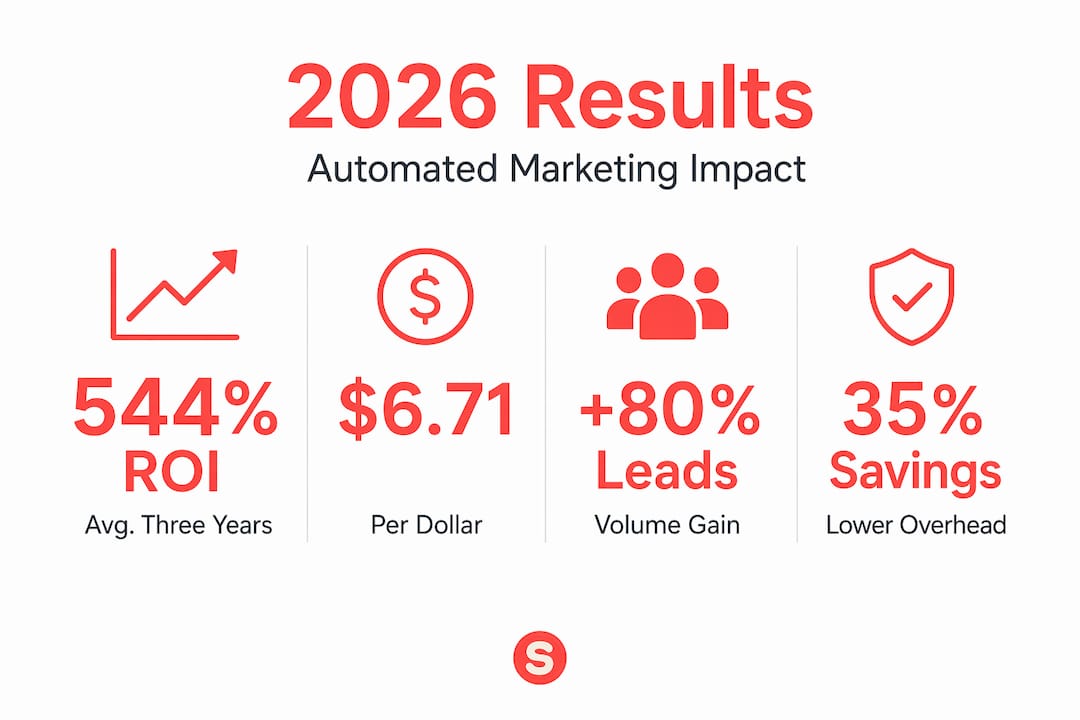
The efficiency gains also go beyond just time. Marketing automation reduces marketing overhead by 12.2% to 35% and increases sales productivity by 14.5%. For restaurants working with tight margins, that reduction in overhead is real money staying in the business.
How automated marketing actually works
Understanding how automated marketing works requires separating two generations of the technology. They are fundamentally different in capability.
Traditional rule-based automation
The first generation operates on an “if this, then that” logic. A customer subscribes to your email list, so they enter a welcome sequence. They haven’t visited in 30 days, so a re-engagement email fires. They abandon a cart, so a recovery email sends two hours later. These workflows are effective, predictable, and still widely used. The limitation is that they treat every customer in the same segment identically, regardless of real-time context.
AI-powered adaptive automation
The second generation is where the technology gets genuinely powerful. The shift from static rule-based automation to AI-powered adaptive systems enables real-time personalization at scale. Instead of sending the same re-engagement email to all inactive customers, an AI-powered system analyzes each customer’s past behavior, preferred channel, time-of-day engagement patterns, and purchase history to determine the best message, channel, and send time for that individual.
For a restaurant, this could mean that one inactive customer receives an SMS on a Friday afternoon with a weekend promotion because that’s when they historically engage. Another receives an email on Tuesday morning because that’s when they open. Same goal, completely different execution, all handled without manual intervention.
Pro Tip: Behavioral triggers outperform time-based triggers by aligning communication with actual customer intent. Prioritize “customer visited your website” over “30 days since last purchase” wherever your data allows.
The practical workflow for most businesses combines both generations. You build foundational rule-based sequences for predictable moments like onboarding, birthdays, and post-purchase follow-ups. Then you layer AI optimization on top to improve timing, subject lines, and channel selection using live performance data.
Building an effective automated marketing strategy
Knowing what automated marketing is matters less than knowing how to implement it without wasting months setting up workflows that underperform. Here’s the sequencing that actually works.
-
Define the goal before touching any software. Are you trying to increase repeat visits, reduce churn, convert new subscribers into first-time buyers, or recover abandoned reservations? Each goal maps to a different type of automated marketing strategy.
-
Start with two or three high-impact workflows. Marketing automation implementations succeed best when starting with focused workflows rather than attempting to automate the entire funnel at once. Welcome sequences, cart or booking abandonment flows, and win-back campaigns consistently deliver the highest ROI per hour invested.
-
Segment by behavior, not just demographics. A customer who has visited five times in 60 days should receive entirely different messaging than someone who came once six months ago. Behavioral segmentation produces sharper results than age or location data alone.
-
Audit your workflows every 90 days. Marketing automation requires ongoing maintenance like database hygiene and workflow auditing to prevent failures. Dead email addresses, outdated offers, and broken API connections silently destroy your deliverability and engagement rates over time.
-
Avoid over-segmentation. Avoid over-segmentation and prefer behavioral triggers over static time-based triggers. Creating 40 micro-segments before you have enough data to fill them means most of your workflows will fire infrequently and give you no meaningful performance signal.
-
Treat AI as a collaborator, not a replacement. AI should augment human marketers by handling execution while humans focus on strategy and creative development. Your automation tools should free you to think about the offer, the story, and the customer relationship. Not replace your judgment about those things.
Real-world applications that deliver results
The most useful way to understand automated marketing strategies is to see them at the specific workflow level. Here’s where businesses consistently see the clearest returns.
-
Welcome flows set the tone for every new relationship. A three-part email sequence over the first week, timed to when new subscribers actually open their emails, produces dramatically higher first-purchase rates than a single welcome email sent immediately after signup.
-
Post-visit feedback requests sent 24 hours after a restaurant visit, triggered automatically by a POS integration or reservation system, generate review volume that directly improves local search rankings without any manual outreach.
-
Cart or reservation abandonment flows are among the highest-ROI workflows any business can build. A guest who looked at your reservation page and left is already interested. An automated follow-up three hours later captures a measurable percentage of those near-conversions.
-
Cross-channel re-engagement sequences use the fact that some customers respond to email, others to SMS, and others to retargeted ads. An automated strategy tests across channels and routes each customer to their preferred one rather than defaulting to a single channel for everyone.
-
Automated lead scoring and routing aligns sales and marketing by automatically advancing high-intent leads to direct outreach while keeping lower-intent contacts in nurture sequences. This prevents your team from spending time on cold leads while hot ones go uncontacted.
On the technical side, maintaining email deliverability now requires automation because mailbox providers have tightened filtering rules to the point where manual broadcast sending frequently triggers spam classification. Automation handles sending cadence, authentication, and list hygiene in ways that manual tools simply cannot match at scale.
My take on where automated marketing is actually headed
I’ve watched a lot of businesses set up marketing automation and then wonder why it’s underperforming six months later. The pattern is almost always the same. They treated it as a setup project rather than an ongoing practice. You build the workflows, and then you walk away. The results slowly degrade and nobody notices until the numbers are significantly worse.
What I’ve learned is that automation handles execution brilliantly and handles strategy not at all. The moment you let the technology make your strategic calls, things go sideways. Your AI can determine the best send time for a promotional email. It cannot determine whether that promotion is the right offer for your brand at this moment in your customer relationship. That judgment belongs to you.
The other thing worth saying directly: personalization at scale sounds like a technical achievement, but the businesses I’ve seen do it well treat it as a human achievement enabled by technology. They know their customers. They’ve thought carefully about what those customers actually want to hear. The automation just delivers that thinking at scale and at the right moment. You can explore how AI drives engagement at the operational level, but the creative brief still starts with a person who understands the audience.
The role of the marketer isn’t shrinking because of automation. It’s shifting. Less execution. More thinking about what the customer actually needs next.
— Barthelemy
How Sorbey helps your restaurant automate and grow
If you run a restaurant or local food business, the gap between knowing what automated marketing is and actually running it well is where most operators get stuck. Sorbey is built specifically for that gap. The platform brings email, SMS, review management, and AI-powered customer engagement into one place, designed for restaurant teams who don’t have a dedicated marketing department.
You can see what results look like in practice by reading the Crème Restaurant case study, where a Paris restaurant achieved a 162% increase in Google Maps views using Sorbey’s marketing automation. And if you’re ready to see what’s available for your business, the full breakdown of restaurant marketing services covers every tool Sorbey offers, from automated campaigns to local SEO and analytics.
FAQ
What is automated marketing in simple terms?
Automated marketing uses software to send the right message to the right customer at the right time, without manual effort for each action. It works by connecting customer behavior to predefined or AI-driven responses across email, SMS, and other channels.
How does automated marketing work for restaurants?
A restaurant automation system connects your reservation platform, POS, or loyalty program to a marketing tool. When a customer books, visits, or goes inactive, the system automatically sends a relevant message such as a confirmation, a review request, or a win-back offer.
What are the main benefits of automated marketing?
Marketing automation delivers an average ROI of 544% over three years, reduces marketing overhead by up to 35%, and increases nurtured lead conversion rates by 77%. For local businesses, the biggest day-to-day benefit is recovering time spent on repetitive manual tasks.
What types of automated marketing should I start with?
Start with welcome sequences, post-visit follow-ups, and abandonment flows. These three workflows consistently generate the highest returns and give you performance data quickly enough to refine your broader automated marketing strategies before scaling further.
Do I need a large team to use automated marketing tools?
No. Modern automated marketing tools are designed for small teams and single operators. The setup requires time upfront, but once your core workflows are running, a single person can manage a mature automation program in a few hours per week.
Recommended
Potrebbe interessarti anche

Best Restaurant Loyalty Programs 2026: ROI Guide
Discover the best restaurant loyalty programs 2026 that boost repeat visits. Learn how Sorbey’s platform can transform your guest data strategy!

Why Mobile Marketing Matters for Business Growth
Discover why mobile marketing matters for business growth. Learn how optimizing for mobile drives traffic, conversions, and customer retention.

SF Dim Sum Restaurant Marketing Checklist for 2026
Transform your SF dim sum with our 2026 marketing checklist. Optimize your profile, showcase dishes, and attract customers fast!