
Blog
What Is Content Marketing? A 2026 Strategy Guide
Discover what is content marketing and how to use it effectively. Learn strategies and benefits for building a successful content program.

What Is Content Marketing? A 2026 Strategy Guide
TL;DR:
- Content marketing involves creating valuable content to attract and retain customers through trusted relationships. It is a long-term strategy that relies on organic reach and consistent promotion across digital channels. For local businesses, integrating content into their marketing systems boosts brand authority, loyalty, and sustained traffic.
Content marketing is defined as the strategic creation and distribution of valuable, relevant, and consistent content to attract and retain a clearly defined audience and drive profitable customer action. Unlike traditional advertising, it builds trust before asking for a sale. For marketing professionals and business owners, understanding what is content marketing means understanding the engine behind modern brand growth. This guide breaks down the core formats, strategies, and measurable benefits so you can build a content program that actually works.
What is content marketing and how does it work?

Content marketing is a pull strategy that attracts customers by providing helpful, relevant content rather than pushing ads at them. That distinction matters because it changes the entire relationship between brand and buyer. Instead of interrupting someone’s day, you earn their attention by solving a problem or answering a question they already have.
Asana defines content marketing as a key component of inbound marketing, emphasizing attraction through information rather than intrusive advertising. Loyola University’s academic perspective reinforces this: content marketing creates meaningful relationships where brand values align with customer values, building loyalty over time. Both definitions point to the same truth. The goal is not a single transaction. It is a long-term relationship built on trust.
Content marketing also sits at the center of what is digital marketing more broadly. Every channel, from search to social to email, needs content to function. Without it, you have distribution infrastructure and nothing worth distributing.
How does content marketing differ from traditional advertising?
Traditional advertising pushes a message at an audience. Content marketing pulls an audience toward a brand by giving them something worth their time. That philosophical difference produces very different results in terms of trust, loyalty, and long-term brand authority.
Here is where the confusion often starts for business owners:
- Traditional advertising interrupts. A TV spot, a banner ad, or a paid search placement appears whether the viewer wants it or not.
- Content marketing earns attention. A well-written restaurant guide, a how-to video, or a weekly newsletter appears because someone sought it out or subscribed.
- Social media marketing is a channel, not a tactic. You can run paid ads on Instagram or publish organic content there. Content marketing is what you put on that channel.
- Native advertising looks like content but is paid placement. True content marketing relies on organic discovery and the intrinsic value of the content itself, not constant paid promotion.
Content marketing also functions as the fuel within digital marketing, providing the valuable substance that powers channels like search engine marketing and social media for brand building and lead generation. Remove the content, and those channels run dry.
Pro Tip: If your content only makes sense when you pay to promote it, it is not content marketing. Real content marketing earns organic reach because it genuinely helps people.
What types of content marketing formats work best?
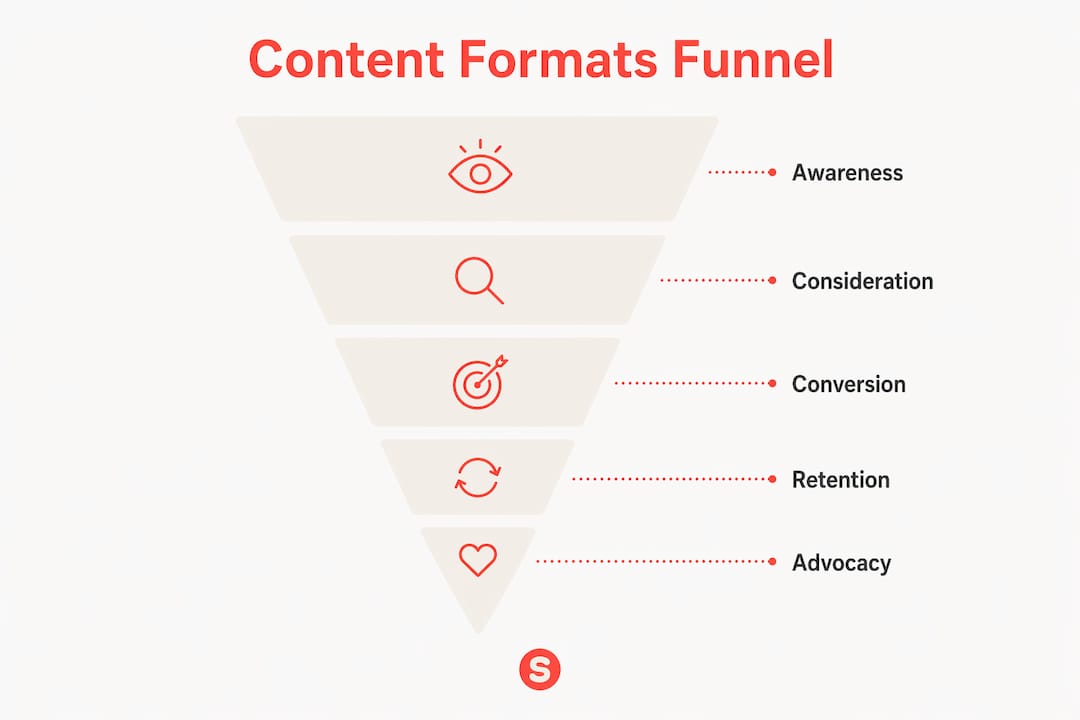
The most effective content marketing formats in 2026 include educational blogs, long-form guides, videos, newsletters, podcasts, and interactive assets like quizzes. Each format serves a different stage of the buyer’s journey, from first awareness all the way to a purchase decision.
Formats by funnel stage
| Format | Funnel stage | Primary goal |
|---|---|---|
| Blog posts and guides | Awareness | Drive organic search traffic |
| Videos and podcasts | Consideration | Build trust and demonstrate expertise |
| Email newsletters | Consideration to decision | Nurture leads and deepen loyalty |
| Quizzes and interactive tools | Decision | Personalize the experience and qualify buyers |
| Case studies and testimonials | Decision | Reduce purchase hesitation |
Interactive content has emerged as a high-engagement format in 2026. Quizzes, assessments, and calculators move prospects from passive reading to active participation. That shift in behavior signals stronger intent and produces more qualified leads than static content alone.
For local businesses like restaurants, video content is particularly powerful. A 60-second behind-the-scenes kitchen video or a chef’s recipe walkthrough builds the kind of personal connection that a menu page never could. Food businesses that publish educational content about their cuisine, sourcing, or culture also benefit from the growing interest in food and hospitality storytelling, which positions them as authorities in their local market.
Email newsletters deserve special mention. They represent a direct, owned channel where you are not subject to algorithm changes. A consistent newsletter builds a subscriber base that belongs to your brand, not to a platform.
How to do content marketing: strategy and best practices
A content marketing strategy is a documented plan that defines your audience, your content formats, your distribution channels, and the metrics you will use to measure success. Without that plan, content production becomes random and expensive.
Follow these steps to build a strategy that produces results:
- Define your audience clearly. Know their questions, pain points, and the language they use. A restaurant owner targeting lunch crowds in a business district needs different content than one targeting weekend families.
- Map content to the buyer’s journey. Awareness content answers broad questions. Consideration content compares options. Decision content removes the final objection.
- Choose your primary formats. Start with one or two formats you can produce consistently. Consistency beats volume every time.
- Build a distribution plan before you publish. Investing at least 50% of marketing time in content distribution is critical for success. Publishing without promoting is the single biggest mistake beginners make.
- Measure engagement, not just traffic. Time on page, scroll depth, newsletter sign-ups, and return visits tell you more about content quality than raw page views.
- Iterate based on data. Producing content without measuring performance against business goals leads to wasted effort. Review your metrics monthly and adjust your topics and formats accordingly.
Pro Tip: Successful content marketers focus on answering audience questions rather than selling directly. Write the article your ideal customer is already searching for, and the sale follows naturally.
The “build it and they will come” mentality kills more content programs than any other mistake. Great content without a distribution strategy sits unread. Your SEO, social media, and email channels must work together to get content in front of the right people at the right time. A restaurant content marketing workflow that integrates all three channels consistently outperforms one that relies on a single channel.
Why does content marketing matter for brand awareness and loyalty?
Content marketing builds brand authority and trust, which drives audience engagement and customer loyalty. The return on investment should be measured by engagement depth and subscription growth before revenue outcomes. That sequencing is not a compromise. It is the correct order of operations.
Here is what consistent content marketing produces over time:
- Brand authority. Publishing expert content on a topic positions your business as the go-to source. Customers trust brands that teach them something.
- Organic search visibility. Search engines reward consistent, high-quality content with higher rankings. Higher rankings mean free, recurring traffic.
- Audience loyalty. A reader who has consumed ten of your articles or watched five of your videos is far more likely to buy than someone who saw a single ad.
- Lower customer acquisition cost. Organic content compounds over time. A blog post written today can generate leads for years without additional spend.
“Content marketing is about creating meaningful relationships with consumers where brand values align with customer values, fostering loyalty that outlasts any single campaign or promotion.” — Loyola University
The importance of content marketing becomes clearest when you compare it to paid advertising over a 12-month period. Ad spend stops producing results the moment you stop paying. Content assets, from a well-ranked article to a popular video series, continue generating traffic and trust long after creation costs are recovered. For local businesses operating on tight marketing budgets, that compounding effect is the most powerful financial argument for content marketing.
Key Takeaways
Content marketing is a long-term pull strategy that builds brand authority, audience trust, and customer loyalty through consistent, valuable content rather than interruptive advertising.
| Point | Details |
|---|---|
| Core definition | Content marketing attracts audiences through valuable content, not paid interruptions. |
| Distribution is non-negotiable | Spend at least half your marketing effort promoting content, not just creating it. |
| Format choice matters | Match content formats to funnel stages: blogs for awareness, newsletters for nurture, quizzes for decisions. |
| Measure engagement first | Track scroll depth, time on page, and newsletter sign-ups before focusing on revenue metrics. |
| Long-term compounding value | Content assets generate traffic and leads for years, unlike paid ads that stop when spend stops. |
Content marketing is a long game, and that is the point
Most business owners I talk to want content marketing to work like a paid ad. They publish three blog posts, see no spike in sales, and conclude it does not work. That conclusion is wrong, and it costs them years of compounding brand equity.
Content marketing is a long-term investment. The brands that win with it are the ones that commit to a 12-month plan before they expect results. I have seen restaurants go from zero organic traffic to a steady stream of new diners simply by publishing one well-researched local guide per month and promoting it consistently through email and social. No ad budget required.
The other mistake I see constantly is treating content as separate from the rest of digital marketing. Content is not a standalone tactic. It is the substance that makes every other channel work better. Your SEO needs it. Your email program needs it. Your social media needs it. When you integrate content across all channels with a clear measurement plan, the results compound faster than any single-channel approach ever could.
The professionals who get the most from content marketing are the ones who treat it like a product. They research their audience, test formats, measure results, and improve every quarter. That discipline, more than any single piece of content, is what separates brands that grow from brands that stall.
— Barthelemy
How Sorbey helps local businesses with content marketing
Content marketing works best when it is built into a complete marketing system, not treated as an afterthought.
Sorbey is an all-in-one marketing platform built specifically for local businesses like restaurants. It handles content strategy, creation, and distribution across the channels that matter most for local visibility. From restaurant-specific content tips to full campaign management, Sorbey gives business owners the tools to build real audience relationships without needing a full marketing team. If you are ready to put a real content strategy behind your brand, explore Sorbey’s marketing services and see how a structured approach changes your results.
FAQ
What is content marketing in simple terms?
Content marketing is the practice of creating and sharing useful content to attract and keep customers. Instead of running ads, you publish articles, videos, or guides that answer your audience’s questions and build trust over time.
How does content marketing differ from social media marketing?
Social media marketing is a distribution channel. Content marketing is the strategy and material you use on that channel. You can run paid ads on social media or publish organic content there. Content marketing defines what you create and why.
What are the main benefits of content marketing?
Content marketing builds brand authority, improves organic search rankings, and creates customer loyalty that outlasts any single campaign. Unlike paid ads, content assets continue generating traffic and leads long after the initial creation cost.
How long does content marketing take to show results?
Content marketing typically takes 6–12 months of consistent effort before producing measurable organic growth. Distribution strategy and content quality both affect how quickly results appear.
What types of content marketing work best for local businesses?
Local businesses see strong results from educational blog posts, short-form videos, and email newsletters. Restaurant-specific formats like recipe guides, behind-the-scenes videos, and local food trend coverage are particularly effective for building community and driving repeat visits.
Recommended
- What Is Automated Marketing? Your 2026 Strategy Guide | Sorbey Blog | Sorbey
- The Role of Analytics in Marketing: 2026 Guide | Sorbey Blog | Sorbey
- Content marketing tips for restaurants: attract more local diners | Sorbey Blog | Sorbey
- What Is Community Marketing? A Guide for Brands | Sorbey Blog | Sorbey
Potrebbe interessarti anche

Best Restaurant Loyalty Programs 2026: ROI Guide
Discover the best restaurant loyalty programs 2026 that boost repeat visits. Learn how Sorbey’s platform can transform your guest data strategy!

Why Mobile Marketing Matters for Business Growth
Discover why mobile marketing matters for business growth. Learn how optimizing for mobile drives traffic, conversions, and customer retention.

SF Dim Sum Restaurant Marketing Checklist for 2026
Transform your SF dim sum with our 2026 marketing checklist. Optimize your profile, showcase dishes, and attract customers fast!