
Blog
What Is Event-Based Marketing? A 2026 Strategy Guide
Discover what event-based marketing is and how it boosts engagement and revenue. Learn to react in real-time and enhance your strategies.

What Is Event-Based Marketing? A 2026 Strategy Guide
TL;DR:
- Event-based marketing sends personalized messages instantly triggered by customer actions, improving response relevance. It relies on real-time data, integrating multiple sources to deliver timely, targeted communication. Most businesses can implement it cost-effectively and see faster deal closures and stronger customer loyalty.
Event-based marketing is the practice of sending personalized messages triggered instantly by specific user behaviors, not by fixed schedules. A customer abandons a cart, signs up for a newsletter, or attends a live tasting event, and your marketing system responds in real time. This approach is also called event-driven marketing in the industry, and the distinction matters: you are reacting to what a customer just did, not guessing what they might want next week. For marketing professionals and business owners, understanding what is event-based marketing means understanding how to turn customer behavior into revenue, faster and more reliably than traditional campaigns allow.
What is event-based marketing and how does it work?
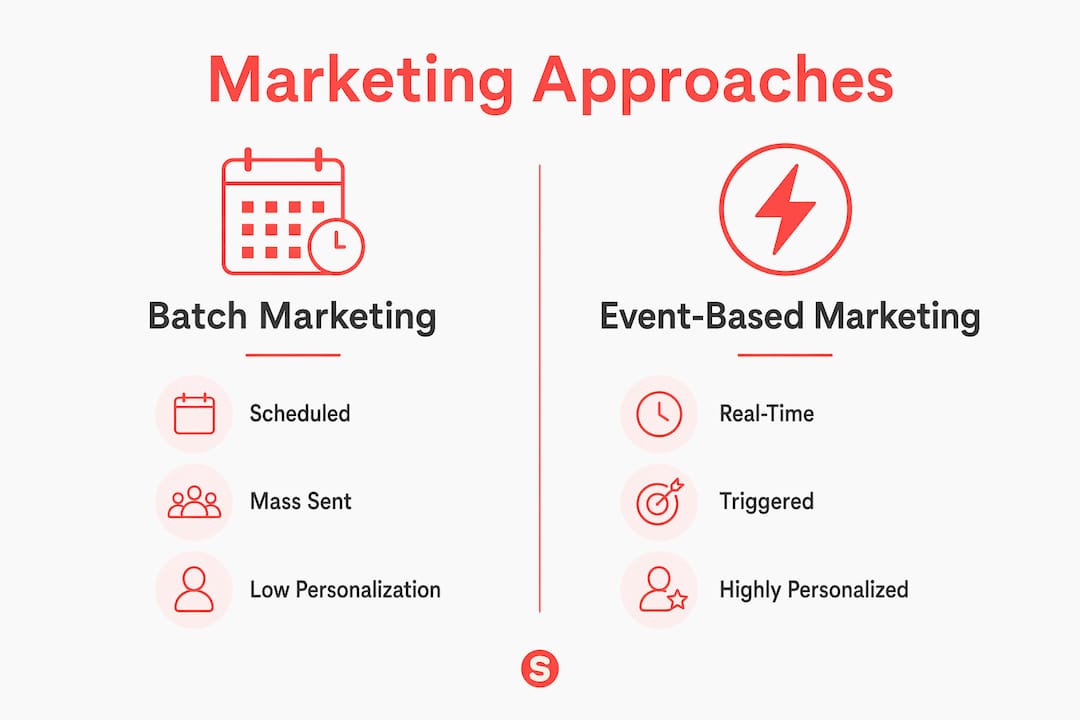
Event-based marketing is defined by real-time triggers that fire personalized messages the moment a user completes a specific action. Those actions, called “events,” include signups, feature usage, cart abandonments, purchase completions, and loyalty milestone hits. The system detects the event, matches it to a predefined workflow, and delivers the message before the moment passes.

The mechanics depend on real-time data ingestion. Traditional batch marketing collects user data overnight and sends campaigns the next morning. Event-driven marketing processes that data the instant it arrives. That difference in timing is the entire competitive advantage. A message sent within minutes of a cart abandonment converts at a far higher rate than one sent 24 hours later.
Centralized data integration is what makes accurate triggers possible. Accurate trigger context requires pulling behavioral signals from your CRM, ERP, and analytics platforms into a single system. Without that integration, your triggers fire on incomplete data, and you send the wrong message at the wrong time. That damages trust faster than sending no message at all.
- Signup or registration: Welcome sequence fires immediately, while intent is highest.
- Cart abandonment: Reminder sent within the first hour, when purchase intent is still active.
- Feature usage milestone: Congratulatory message reinforces product value and encourages deeper engagement.
- Inactivity trigger: Re-engagement message fires after a defined period of silence.
- Purchase completion: Upsell or loyalty reward message follows the transaction.
Pro Tip: Map your top five customer actions before building any trigger workflow. Knowing which events carry the most revenue intent lets you prioritize the triggers that move the needle first.
What are the key benefits of event-based marketing?
The business case for event-driven marketing is backed by clear numbers. 72% of marketers report that deals close faster when prospects attend events, and 74% can trace pipeline revenue directly to event touchpoints. Those figures tell you that events are not just awareness plays. They are closing tools.
The benefits extend beyond speed. Event-based marketing reduces message fatigue because customers only receive communications that are directly relevant to what they just did. A guest who just booked a reservation does not need a “come visit us” email. They need a confirmation, a menu preview, and a parking tip. Relevance at that level builds loyalty, not just transactions.
“88% of marketers practicing Event-Led Growth report steady event-driven revenue, and 46% say events contribute to over 40% of their closed-won deals.”
This is not a niche tactic. Event-Led Growth (ELG) is now a primary revenue strategy for marketers who want predictable pipeline, not just campaign spikes.
Live and in-person events add a layer that digital channels cannot replicate. Face-to-face experiences build deeper customer trust and create brand credibility that no email sequence can manufacture. A restaurant hosting a chef’s table dinner or a cooking class gives guests a memory tied directly to the brand. That memory influences every future purchase decision.
Focused audience attention at live or virtual events also creates a brand moment that outperforms traditional digital ads. Attendees choose to be there. That active participation improves brand recall and strengthens the customer relationship in ways that passive ad exposure never will. For local businesses especially, that distinction is the difference between a one-time visitor and a regular.
Best practices for implementing an event marketing strategy
A strong event marketing strategy starts with trigger selection. Not every user action deserves a marketing response. Focus on events that signal clear intent: a purchase, a repeat visit, a loyalty tier upgrade, or a direct inquiry. Responding to low-intent signals with aggressive messaging trains customers to ignore you.
- Define your trigger hierarchy. Rank events by revenue intent. High-intent triggers (cart abandonment, booking confirmation) get immediate responses. Low-intent triggers (page views, email opens) get batched into weekly digests or suppressed entirely.
- Audit your triggers every 90 days. Over-automation without human context causes customer annoyance. A trigger that worked in january may feel invasive by april if customer behavior has shifted. Regular audits keep your cadence aligned with actual customer expectations.
- Integrate your data sources before you build workflows. Missing or inconsistent data undermines trigger relevance and effectiveness. Connect your CRM, point-of-sale system, and email platform before you write a single trigger rule.
- Blend digital triggers with live event touchpoints. A customer who attends your in-person event and then receives a personalized follow-up email within two hours experiences a level of care that competitors rarely match. The combination of live experience and timely digital follow-up is where audience engagement strategies produce the strongest long-term results.
- Set message frequency caps. Even perfectly timed triggers become noise if a customer receives five messages in one day. Cap the number of automated messages per customer per 24-hour window, and build suppression logic for customers who have already converted.
Pro Tip: Start with three triggers only: a welcome event, a purchase confirmation, and a re-engagement trigger for customers inactive for 30 days. Master those before adding complexity.
How does event-based marketing compare to batch and trigger marketing?
Understanding the differences between these three approaches helps you choose the right method for each situation. They are not interchangeable, and using the wrong one costs you conversions.
Batch marketing sends the same message to a large segment on a fixed schedule. A weekly newsletter goes to everyone on your list every Tuesday at 10:00 AM, regardless of what any individual did that week. It is easy to manage and works well for brand awareness and content distribution. The limitation is relevance. Batch campaigns cannot respond to individual behavior, so they generate lower engagement rates and higher unsubscribe rates over time.
Trigger marketing is a step up. A trigger email fires when a user completes a specific action, like clicking a link or making a purchase. Most email platforms support basic trigger logic. The gap between trigger marketing and true event-based marketing is depth. Trigger marketing typically uses a single data point to fire a single email. Event-driven marketing uses multiple behavioral signals from integrated data sources to fire a coordinated, multi-channel response.
| Feature | Batch marketing | Trigger marketing | Event-based marketing |
|---|---|---|---|
| Timing | Scheduled | Action-based | Real-time |
| Personalization | Segment-level | Basic individual | Deep behavioral |
| Data sources | Single list | Single trigger point | CRM, ERP, analytics |
| Complexity | Low | Medium | High |
| Conversion potential | Lower | Medium | Highest |
| Best use case | Brand awareness | Simple follow-ups | Full customer lifecycle |
The table makes the trade-offs clear. Batch marketing is the easiest to run but the least effective at driving individual conversions. Event-based marketing requires the most setup but delivers the strongest results across the customer lifecycle. Most businesses benefit from running all three in parallel, using each method where it fits best.
Key Takeaways
Event-based marketing drives faster deal closures and more reliable revenue by responding to customer behavior in real time rather than on a fixed schedule.
| Point | Details |
|---|---|
| Real-time triggers win | Messages sent immediately after a user action convert far better than scheduled batch campaigns. |
| Data integration is non-negotiable | Connecting your CRM, ERP, and analytics is what makes accurate, relevant triggers possible. |
| Human oversight prevents fatigue | Audit triggers every 90 days to keep messaging timely and avoid annoying customers with over-automation. |
| Live events accelerate pipeline | 72% of marketers report faster deal closures when prospects attend events, making live touchpoints a revenue tool. |
| Blend digital and live tactics | Combining behavioral triggers with in-person events produces the strongest long-term customer relationships. |
Why I think most businesses underestimate event-based marketing
Most marketing professionals I talk to treat event-based marketing as an advanced tactic reserved for large tech companies with big data teams. That assumption is wrong, and it is costing local businesses real revenue.
The core principle is simple: respond to what your customer just did, and respond fast. A restaurant that texts a loyalty reward within five minutes of a guest’s third visit does not need a sophisticated data warehouse to pull that off. It needs the right system and the discipline to set it up correctly.
What I have seen trip up even experienced marketers is the over-automation trap. They build 20 triggers in the first month, and within 90 days, customers are unsubscribing in bulk. The fix is not fewer triggers. The fix is smarter auditing. Authenticity in branding matters here too. Customers can tell when a message was written by a human who cared versus a workflow that fired because a checkbox got ticked. That difference shows up in your open rates.
The other mistake I see constantly is treating live events as separate from digital marketing. They are the same strategy. A cooking class, a wine pairing dinner, or a community pop-up is a behavioral event. Every guest who attends gives you a signal about their preferences, their spending level, and their loyalty potential. If you are not capturing that signal and following up with a personalized digital message within hours, you are leaving the most valuable part of the event on the table.
My honest recommendation: start small, measure everything, and treat every customer action as a data point worth responding to. The businesses that win with event-driven marketing are not the ones with the biggest budgets. They are the ones who pay the closest attention.
— Barthelemy
How Sorbey helps local businesses run event-based marketing
Running a coordinated event marketing strategy takes more than good intentions. It takes the right tools, clean data, and a system that connects your in-person events to your digital follow-ups without gaps.
Sorbey is built for local businesses, including restaurants, that want to run marketing like a professional operation without hiring a full agency. From restaurant event marketing with proven ROI to automated follow-up sequences that turn one-time guests into regulars, Sorbey handles the execution so you can focus on the experience. Explore Sorbey’s marketing services to see how event-driven tactics can fit into your current marketing mix and start generating measurable pipeline from every customer interaction.
FAQ
What is event-based marketing in simple terms?
Event-based marketing sends personalized messages triggered by specific customer actions, like a signup or purchase, rather than on a fixed schedule. The goal is to respond to what a customer just did while the moment is still relevant.
How does event-based marketing differ from email automation?
Standard email automation fires messages based on time delays after a single trigger point. Event-based marketing uses real-time behavioral data from multiple sources, such as CRM and point-of-sale systems, to fire coordinated, multi-channel responses.
What are common examples of marketing events?
Common events include cart abandonments, new account signups, loyalty milestone completions, in-person event attendance, and repeat purchase triggers. Each signals a specific level of customer intent that warrants a tailored response.
Why does event-based marketing close deals faster?
72% of marketers report faster deal closures when prospects attend events because live and timely digital touchpoints create trust and relevance that generic campaigns cannot match.
How many triggers should I start with?
Start with three: a welcome trigger, a purchase confirmation, and a 30-day re-engagement message. Master those before expanding, since over-automation without regular auditing is the most common reason event-based programs fail.
Recommended
- What Is Automated Marketing? Your 2026 Strategy Guide | Sorbey Blog | Sorbey
- The Role of Analytics in Marketing: 2026 Guide | Sorbey Blog | Sorbey
- Restaurant marketing trends for explosive growth in 2026 | Sorbey Blog | Sorbey
- The Real Role of Event Marketing for Growth in 2026 | Sorbey Blog | Sorbey
Potrebbe interessarti anche

Best Restaurant Loyalty Programs 2026: ROI Guide
Discover the best restaurant loyalty programs 2026 that boost repeat visits. Learn how Sorbey’s platform can transform your guest data strategy!

Why Mobile Marketing Matters for Business Growth
Discover why mobile marketing matters for business growth. Learn how optimizing for mobile drives traffic, conversions, and customer retention.

SF Dim Sum Restaurant Marketing Checklist for 2026
Transform your SF dim sum with our 2026 marketing checklist. Optimize your profile, showcase dishes, and attract customers fast!