
Blog
What Is Proximity Marketing? A Guide for Restaurants
Discover what proximity marketing is and how it can boost foot traffic for your restaurant. Unlock personalized offers to attract customers!

What Is Proximity Marketing? A Guide for Restaurants
TL;DR:
- Proximity marketing delivers targeted, location-based messages to customers when they are near a specific place. It uses technologies like beacons, NFC, geofencing, and Wi-Fi to trigger personalized content at the right moment. Its effectiveness depends on app adoption, relevant messaging, and respecting customer privacy to build trust.
Proximity marketing is the practice of sending personalized, location-based messages to customers when they are physically near a specific place. It uses technologies like BLE beacons, NFC, geofencing, and Wi-Fi to deliver targeted content at the exact moment a customer is most likely to act. For restaurant owners and marketing professionals, that moment is everything. A well-timed offer when someone walks past your door converts far better than a generic email sent at noon on a Tuesday. This guide breaks down how proximity marketing works, why it drives foot traffic, and how to put it to work for your business.
What is proximity marketing and how does it work?
Proximity marketing is a granular subset of location-based marketing that uses physical hardware to trigger messages based on where a customer stands at a given moment. Standard location-based marketing relies on GPS, which works well outdoors but fails inside a building. Proximity marketing fills that gap with hardware that works at close range.
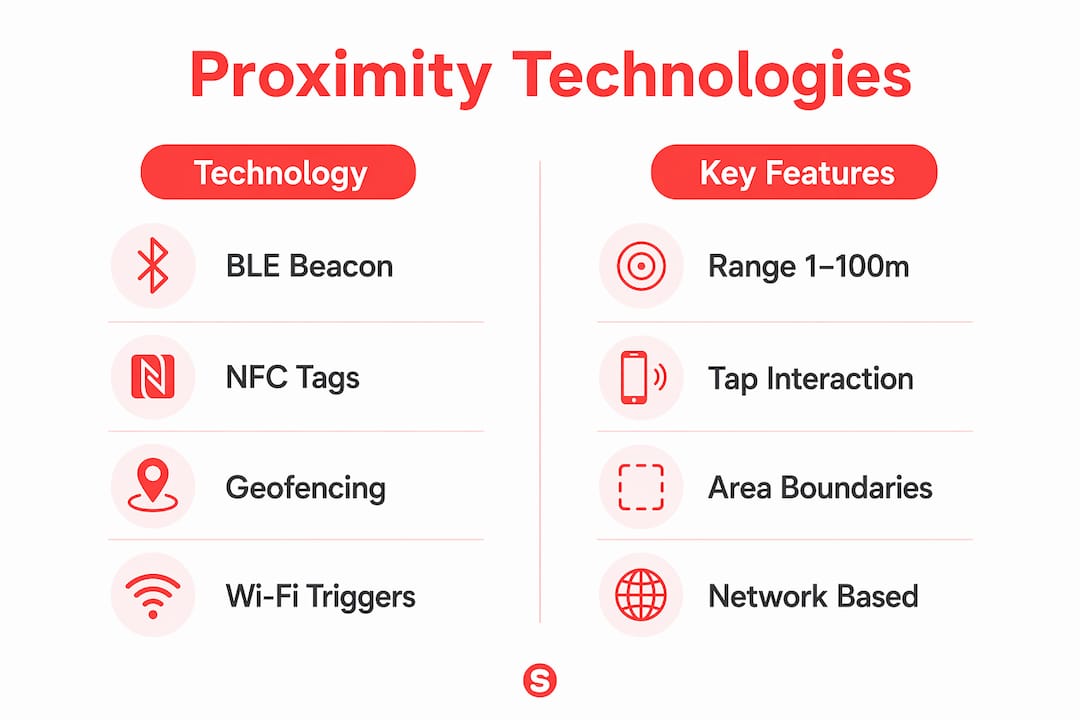
The four core technologies each operate at different distances and serve different use cases:
- BLE beacons broadcast a Bluetooth signal that spans 1 to 100 meters, making them ideal for indoor environments like dining rooms, waiting areas, or retail floors.
- NFC (Near Field Communication) requires a customer to tap or hold their phone within approximately 4 centimeters of a tag. Think contactless menus or loyalty card check-ins at a host stand.
- Geofencing draws a virtual boundary around a building or neighborhood. When a customer’s phone crosses that boundary, a message fires. This works at the block or street level.
- Wi-Fi triggers detect when a device connects to your network and can prompt a welcome message, a menu link, or a loyalty sign-up prompt.
The process follows a clear sequence. A customer installs your app, grants location permission, and walks into range. The system detects their presence and delivers a message. That three-step requirement is actually an advantage. By the time a customer receives your message, they have already opted in three times. That is a high-intent audience.
Pro Tip: Geofencing works at the neighborhood scale, while beacons deliver micro-moment targeting inside your restaurant. Use both together: geofencing to pull customers in, beacons to guide them once they arrive.

What are the benefits of proximity marketing for restaurants?
The core benefit of proximity marketing is that it reaches customers at the point of highest purchase intent. A customer standing outside your restaurant at 6 p.m. is far more valuable to target than someone browsing social media at home.
The business case goes beyond timing. Over 50% of customers report spending more at businesses that offer free Wi-Fi. That single data point shows that proximity-based engagement directly lifts average check size, not just foot traffic.
The specific benefits for restaurant owners and marketers include:
- Higher conversion rates. Messages sent at the moment of physical presence convert at a much higher rate than broadcast advertising.
- Increased dwell time. Wi-Fi access, digital menus, and in-app loyalty check-ins give customers a reason to stay longer and order more.
- Personalized customer experience. Proximity triggers can fire based on visit history, loyalty tier, or time of day, making each interaction feel relevant rather than generic.
- Loyalty program integration. Proximity events like entering the restaurant or reaching a specific table area can automatically award loyalty points, reducing friction for the customer.
- Better data collection. Every proximity interaction generates behavioral data: visit frequency, dwell time, and response rates. That data sharpens every future campaign.
The most effective proximity marketing experiences are viewed as helpful services, not intrusive ads. That distinction builds long-term customer trust and keeps your app installed on their phone.
What are practical examples of proximity marketing in restaurants?
Concrete examples make the strategy real. The following scenarios show how restaurants and local businesses put proximity marketing to work.
-
Wi-Fi sign-up capture. A customer connects to your restaurant’s free Wi-Fi. A landing page prompts them to enter their email or phone number to get access. You collect a first-party contact and can follow up with a loyalty offer after their visit.
-
Beacon-triggered table offer. A beacon placed near the bar detects a customer who has been seated for 20 minutes. The app sends a push notification: “Enjoy a complimentary dessert with your next order tonight.” The offer is relevant, timely, and tied to their physical location inside the restaurant.
-
Geofencing campaign for lunch traffic. You set a geofence around a two-block radius of your restaurant. At 11:30 a.m. on weekdays, any loyalty app user who enters that zone receives a push notification with your lunch special. The message reaches them while they are actively deciding where to eat.
-
NFC-powered loyalty check-in. An NFC tag at the host stand lets customers tap their phone to check in and earn loyalty points automatically. No staff involvement, no friction, and the customer feels rewarded the moment they walk in.
-
Beacon micro-moment targeting at a specific display. A restaurant with a retail section uses a beacon near a wine display to trigger a message about a pairing promotion when a customer lingers nearby. This level of precision is only possible with beacon hardware, not GPS.
Each of these examples shares one quality: the message serves the customer’s immediate context. That relevance is what separates proximity marketing from broadcast advertising.
What are the challenges and best practices for proximity marketing?
The biggest structural challenge is app dependency. Beacon-based marketing requires the customer to have your app installed and Bluetooth enabled. Without both, the beacon cannot reach them. This means your proximity marketing program is only as strong as your app adoption rate.
The second challenge is alert fatigue. Sending too many notifications, or notifications that feel irrelevant, causes customers to disable permissions or uninstall the app entirely. Utility-based proximity triggers maintain app retention far better than unsolicited discount blasts. Sending a customer their loyalty point balance when they walk in is useful. Sending them a generic 10% off coupon every time they pass by is noise.
Best practices that address both challenges:
- Incentivize app downloads actively. Offer a free item or bonus loyalty points for first-time app installs. The app is the gateway to your entire proximity marketing program.
- Set message frequency caps. Limit push notifications to one or two per visit. More than that crosses into intrusion.
- Prioritize consent and privacy. Thoughtful, privacy-conscious marketing builds trust. Always make it easy for customers to manage their notification preferences.
- Integrate proximity triggers with loyalty programs. Tying proximity events to loyalty rewards creates a permission-based infrastructure that customers actively want to engage with.
- Test message timing and content. A message sent when a customer first sits down performs differently than one sent after 30 minutes. Test both and measure response rates.
Pro Tip: Frame every proximity message around what the customer gets, not what you want them to buy. “Your loyalty points just updated” outperforms “Buy now and save” every time.
The table below shows how different proximity technologies compare across key implementation factors.
| Technology | Typical range | Best use case | Key requirement |
|---|---|---|---|
| BLE beacon | 1–100 meters | Indoor micro-moment targeting | App install, Bluetooth on |
| NFC | ~4 centimeters | Loyalty check-ins, contactless menus | NFC-enabled device |
| Geofencing | Block to neighborhood | Pre-arrival offers, foot traffic | App install, location permission |
| Wi-Fi trigger | Within network range | Data capture, welcome messages | Wi-Fi connection |
Key takeaways
Proximity marketing delivers its highest value when location-aware triggers connect directly to a loyalty program, because that combination creates permission-based, high-intent engagement that drives both foot traffic and repeat visits.
| Point | Details |
|---|---|
| Technology selection matters | Match the technology to the use case: beacons for indoor precision, geofencing for neighborhood reach. |
| App adoption is the foundation | Your proximity program only works for customers who have your app installed and permissions enabled. |
| Utility beats discounts | Messages offering loyalty updates or useful content retain customers better than generic promotions. |
| Privacy builds trust | Respectful, consent-based interactions keep customers engaged long-term and prevent app uninstalls. |
| Loyalty integration multiplies results | Linking proximity triggers to loyalty rewards creates a system customers actively choose to participate in. |
The part most restaurant owners get wrong about proximity marketing
Most restaurant owners I talk to treat proximity marketing as a notification system. They set up a geofence, write a discount message, and wait for foot traffic to spike. It rarely works that way.
The mistake is treating proximity as a broadcast channel rather than a service layer. The restaurants that see real results use proximity triggers to make the customer’s experience easier and more rewarding. A beacon that automatically updates a customer’s loyalty points when they walk in feels like magic. A push notification that says “20% off, today only” feels like spam.
The other thing I see overlooked is the app adoption problem. Proximity marketing is not a standalone tactic. It lives inside your loyalty app. If you have not built a reason for customers to download and keep that app, no amount of beacon hardware will move the needle. The mobile marketing strategies that work in 2026 treat the app as the core product and proximity as one feature within it.
The privacy piece also matters more than most people expect. Customers are increasingly aware of location tracking. A restaurant that communicates clearly about what data it collects and why builds a level of trust that translates directly into higher app retention and better campaign performance. That trust is not a soft benefit. It shows up in your repeat visit numbers.
Start with one use case, measure it carefully, and expand from there. The restaurants that win with proximity marketing are not the ones with the most sophisticated tech stack. They are the ones that use simple tools consistently and in service of the customer.
— Barthelemy
How Sorbey helps restaurants put proximity marketing into practice
Running proximity marketing well requires more than hardware. It requires a connected system where location triggers, loyalty rewards, and customer data all work together.
Sorbey is built specifically for local businesses like restaurants that need all of that in one place. From location-based campaigns that pull in foot traffic to loyalty program integration that keeps customers coming back, Sorbey handles the full picture. You do not need a separate beacon vendor, a separate loyalty platform, and a separate email tool. Sorbey connects those pieces so your proximity triggers actually lead somewhere. Visit Sorbey’s services page to see how it works for restaurants like yours.
FAQ
What is the proximity marketing definition?
Proximity marketing is the delivery of targeted, location-based messages to customers when they are physically near a specific location, using technologies like BLE beacons, NFC, geofencing, or Wi-Fi.
How does proximity marketing differ from location-based marketing?
Location-based marketing uses GPS to target customers at a city or neighborhood scale. Proximity marketing uses hardware like beacons to deliver indoor precision targeting where GPS cannot reach.
What technologies power proximity marketing?
The four main proximity marketing technologies are BLE beacons, NFC tags, geofencing, and Wi-Fi triggers. Each operates at a different range and suits different points in the customer journey.
Do customers need an app for proximity marketing to work?
Yes. Beacon and geofencing-based proximity marketing requires customers to have your app installed and location permissions enabled. Without the app and Bluetooth active, beacon messages cannot reach the customer.
What is the biggest risk of proximity marketing?
Alert fatigue is the primary risk. Sending too many or irrelevant notifications causes customers to disable permissions or uninstall the app. Keeping messages useful and infrequent protects long-term engagement.
Recommended
- How to attract local diners and grow restaurant loyalty | Sorbey Blog | Sorbey
- Location-based marketing that drives real restaurant traffic | Sorbey Blog | Sorbey
- Hyperlocal targeting for restaurants: drive more traffic | Sorbey Blog | Sorbey
- What is hyperlocal marketing? Strategies for restaurants | Sorbey Blog | Sorbey
Potrebbe interessarti anche

Best Restaurant Loyalty Programs 2026: ROI Guide
Discover the best restaurant loyalty programs 2026 that boost repeat visits. Learn how Sorbey’s platform can transform your guest data strategy!

Why Mobile Marketing Matters for Business Growth
Discover why mobile marketing matters for business growth. Learn how optimizing for mobile drives traffic, conversions, and customer retention.

SF Dim Sum Restaurant Marketing Checklist for 2026
Transform your SF dim sum with our 2026 marketing checklist. Optimize your profile, showcase dishes, and attract customers fast!