
Blog
What is restaurant PPC? Boost local visibility with smart ads
Learn what restaurant PPC is, how it works, and the exact tactics to boost local visibility, cut wasted spend, and drive more reservations with Google Ads.

What is restaurant PPC? Boost local visibility with smart ads
Many restaurant owners spend hundreds of dollars every month on digital ads and still wonder why reservations aren’t climbing. The problem usually isn’t the budget. It’s that most restaurants confuse broad social media spending with targeted Pay-Per-Click advertising, and those two things perform very differently. Restaurant PPC is built for high-intent local searches, meaning the people who see your ad are already hungry and looking for somewhere to eat right now. This guide breaks down exactly what restaurant PPC is, how to structure winning campaigns, what benchmarks to expect, and the mistakes that quietly drain your budget.
Table of Contents
- What is restaurant PPC and how does it work?
- Essential PPC campaign tactics for restaurants
- PPC performance benchmarks and budgeting for restaurants
- Real-world results: Restaurant PPC in action
- Why most restaurants underperform with PPC and what actually works
- How Sorbey helps restaurants succeed with PPC
- Frequently asked questions
Key Takeaways
| Point | Details |
|---|---|
| Target real demand | Restaurant PPC means you only pay for local searchers who are ready to book or order. |
| Structure campaigns smartly | Dividing by keyword type, service, and using geo-targeting boosts efficiency and results. |
| Benchmark and adapt | Use average CPC, CTR, and ROAS data to set goals, adjust, and grow profitably. |
| Avoid wasted spend | Regularly prune negative keywords and focus on ad scheduling to cut budget leaks. |
| Real-world wins | Effective PPC gives restaurants real ROI, often fueling both sales and organic growth. |
What is restaurant PPC and how does it work?
PPC stands for Pay-Per-Click. You only pay when someone actually clicks your ad, not just when they see it. That’s the key difference from CPM advertising, which charges you per thousand impressions regardless of whether anyone engages. For restaurants, that distinction matters a lot because you’re not trying to build brand awareness with a Super Bowl budget. You’re trying to get someone who just typed “best tacos near me” to walk through your door tonight.
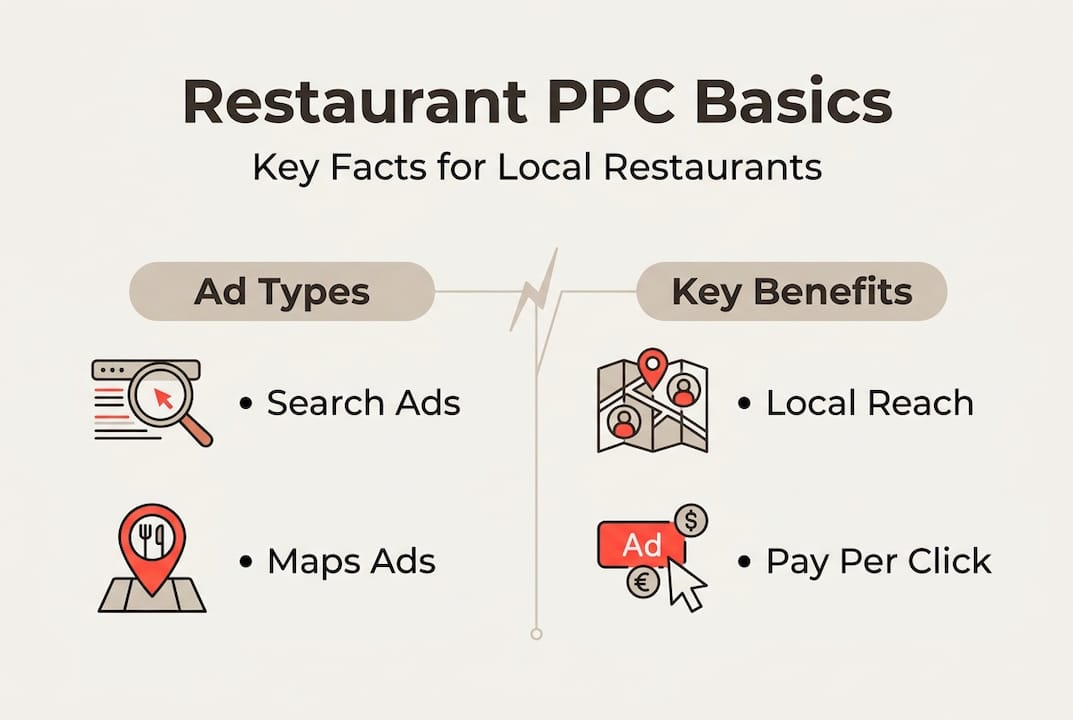
Restaurant PPC is primarily run through Google Ads, using three main formats: Search ads (text ads that appear above organic results), Performance Max campaigns (automated ads that run across Google’s full network), and Google Maps ads (which place your restaurant at the top of map results). Each format targets users at different stages, but all three share one powerful quality: the people searching are already in buying mode.
Here’s how the targeting works. You bid on keywords like “Italian restaurant near me” or “pizza delivery downtown Chicago.” Google matches your ad to those searches based on your bid, your ad quality score, and your geo-targeting settings. You set a radius around your location, say three to five miles, and your ads only show to people inside that zone. That combination of intent plus location is what makes restaurant PPC so effective compared to restaurant marketing insights that rely on passive reach.
Before you launch anything, it helps to know the core vocabulary:
| Term | Definition |
|---|---|
| PPC | Pay-Per-Click: you pay only when someone clicks your ad |
| CPC | Cost Per Click: the dollar amount you pay per click |
| CTR | Click-Through Rate: percentage of people who click after seeing your ad |
| CVR | Conversion Rate: percentage of clicks that turn into a reservation or order |
| CPA | Cost Per Acquisition: total cost to earn one customer action |
The mechanics behind a PPC campaign follow a simple loop:
- You choose keywords and set a maximum bid
- Google enters your ad in a real-time auction every time a matching search happens
- Your ad appears if your bid and quality score beat competitors
- You pay only when the user clicks
- The click lands on your website or booking page, and the conversion begins
Understanding local SEO for restaurants alongside PPC gives you a fuller picture of how paid and organic search work together to dominate local results.
Essential PPC campaign tactics for restaurants
Now that we know what PPC is, let’s look at the tactics top restaurant marketers use to make campaigns work in busy cities.
The first step is building a smart campaign structure. Most high-performing restaurant accounts separate campaigns into three buckets: brand campaigns (your restaurant’s name), category campaigns (cuisine type like “sushi” or “brunch”), and service campaigns (takeout, delivery, catering). This separation lets you control budgets and bids for each intent type without one campaign cannibalizing another.

Keyword targeting is where most restaurants either win or waste money. High-intent local terms like “dinner reservations downtown” or “best burger near me” convert far better than broad terms like “restaurant.” Negative keywords are just as important. If you don’t serve lunch, add “lunch” as a negative keyword so you stop paying for irrelevant clicks. This one habit alone can cut wasted spend by 20 to 30 percent.
Geo-targeting should match your real service area. For dine-in restaurants, a three to five mile radius usually covers your walkable and drivable audience. Delivery operations can extend that to seven miles or more. Use tiered radius bidding, meaning you bid higher for people one mile away and lower for people five miles out, because proximity strongly predicts conversion.
Ad scheduling is a tactic many restaurants skip entirely, and it costs them. Your lunch crowd searches between 10:30 AM and 1:00 PM. Dinner traffic peaks from 4:30 PM to 7:30 PM. Pausing or reducing bids during off-hours means your daily budget concentrates on the moments that actually drive covers. Investing in local search at the right times multiplies your return significantly.
Ad extensions are free additions that make your ads much more clickable. Use these consistently:
- Call extensions: let mobile users call directly from the search results
- Location extensions: show your address and link to Google Maps
- Sitelink extensions: add links to your menu, reservations page, or specials
- Callout extensions: highlight offers like “Open Late” or “Free Delivery Over $30”
| Campaign type | Best for | Bid strategy |
|---|---|---|
| Brand search | Protecting your name | Manual CPC |
| Category search | New customer acquisition | Target CPA |
| Performance Max | Full-funnel reach | Max Conversions |
| Google Maps | Foot traffic | Target CPA |
Pro Tip: Pull your Google Ads data from the past 90 days and identify the three to five hours with the highest conversion rates. Increase bids by 20 to 30 percent during those windows using AI-powered restaurant marketing tools that automate bid adjustments in real time.
PPC performance benchmarks and budgeting for restaurants
Before launching, you need to know what success looks like and how much to invest.
The restaurant and hospitality industry has some of the most favorable PPC benchmarks of any sector. Average Google Ads CPC for restaurants sits around $1.95, with a click-through rate of 7.2 percent and an average conversion rate of 6.8 percent. The average cost per acquisition lands near $18.50, meaning you’re spending less than $20 to earn one booking or order. Hospitality-specific campaigns can perform even better, with CPCs as low as $0.71 and conversion rates reaching 41 to 66 percent under optimized conditions.
Here’s what those numbers mean in practice. If you spend $1,500 per month and your CPC is $1.95, you’re getting roughly 770 clicks. At a 6.8 percent conversion rate, that’s about 52 new customers per month. If your average check is $45, that’s $2,340 in new revenue from a $1,500 investment, before factoring in repeat visits.
| Metric | Industry average | Strong performance |
|---|---|---|
| CPC | $1.95 | Under $1.50 |
| CTR | 7.2% | Above 10% |
| CVR | 6.8% | Above 12% |
| CPA | $18.50 | Under $12.00 |
| ROAS | 3-5x (break-even) | 7x+ (excellent) |
Budgeting depends on your city and competition level:
- Small restaurants in mid-size cities: $1,000 to $1,500 per month
- Restaurants in major metros like NYC or LA: $2,000 to $3,000 per month
- Multi-location groups: $3,000 and up, scaled per location
Roas targets give you a clear finish line. A 3 to 5x return on ad spend means you’re breaking even after accounting for food costs. A 5 to 7x ROAS is profitable. Anything above 7x is excellent and usually signals a well-optimized campaign with strong landing pages. Pairing your PPC efforts with a fully optimized Google My Business profile improves your Quality Score and lowers your CPC over time.
Real-world results: Restaurant PPC in action
Numbers are helpful, but real stories show what actually works in practice.
The results from well-run restaurant PPC campaigns are genuinely impressive. A Reno pub running combined Search and Performance Max campaigns generated $19,000 in sales within 30 days and saw 35 percent year-over-year growth. Buca di Beppo increased location visits by 115 percent while dropping their CPA by 17 percent. One pizza spot brought their CPA down to just $1.98 per order. And a London chain achieved a 589 percent ROI after systematically optimizing their campaigns over several months.
“The London chain saw 589% ROI after optimizing campaigns, proving that patience and systematic refinement outperform any single tactic.”
What do these campaigns have in common? They all combined geo-targeting, retargeting, and full-funnel ad formats. That combination creates a flywheel effect: geo-targeted PPC drives new foot traffic, those customers tell friends, and organic search rankings improve as reviews and citations accumulate. Each part feeds the next.
Key lessons from standout campaigns:
- Start with tight geo-radii to prove ROI before expanding reach
- Retarget website visitors who didn’t convert with special offers
- Use Performance Max to capture demand across Search, Maps, and Display simultaneously
- Review search term reports weekly to catch irrelevant spend early
- Build separate landing pages for each campaign type to improve CVR
Pro Tip: Test Performance Max campaigns with a geo-radius of two to three miles before widening. This tight targeting forces Google’s algorithm to find your best local converters first, giving you cleaner data and better results when you eventually scale. Connecting PPC to your local search results strategy amplifies both channels.
Why most restaurants underperform with PPC and what actually works
Here’s an uncomfortable truth: most restaurant PPC campaigns fail not because of high costs, but because of poor setup and zero ongoing maintenance. Owners launch a campaign, set it to run, and check back in three months wondering why the budget disappeared.
The most common mistakes are skipping negative keywords, using overly broad match types, and ignoring ad scheduling. These three errors alone can waste 40 to 60 percent of a monthly budget on clicks that were never going to convert. Broad searches like “food” or “restaurants” sound logical but attract zero-intent users who are just browsing.
“The biggest cost is wasted budget due to poor targeting, not high CPCs.”
Real return comes from weekly refinement. Check your search terms report every Monday. Remove irrelevant matches. Raise bids on your top-converting keywords. Lower bids or pause anything with a CPA above your target. This kind of disciplined iteration is what separates the 589 percent ROI campaigns from the ones that just burn cash. Understanding SEO mistakes restaurants make gives useful context for why both paid and organic channels require the same attention to detail.
Focus on your cheapest winning keyword and ad combinations first. Scale what works before experimenting with new formats. Vanity metrics like impressions mean nothing if your tables are empty.
How Sorbey helps restaurants succeed with PPC
If the tactics above sound like a lot to manage on top of running a restaurant, you’re not wrong. PPC rewards consistency and expertise, and most restaurant teams don’t have a dedicated ads manager on staff.
Sorbey offers end-to-end restaurant PPC services built specifically for local restaurants, covering Google Search, Performance Max, Maps, and integrated local marketing. Every campaign is set up with the geo-targeting, ad scheduling, and negative keyword strategies outlined in this guide. You can see client results from real restaurant campaigns and get started with a setup that’s already proven to work.
Frequently asked questions
How much should a restaurant budget for PPC advertising?
Most small restaurants invest between $1,000 and $3,000 per month in PPC, depending on city competitiveness and campaign goals. Larger metros typically require higher budgets to stay competitive.
What are typical results for a well-optimized restaurant PPC campaign?
Strong campaigns target a 3 to 7x ROAS, with lower customer acquisition costs and measurable increases in reservations or online orders. Case study results have reached as high as 589 percent ROI.
Is Google Ads the best PPC platform for local restaurants?
Google Ads Search, Performance Max, and Maps are the primary platforms for restaurant PPC because they capture high-intent local searches at the exact moment someone is deciding where to eat.
How can I target customers near my restaurant with PPC?
Use geo-targeting with tiered radii, typically three to seven miles, and combine it with ad scheduling to reach nearby customers during peak meal times.
Recommended
You might also like

Best Restaurant Loyalty Programs 2026: ROI Guide
Discover the best restaurant loyalty programs 2026 that boost repeat visits. Learn how Sorbey’s platform can transform your guest data strategy!

Why Mobile Marketing Matters for Business Growth
Discover why mobile marketing matters for business growth. Learn how optimizing for mobile drives traffic, conversions, and customer retention.

SF Dim Sum Restaurant Marketing Checklist for 2026
Transform your SF dim sum with our 2026 marketing checklist. Optimize your profile, showcase dishes, and attract customers fast!