
Blog
Local Influencer Marketing Guide for Small Businesses in 2026
Discover effective strategies in our local influencer marketing guide, tailored for small businesses to boost sales and foot traffic.

Local Influencer Marketing Guide for Small Businesses in 2026
What is local influencer marketing, and why does it work?
Local influencer marketing is the practice of partnering with creators who have authentic trust and a geographically concentrated audience to drive real business outcomes: foot traffic, calls, bookings, and sales. You are not paying for broad exposure. You are paying for attention from people who can actually walk through your door tonight.
Hootsuite and HubSpot both point to this model as one of the highest-ROI channels available to small and medium businesses, precisely because the audience is already pre-qualified by location and trust. A local food creator with 9,000 engaged followers in your city will almost always outperform a national influencer with 500,000 scattered ones.
Two platforms make discovery fast. TikTok Creator Marketplace lets you filter creators by niche, location, and audience demographics, making it the most efficient tool for scaling local influencer partnerships. Instagram’s location-specific hashtags, such as #[city]homeowner or #[city]realestate, surface creators whose content is already rooted in your community.
What local influencer marketing delivers:
- Foot traffic and in-store visits from nearby audiences
- Trust built faster than traditional advertising because the messenger is already credible
- Measurable outcomes tied to calls, bookings, and redemptions, not just impressions
- Content that doubles as local search signals when creators tag your address and neighborhood
- A cost structure that fits small business budgets, especially with nano and micro creators
Why local influencer marketing pays off for small businesses
The economics favor local businesses in a way that national campaigns rarely do. When a creator’s audience lives within five miles of your storefront, every impression has purchase potential. That precision is what drives the returns.

Micro-influencers tend to generate more engagement than larger creators, and smaller accounts often outperform big ones on real interaction. For a local restaurant or service business, that engagement translates directly into reservation clicks and appointment requests, not just likes.
Local food influencer campaigns have seen significant ROI and increases in reservations within a week of posting. Those numbers reflect a simple truth: you are not competing for attention across the internet. You are showing up in the feeds of people who are already deciding where to eat or who to call.
Core benefits at a glance:
- Lower acquisition costs compared to paid search or display ads, especially for service businesses
- Faster trust because audiences follow local creators for recommendations, not entertainment
- Authenticity that polished brand ads cannot replicate
- Dual-channel impact: social reach plus local SEO signals from location tags and neighborhood keywords
- Flexible compensation including free services, affiliate codes, and flat fees
How do you find the right local influencers?
Local influencer discovery requires a different mindset than finding national creators. You want concentrated local audiences, not the largest possible following.
TikTok Creator Marketplace is the starting point for most local businesses. You can filter by niche, location, follower count, and audience demographics, which cuts hours of manual searching. Trades content, before-and-after videos, and “watch me fix this” formats perform exceptionally well on TikTok, and the platform’s home improvement niche has grown into one of the most active creator communities since 2022.
Instagram hashtag search is equally productive. Search location hashtags like #dallashomeowner, #austinrealestate, or #fortworth diy to find local creators whose content already lives in your community. Look for home improvement bloggers, local real estate influencers, and lifestyle accounts covering home and family topics.
Beyond those two platforms, Google searches like “[your city] + lifestyle influencer” or “[your city] + home blogger” surface creators who may not appear on discovery platforms. YouTube channels with 5,000–20,000 subscribers can have highly engaged audiences actively searching for home service content. Local podcasts are consistently underused: a five-minute segment on a community podcast with 2,000 listeners in your market can outperform a social post to a national audience.
Influencer search platforms including Upfluence, Aspire, and Modash let you filter by audience location breakdown, engagement rate, and niche, which is useful when you need to vet a shortlist quickly.
Pro Tip: Before sending any outreach, spend two weeks engaging with a creator’s content. Like posts, leave genuine comments, and reply to Stories. Cold pitches to local creators have low response rates. Warm relationships convert far better, and community authenticity matters more in local campaigns than in national ones.
What to look for when building your shortlist:
- At least 80% of the creator’s audience located in your target city or region
- Authentic engagement rate of 5–7%, with real comments and balanced likes-to-views ratios
- Content style that matches your brand tone without requiring heavy scripting
- A track record of honest sponsored content, not a feed saturated with paid posts
How do you evaluate and choose the right local influencer?
Follower count is the least useful metric when evaluating local creators. An influencer with 12,000 followers where 80% live in your market is worth more than one with 60,000 followers spread nationally. Start your evaluation there.
Audience demographics come first. Check where the creator’s followers actually live, their age range, and whether they match your customer profile. A plumbing company needs homeowners, not renters. A family restaurant needs parents, not college students. Most platforms surface this data directly, and Modash provides detailed audience location breakdowns.
Content authenticity is the second filter. Scroll back six months and look at how the creator handles sponsored posts. Do they feel native to the feed, or do they read like press releases? Audiences notice the difference immediately, and so will you. For local service businesses, before-and-after videos documenting real work drive significantly more trust than polished lifestyle promos.
Evaluation checklist:
- Audience location concentration (80%+ local)
- Engagement quality: are comments specific and conversational, or generic?
- Sponsored content frequency: too many paid posts signal audience fatigue
- FTC disclosure history: do they label paid partnerships clearly?
- Cultural fit with your neighborhood and customer base
- Content format alignment with your campaign goals (video, carousel, Stories)
Balance your creator mix across three roles: discovery creators with broad local reach, trust builders embedded in niche communities, and converters who drive strong calls to action. Betting everything on one large account is the fastest way to waste a local budget.
How do you plan and run a successful local influencer campaign?
Set your goal before you touch a creator brief. “More visibility” is not a goal. “Twenty new bookings from the Riverside neighborhood in the next 30 days” is. SMART goals tied to local outcomes, such as foot traffic, calls, or reservation clicks, give you a brief that actually guides the creator and a result you can measure.
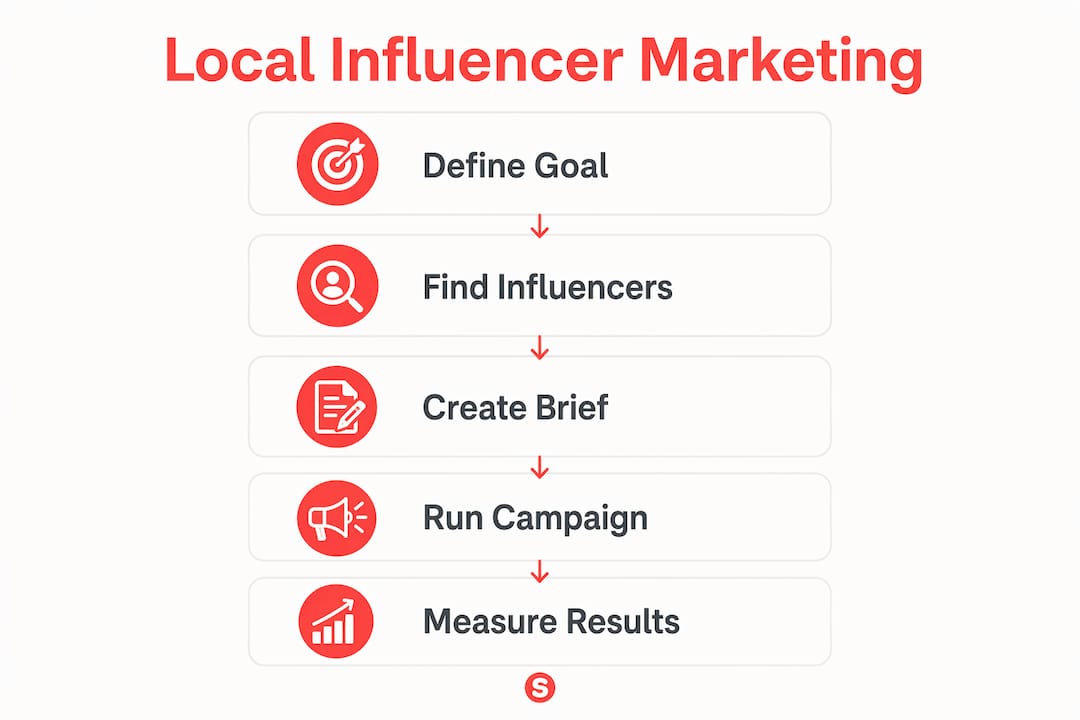
Write a brief that forces local signals. Require a location tag, neighborhood keywords spoken on camera, and at least one shot that proves address context, whether that is a street sign, storefront, or recognizable landmark. Ask for a “how to get there” moment. Creators who include neighborhood names and physical context help both the algorithm and the viewer connect your business to a specific place.
Build tracking into the creative from day one. Give each creator a unique discount code and a unique URL with UTM parameters. For walk-ins, train staff to ask one question at checkout: “Did you see us on TikTok or Instagram, and whose video?” That single question closes the attribution gap that digital-only tracking leaves open.
Campaign planning steps:
- Define one primary goal and one secondary goal, not five
- Set a realistic catchment radius: 3 miles in dense cities, 10–20 miles in suburbs
- Assign creators to roles: discovery, trust builder, or converter
- Write a tight brief with required local signals and clear deliverables
- Issue unique codes and URLs per creator before launch
- Schedule content approvals without over-scripting the creative
- Repurpose top-performing posts as whitelisted ads or FAQ carousels
For restaurants specifically, Sorbey’s restaurant influencer marketing examples show how local campaigns translate directly into reservation lifts and repeat visits.
Best practices and mistakes to avoid
The most common mistake is treating influencer marketing as a series of one-off transactions. A single post generates a spike. An ongoing ambassadorship builds the kind of consistent local search signals and word-of-mouth that compound over months. Long-term brand ambassadorships outperform one-off posts on both trust and local SEO impact, and that gap widens the longer the relationship runs.
Over-scripting is the second most expensive mistake. Creators given genuine creative freedom produce content that audiences trust more than ads that read like a press release. Give the creator your key message, your required local signals, and your call to action. Then let them decide how to say it.
Prioritizing relevance over reach is what separates campaigns that drive store visits from campaigns that drive impressions. A creator with deep credibility in your neighborhood moves people toward a specific action. A creator with broad reach moves people toward a vague awareness.
Integrate local influencer work with your broader community presence. Invite creators to your events. Cross-promote with neighboring businesses. When influencer content and in-person community moments reinforce each other, the trust compounds faster than either channel alone. Sorbey’s guide on local advertising strategy covers how to weave these channels together for maximum impact.
For deeper strategy on building influencer marketing ROI, the frameworks around long-term creator relationships and campaign measurement apply directly to local campaigns.
How do you measure local influencer campaign performance?
Attribution is the difference between “that was fun” and “we should do this every month.” Local campaigns need two tracking methods per creator: one digital, one offline.
Digital tracking: UTM parameters on every creator link let you compare sessions, conversion rate, and cost per acquisition across creators in Google Analytics. A simple template looks like this: ?utm_source=instagram&utm_medium=influencer&utm_campaign=citylaunch&utm_content=creatorname. Platform link stickers and unique booking URLs add a second layer.
Offline tracking: Staff asking “whose video brought you in?” at checkout captures walk-in attribution that no pixel can track. Unique POS codes per creator close the loop on in-store redemptions.
Key metrics to track by goal:
| Goal | Primary metric | Offline backup |
|---|---|---|
| Walk-ins | Unique code redemptions | Staff source question |
| Calls | Tracked phone number clicks | Keyword call prompt |
| Bookings | Unique URL conversions | Appointment source field |
| Leads | Landing page form fills | QR code scans in-store |
If a creator drives high saves but low redemptions, the content is working but the offer or call to action is weak. If a creator drives redemptions with modest reach, you found a converter. Book them again.
What does local influencer marketing actually cost?
For small and medium businesses, local influencer marketing is far more accessible than most owners assume. Nano creators (1,000–10,000 followers) often accept free products or services in exchange for content, particularly when the service is visually compelling, such as a full kitchen renovation or a before-and-after HVAC installation. That arrangement eliminates upfront cash cost while generating authentic content the creator is genuinely invested in.
Cash rates vary by city, niche, and production quality. Micro-influencers (10,000–100,000 followers) typically charge more than nano creators, but local audience concentration matters more than follower count when setting your budget. An influencer with 12,000 highly local followers commands a premium over one with 60,000 scattered nationally.
Structure your budget around outcomes, not vanity metrics. Separate content creation fees from distribution value and usage rights in every negotiation. Affiliate models, where the creator earns a commission per referral, align incentives and reduce upfront risk. For walk-in-dependent businesses, a hybrid of a small flat fee plus a per-redemption bonus keeps both parties focused on the same result.
Sorbey’s SMS campaign ROI calculator can help you model expected returns before committing budget, especially useful when comparing influencer spend against other local channels.
Legal considerations and FTC compliance
The FTC updated its endorsement guidelines in 2023 with stricter requirements, and compliance is a shared responsibility. As the business paying for or providing compensation, you are legally accountable alongside the creator if disclosures are missing or unclear.
Every paid partnership, gifted product, or free service exchange requires a clear disclosure. “Ad,” “Paid partnership,” or “Sponsored” must appear prominently, not buried in a caption or hidden among hashtags. The FTC’s disclosure guidelines are specific: disclosures must be hard to miss, in plain language, and placed where viewers will see them before engaging with the content.
Put everything in a written contract before any content goes live. A solid influencer contract covers deliverables and deadlines, compensation terms, content approval process, usage rights and duration, FTC disclosure requirements, and exclusivity clauses if relevant. Verbal agreements leave both parties exposed. Contracts protect the creator’s creative expectations and your brand’s legal standing equally.
Brief creators on disclosure requirements explicitly. Do not assume they know the rules. Include FTC compliance language directly in your brief, and make disclosure a non-negotiable deliverable alongside the post itself.
Key Takeaways
Local influencer marketing works because it puts your business in front of nearby audiences through trusted voices, driving measurable foot traffic, calls, and bookings rather than abstract awareness.
| Point | Details |
|---|---|
| Prioritize local audience concentration | Look for creators where 80%+ of followers live in your target area, not just high follower counts. |
| Micro-influencers drive stronger engagement | Smaller creators generate up to 60% more engagement than larger accounts, translating to real local action. |
| Track with two methods per creator | Combine UTM links with offline staff questions to capture both digital and walk-in attribution. |
| Build long-term ambassadorships | Ongoing creator relationships outperform one-off posts on trust, consistency, and local search signals. |
| FTC compliance is non-negotiable | Every paid or gifted partnership requires a clear, prominent disclosure per updated 2023 FTC guidelines. |
Recommended
También te puede interesar

Best Restaurant Loyalty Programs 2026: ROI Guide
Discover the best restaurant loyalty programs 2026 that boost repeat visits. Learn how Sorbey’s platform can transform your guest data strategy!

Why Mobile Marketing Matters for Business Growth
Discover why mobile marketing matters for business growth. Learn how optimizing for mobile drives traffic, conversions, and customer retention.

SF Dim Sum Restaurant Marketing Checklist for 2026
Transform your SF dim sum with our 2026 marketing checklist. Optimize your profile, showcase dishes, and attract customers fast!