
Blog
What is local SEO? A 2026 guide for restaurant owners
Discover how local SEO helps restaurants in major US cities attract ready-to-act customers faster and cheaper than broad marketing strategies.
What is local SEO? A 2026 guide for restaurant owners
Most restaurant owners think online marketing takes months and costs thousands. Local SEO flips that script. It targets customers in your neighborhood who are ready to book, call, or walk in today. Unlike broad SEO strategies that compete nationally, local SEO focuses on geographic intent, delivering faster results at a fraction of the cost. This guide shows you exactly how to leverage local SEO to fill tables in major US cities.
Table of Contents
- What Is Local SEO And Why Does It Matter For Restaurants?
- How Local Searches Signal Customers Ready To Act
- Core Local SEO Strategies For Restaurants In Major US Cities
- Measuring Success And Refining Your Local SEO Approach
- How Sorbey Helps Restaurants Master Local SEO
- FAQ
Key takeaways
| Point | Details | |-------|---------|| | Local SEO targets nearby customers | It optimizes your presence for searches like “restaurant near me” to capture ready-to-act diners. | | Faster and cheaper than broad SEO | Local strategies deliver results quickly without competing for expensive national keywords. | | Local searchers convert at higher rates | People searching locally have immediate intent to visit, call, or make reservations. | | Business listings are critical | Google Business Profile optimization and consistent NAP citations drive local visibility. | | Reviews and local links strengthen rankings | Positive reviews and backlinks from local sources boost your search position and credibility. |
What is local SEO and why does it matter for restaurants?
Local SEO is the practice of optimizing your online presence to attract customers searching with geographic intent. When someone types “best Italian restaurant downtown” or “brunch near me,” they’re sending a clear signal: they want options in their immediate area. Local SEO ensures your restaurant appears prominently in those results.
Unlike traditional SEO, which targets broad keywords with national competition, local SEO focuses on location-based signals. You optimize your Google Business Profile, maintain consistent business information across directories, and build reviews that influence local rankings. The competition is narrower because you’re only competing with restaurants in your city or neighborhood, not the entire country.
This matters enormously for restaurants. Local SEO is more affordable, more targeted and often drives results faster than trying to rank for broad, high-competition terms. Instead of spending months chasing “best restaurant” rankings, you can dominate “best tacos in Brooklyn” within weeks.
Here’s what sets local SEO apart:
- Targets searches with phrases like “near me” or city names
- Leverages Google Maps and local pack results
- Prioritizes mobile optimization for on-the-go searchers
- Emphasizes review quantity and quality as ranking factors
- Builds authority through local backlinks and community presence
“Local customers searching on their phones are often making decisions in real time. If you’re not visible in local results, you’re invisible to the people most likely to visit tonight.”
For restaurants in competitive urban markets, local SEO isn’t optional. It’s the difference between appearing in the Google Maps three-pack above organic results or getting buried on page two. Following a step by step local SEO for restaurants approach helps you systematically build this visibility.
How local searches signal customers ready to act
Local search behavior reveals powerful intent. When someone searches for restaurants with geographic modifiers, they’re not researching for next month. They’re hungry now, planning tonight’s dinner, or looking for a reservation this weekend. Local searches often mean people are ready to act. They’re not just browsing; they’re looking to book, call or visit. That’s the kind of traffic you want.
The conversion rate from local search traffic dramatically exceeds general search traffic. A person typing “pizza delivery 10001” has immediate purchase intent. Compare that to someone searching “pizza recipes” who’s just browsing. Local searchers take action: they tap your phone number, request directions, or click through to make reservations.

Google Maps and the local pack capture massive attention from these high-intent users. The three businesses featured in the local pack receive the majority of clicks from local searches. If you’re not in that coveted space, you’re missing customers who are literally looking for you.
Mobile devices amplify this dynamic. Over 60% of local searches happen on smartphones, often while people are out and about. They’re searching from their car, walking down the street, or sitting in a hotel room deciding where to eat. Mobile local searches convert to physical visits within hours, not days.
Pro Tip: Set up call tracking on your Google Business Profile number. You’ll see exactly how many customers call directly from search results, proving the immediate value of local SEO.
Capturing these local queries transforms your marketing ROI. Instead of casting a wide net hoping someone eventually finds you, you’re positioning yourself exactly where motivated customers are actively looking. That’s why investing in local search for restaurants in 2026 delivers such strong returns. You’re not building awareness; you’re capturing demand that already exists.
Core local SEO strategies for restaurants in major US cities
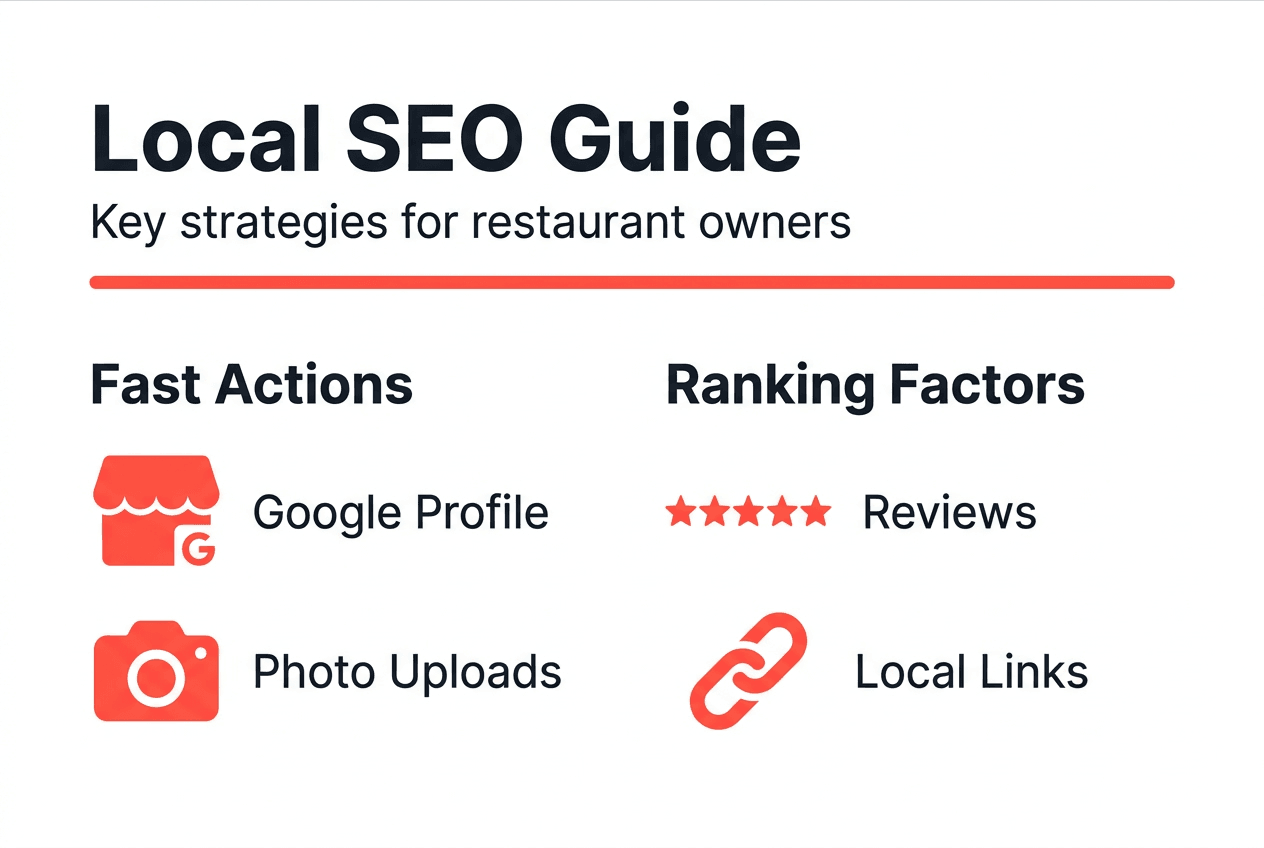
Implementing local SEO successfully requires focusing on five foundational strategies that work together to boost your visibility and attract nearby customers.
-
Optimize your Google Business Profile completely. Claim your listing, add accurate hours, upload high-quality photos of your food and space, select relevant categories, and write a compelling description. This is your primary tool for appearing in local pack results.
-
Ensure NAP consistency everywhere. Your Name, Address, and Phone number must match exactly across your website, Google Business Profile, Yelp, social media, and every directory listing. Inconsistencies confuse search engines and hurt rankings.
-
Build and manage your review profile. Encourage satisfied customers to leave Google reviews. Respond to all reviews, positive and negative, within 24 to 48 hours. Review volume and average rating directly influence local rankings.
-
Create neighborhood-specific content. Write blog posts or web pages targeting local keywords like “best brunch in Lower East Side” or “romantic dinner spots in Georgetown.” Include local landmarks and neighborhood details to signal relevance.
-
Earn local backlinks strategically. Partner with local food bloggers, get featured in neighborhood guides, sponsor community events, or join local business associations. Links from local websites carry more weight for local rankings.
Local SEO is more affordable, targeted, and drives results faster than broad SEO because you’re competing in a defined geographic area. A well-optimized profile can put you in the local pack within weeks, not months.
| Strategy | Impact on Rankings | Time to Results |
|---|---|---|
| Google Business Profile optimization | High | 2-4 weeks |
| NAP consistency across directories | Medium | 4-6 weeks |
| Review generation and management | High | Ongoing |
| Localized content creation | Medium | 6-8 weeks |
| Local backlink building | Medium to High | 8-12 weeks |
Pro Tip: Focus on Google Business Profile first. It delivers the fastest wins and costs nothing but your time. Once that’s dialed in, expand to the other strategies.
For comprehensive guidance, follow detailed local SEO steps for restaurants and prioritize Google My Business for restaurants to maximize your visibility where it counts most.
Measuring success and refining your local SEO approach
Tracking performance tells you what’s working and where to double down. Local SEO isn’t set-it-and-forget-it. You need concrete metrics to guide ongoing optimization.
Start with Google Business Profile insights. Check your dashboard weekly to monitor profile views, search queries that trigger your listing, clicks to your website, direction requests, and phone calls. These metrics show how many people find you and what actions they take. Rising direction requests and calls indicate your local visibility is improving.
Track reservation volume and call patterns. If you notice spikes after optimizing your profile or earning new reviews, that’s direct evidence of local SEO impact. Correlate these increases with your optimization activities to identify which tactics drive real business.
Analyze website traffic by source and device. Use Google Analytics to filter for visitors from local searches and mobile devices. Look for increases in sessions from organic search with local intent keywords. High mobile traffic confirms you’re capturing on-the-go searchers.
Local SEO often drives results faster than broader SEO efforts, highlighting the importance of timely measurement. Weekly check-ins let you spot trends early and adjust before wasting time on ineffective tactics.
Key metrics to monitor:
- Google Business Profile views and actions (calls, directions, website clicks)
- Review quantity, average rating, and response rate
- Local pack ranking position for target keywords
- Organic traffic from local search queries
- Mobile traffic volume and conversion rate
- Reservation and walk-in volume correlated with SEO changes
| Metric | Good Target | What It Tells You |
|---|---|---|
| Profile views | 10%+ monthly growth | Growing awareness in local search |
| Direction requests | 5%+ of profile views | Strong intent to visit |
| Phone calls from listing | 3%+ of profile views | Immediate customer interest |
| Average review rating | 4.3+ stars | Competitive reputation |
| Local pack visibility | Top 3 for main keywords | Maximum exposure |
Use this data to refine your approach. If reviews drive more calls than content, focus there. If certain neighborhood keywords bring high-quality traffic, create more content targeting similar terms. Stay current with restaurant SEO trends in 2026 to adapt as search behavior evolves. Continuous optimization based on real performance data separates restaurants that dominate local search from those that remain invisible.
How Sorbey helps restaurants master local SEO
You understand local SEO strategy. Now comes execution, which demands time and expertise many restaurant owners simply don’t have. Sorbey offers AI-powered restaurant marketing services designed specifically to handle local SEO for busy operators. Our platform simplifies Google Business Profile optimization, automates review management, and builds local content that actually ranks.
We’ve helped restaurants in major US cities climb into the local pack within weeks, not months. Our AI-driven approach identifies exactly which local keywords your competitors are missing, then creates targeted content to capture that traffic. You get the benefit of enterprise-level SEO expertise without hiring a full-time team.
Start with our free restaurant marketing tools to audit your current local presence and identify quick wins. When you’re ready for comprehensive support, Sorbey’s AI-powered restaurant marketing handles everything from citation building to review generation, freeing you to focus on what you do best: running an exceptional restaurant.
FAQ
What is local SEO?
Local SEO optimizes your online presence to attract customers searching for businesses in a specific geographic area. It focuses on appearing in Google Maps results, the local pack, and location-based searches. For restaurants, this means showing up when nearby diners search for your cuisine or neighborhood.
How is local SEO different from regular SEO?
Regular SEO targets broad keywords with national or global competition, while local SEO targets geographic searches with local competition. Local SEO emphasizes Google Business Profile, local citations, reviews, and neighborhood content. It delivers faster results because you’re competing only with nearby businesses, not the entire internet.
How quickly can I see results from local SEO?
Most restaurants see initial improvements within two to four weeks after optimizing their Google Business Profile. Ranking in the local pack for competitive keywords typically takes six to eight weeks. Results vary based on competition density, your current online presence, and how thoroughly you implement optimization strategies.
What should I do about negative reviews?
Respond professionally and promptly to every negative review, ideally within 24 hours. Acknowledge the customer’s concern, apologize sincerely, and offer to make it right offline. Never argue publicly. A thoughtful response shows potential customers you care about service quality. Focus on earning more positive reviews to dilute the negative ones over time.
Do I need a website for local SEO to work?
While a website helps, it’s not strictly required for basic local SEO. A fully optimized Google Business Profile alone can get you into local pack results. However, a website with localized content significantly strengthens your rankings and provides a place to convert visitors into customers. For comprehensive guidance, check out our local SEO guide for restaurants.
Recommended
- Why invest in local search for restaurants in 2026 | Sorbey Blog | Sorbey
- Blog - Sorbey | Restaurant Marketing Insights | Sorbey
- Step by Step Local SEO for Restaurants Made Easy | Sorbey Blog | Sorbey
- SEO for Local Restaurants: Winning with Local Search
- Local SEO Guide for Ecommerce: Boost Local Sales Fast
Potrebbe interessarti anche

Best Restaurant Loyalty Programs 2026: ROI Guide
Discover the best restaurant loyalty programs 2026 that boost repeat visits. Learn how Sorbey’s platform can transform your guest data strategy!

Why Mobile Marketing Matters for Business Growth
Discover why mobile marketing matters for business growth. Learn how optimizing for mobile drives traffic, conversions, and customer retention.

SF Dim Sum Restaurant Marketing Checklist for 2026
Transform your SF dim sum with our 2026 marketing checklist. Optimize your profile, showcase dishes, and attract customers fast!