
Blog
Best Restaurant Loyalty Programs 2026: ROI Guide
Discover the best restaurant loyalty programs 2026 that boost repeat visits. Learn how Sorbey’s platform can transform your guest data strategy!

Best Restaurant Loyalty Programs 2026: ROI Guide
TL;DR:
- Restaurant loyalty programs in 2026 focus on owning first-party guest data through POS-native systems that automate engagement based on real sales events. Successful programs prioritize repeat visit frequency and return timing over sign-up counts, with exportable data and automated workflows proving ROI. Platforms like Sorbey offer integrated automation, data ownership, and analytics tailored for independent restaurants to boost customer loyalty effectively.
The best restaurant loyalty programs in 2026 are POS-native CRM platforms that capture first-party guest data at every checkout point, let you export that data, and fire automated SMS and email campaigns triggered by real sales events. Independent operators who get this right see repeat visit frequency climb within the first months. Sorbey is built exactly for this: an all-in-one marketing platform that gives independent restaurants exportable guest lists, built-in automations, and the analytics to prove payback fast.
Table of Contents
- What actually drives repeat visits in 2026?
- What features must your loyalty platform have in 2026?
- Which KPIs actually prove loyalty ROI?
- How do you launch a loyalty program step by step?
- Common mistakes restaurants make with loyalty programs
- How Sorbey maps to the 2026 loyalty checklist
- Key Takeaways
- What most loyalty advice gets wrong
- See Sorbey in action: what a demo covers
- Sources and Further Reading
What actually drives repeat visits in 2026?
The single biggest shift this year is data ownership. Operators who relied on third-party delivery apps or reservation platforms to “know” their guests are discovering those platforms own the relationship, not the restaurant. The guest list lives behind a walled garden, and when you stop paying, it disappears.
Here is what is changing the math on loyalty right now:
- First-party data capture at every touchpoint (POS, online order, QR receipt) is now the baseline, not a bonus feature.
- POS-native identity resolution matches a guest’s payment card to their profile automatically, so you build a real member list without asking staff to manually log names.
- Real-time trigger automation fires a win-back SMS when a guest’s last visit crosses 30 days, not when someone remembers to send a campaign.
- Delivery-app integration matters for operators where off-premise orders represent a significant share of revenue, since those guests need a separate capture path.
- Exportability is the non-negotiable test: if you cannot download your full member list as a CSV on day one, you do not own your audience.
The primary success signals for loyalty in 2026 are repeat visit frequency and return timing, not sign-up counts. A program with 500 active members who return every 18 days beats one with 2,000 sign-ups who never come back.
Platform selection based on operator type and revenue mix matters here. Delivery-heavy operators need delivery-app automation; dine-in operators need POS-native loyalty. Choosing the wrong architecture means your data stays fragmented.
What features must your loyalty platform have in 2026?
Three capabilities are non-negotiable: POS or native integrations that resolve guest identity passively, full first-party data export you own, and built-in automations tied to actual sales events. Everything else is a tier below.
| Feature | Why It Matters | Priority |
|---|---|---|
| POS-native identity resolution | Builds member list without manual staff effort | Must |
| CSV export (members, visits, redemptions) | Protects your audience if you switch vendors | Must |
| SMS + email automation templates | Win-back, birthday, first-visit — no build-from-scratch | Must |
| Reward mechanics (stamps, points, tiers) | Drives repeat behavior and spend lift | Must |
| Staff enrollment UX (QR / SMS magic link) | Enrollment rate depends on frictionless sign-up | Must |
| Cohort analytics and redemption reporting | Proves ROI; required for monthly review cadence | Should |
| Multichannel attribution | Ties campaign spend to actual visits | Should |
| Delivery-app connectors | Captures off-premise guests into your CRM | Nice-to-have |
Operators with limited bandwidth benefit most from platforms that ship automation templates rather than requiring every campaign to be built from scratch. A restaurant CRM that centralizes customer data and enables automated campaigns like birthday and lapsed-guest flows is the operating system for guest relationships. POS-native CRMs that resolve identity across payment, reservations, and online orders reduce manual merging and increase usable member coverage fast.
Pricing models to expect: most platforms charge a monthly subscription ranging from entry-level tiers for single locations to higher tiers for multi-location groups, sometimes with a per-SMS or per-member cost layered on top. Require a line-item breakdown before signing.
Which KPIs actually prove loyalty ROI?
Repeat visit frequency and return timing cohorts tied to redemption behavior are the metrics that prove a loyalty program is working. Sign-up volume tells you nothing about payback.
| KPI | Definition | What to Watch |
|---|---|---|
| Repeat visit rate | % of members who return within 30 days | Baseline before launch; target lift after pilot |
| Median time-to-next-visit | Days between visits for active members | Shorter = program is pulling people back faster |
| Redemption lift | Average check on redemption visits vs. non-redemption | Positive lift means rewards drive spend, not just discounts |
| Member vs. non-member check average | Spend difference between enrolled and unenrolled guests | Quantifies enrollment value |
| Retention curve (30/90-day) | % of new members still active at each interval | Identifies drop-off points to fix |
| Member CLV estimate | Projected lifetime value based on visit frequency and spend | Justifies subscription cost |
| Campaign-level attribution | Visits and revenue tied to a specific send | Measures individual automation performance |
Loyalty platforms must show changes in repeat visit frequency, return timing, and reward impact — not just sign-ups — to prove they increase repeat visits. Look for vendor dashboards that include cohort comparisons, redemption-by-offer breakdowns, and location-level filters. Run directional checks weekly in the first 90 days, then shift to deeper monthly cohort analysis once you have enough data to read trends. Tying promotions to margin, not just top-line orders, is how analysts recommend measuring program effectiveness in 2026.
The analytics role in restaurants goes beyond counting covers; cohort analysis is what separates operators who know their program is working from those who are guessing.
How do you launch a loyalty program step by step?
The shortest reliable path to proving ROI: build your first-party list, pilot one simple reward, then measure repeat visits and spend lift against a pre-launch baseline.
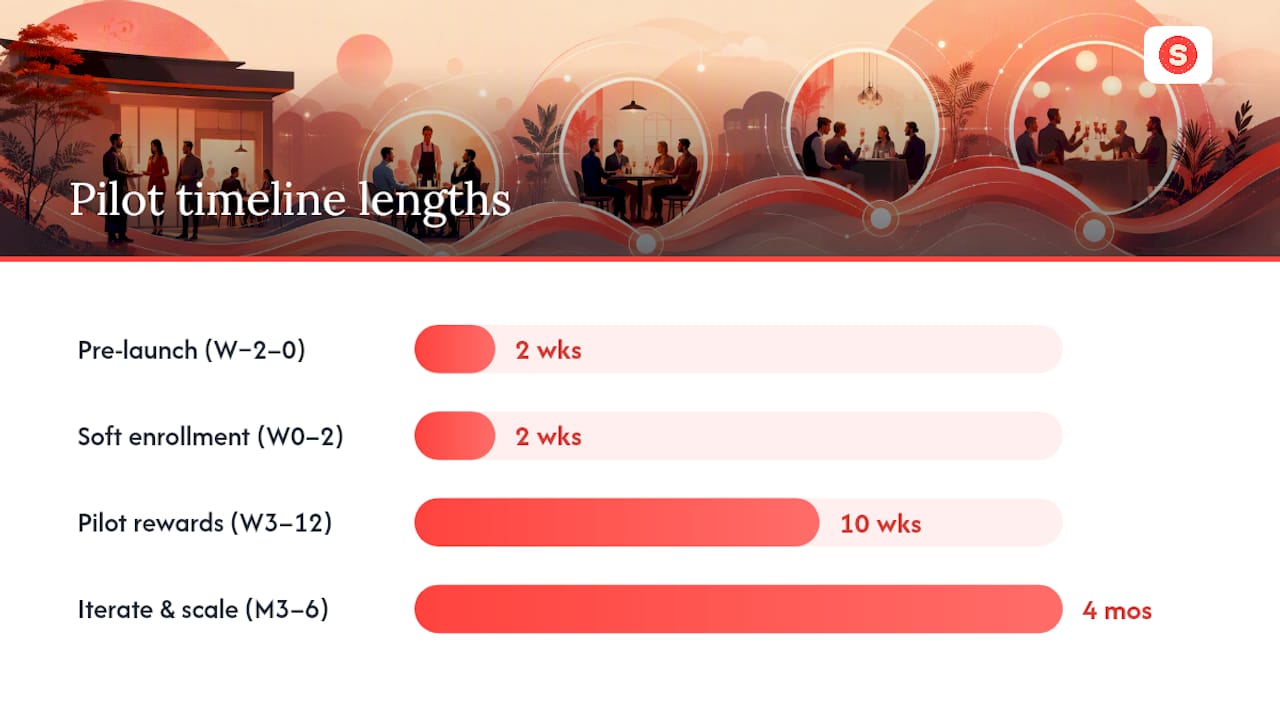
- Pre-launch (week minus 2 to 0): Confirm POS integration or data-capture method. Set up enrollment channels: QR code on receipts, SMS magic link at checkout, and a link in your online ordering confirmation. Write a two-sentence staff script. Define your pilot reward (example: a free item after five visits).
- Weeks 0–2 (soft enrollment): Go live with data capture only. No automated campaigns yet. Track daily enrollment rate and fix any friction in the sign-up flow before you start sending messages.
- Weeks 3–12 (pilot rewards + measure): Activate your first automation: a welcome message on sign-up and a win-back SMS at 30 days of inactivity. Run your pilot reward. Pull weekly repeat visit rate and compare to your pre-launch baseline.
- Months 3–6 (iterate and scale): If cohort data shows a measurable lift in repeat visit rate or median return timing, add a second automation (birthday offer, lapsed-guest campaign). Expand enrollment channels. Review reward economics: if redemption lift is negative, adjust the offer before scaling.
Gate criteria for scale: clear cohort lift in repeat visit rate or a positive member CLV versus subscription cost within the pilot period. If neither shows up by month three, fix the enrollment flow or the reward before adding budget.
Pro Tip: Require a CSV export of member records, visit history, and redemptions in your contract before you sign. If the vendor will not commit to this in writing, walk away.
Common mistakes restaurants make with loyalty programs
The most common error is automating campaigns before you own a reliable first-party guest dataset. Sending win-back messages to a list of 40 people does not move the needle; building the list first does.
Red flags to watch for:
- Vendor walled gardens: No CSV export means you are renting your audience, not owning it.
- Weak POS integration: Manual check-in flows kill enrollment rates and produce unreliable data.
- Rewards that erode margin: A 20% discount on every fifth visit can cost more than the incremental revenue it generates. Model the economics before launch.
- Complicated enrollment flows: Every extra tap in the sign-up process cuts enrollment. QR-to-SMS is the lowest-friction path for most dine-in operators.
- Skipping staff training: Front-of-house staff who do not understand the program or cannot explain it in one sentence will not enroll guests. A two-minute script and a daily enrollment target fix this.
Pro Tip: Design your first reward to encourage a profitable repeat visit, not a discount on the current one. “Free dessert on your next visit” costs less and brings the guest back; “10% off today” just reduces tonight’s check.
How Sorbey maps to the 2026 loyalty checklist
Sorbey meets the core operator requirements: POS integration options, exportable first-party guest lists, built-in SMS and email automations, and reporting that tracks the KPIs that matter.
| Checklist Priority | Sorbey Feature | Expected Operator Outcome |
|---|---|---|
| First-party data export | Exportable CRM with member and visit history | Audience ownership; no lock-in risk |
| POS-native identity resolution | CRM linked to online ordering and reservation data | Faster list growth with less manual effort |
| SMS + email automations | Pre-built templates: welcome, win-back, birthday | Campaigns running within days of launch |
| Cohort analytics and reporting | Dashboard with repeat visit and campaign attribution | ROI visible within first 90-day pilot |
| Staff enrollment UX | QR receipt and SMS magic link enrollment | Higher enrollment rate at checkout |
Sorbey’s blog, authored by Barthelemy, covers practical loyalty program mechanics and enrollment tactics that independent operators can replicate without a marketing team.
Key Takeaways
The fastest path to loyalty ROI is capturing first-party guest data before automating, piloting one reward mechanic, and measuring repeat visit frequency and return timing against a pre-launch baseline within 90 days.
| Point | Details |
|---|---|
| Data ownership first | Require CSV export of members, visits, and redemptions in your contract before signing. |
| POS integration is the foundation | Passive identity resolution builds your list faster than any manual enrollment method. |
| Measure repeat visit frequency | Track return timing and redemption lift weekly in the first 90 days to validate payback. |
| Pilot one reward before scaling | Launch a single simple reward and measure cohort lift before adding automations or budget. |
| Sorbey for independents | Sorbey provides exportable CRM, pre-built automations, and cohort analytics built for independent restaurants. |
What most loyalty advice gets wrong
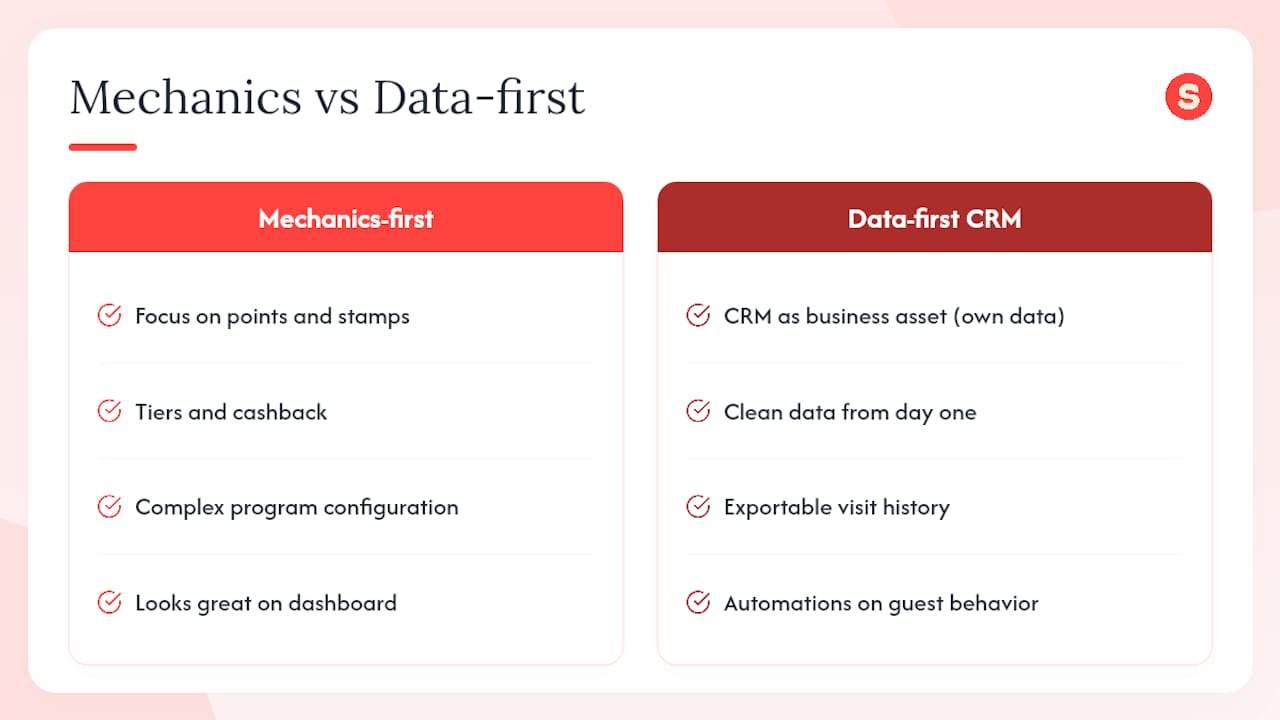
Most loyalty program guides focus on the mechanics: points versus stamps, tiers versus cashback. That is the wrong starting point. The real question is whether you own the data the program generates.
I have seen operators spend months configuring a sophisticated tiered program, only to discover their platform does not export visit history in a usable format. When they want to switch vendors or run a custom campaign, they are starting from zero. The program looked great on the dashboard and did nothing for their actual business continuity.
The operators who get the most out of loyalty are not the ones with the most complex programs. They are the ones who treat the CRM as a business asset from day one: clean data, exportable records, and automations that fire on real guest behavior rather than arbitrary calendar dates. A win-back SMS triggered when a guest has not visited in 28 days outperforms a monthly newsletter every time, because it is responding to something that actually happened.
See Sorbey in action: what a demo covers
Independent restaurants that want to move from research to a running pilot in under 30 days can book a Sorbey demo to see member export, automation templates, and a pilot plan mapped to their specific POS setup.
A standard demo covers three things: a live walkthrough of the data export format so you can confirm portability, sample automation templates (welcome, win-back, birthday) ready to activate, and a pilot cost estimate based on your location count and estimated member volume.
Bring to the meeting: your current POS system name, a rough sense of monthly cover count, and your top-line goal (enrollment rate, repeat visit lift, or revenue per member). Thirty minutes is enough to get a working pilot plan. Operators who want to model the economics first can start with Sorbey’s free restaurant tools and calculators before the call.
Sources and Further Reading
These sources were selected for operator-facing, analytics-first guidance rather than consumer-facing program reviews Sorbey’s internal resources include templates and calculators for pilot economics.
- How to Choose a Restaurant Loyalty Program Platform With Analytics — Loopy Loyalty
- Restaurant CRM: 2026 Guide + Free CLV Calculator — Tableview
- Benefits of a Restaurant CRM — The Access Group
- Restaurant Loyalty Programs: Who Does It Best — Buy Wendy’s
- Boost Restaurant Loyalty With 10 Proven Engagement Tips — Sorbey Blog
- Examples of Restaurant Loyalty Programs That Actually Work — Sorbey Blog
- The Role of Analytics in Restaurants: 2026 Guide — Sorbey Blog
Recommended
You might also like

Why Mobile Marketing Matters for Business Growth
Discover why mobile marketing matters for business growth. Learn how optimizing for mobile drives traffic, conversions, and customer retention.

SF Dim Sum Restaurant Marketing Checklist for 2026
Transform your SF dim sum with our 2026 marketing checklist. Optimize your profile, showcase dishes, and attract customers fast!
QR Code Menu Benefits Every Restaurant Owner Should Know
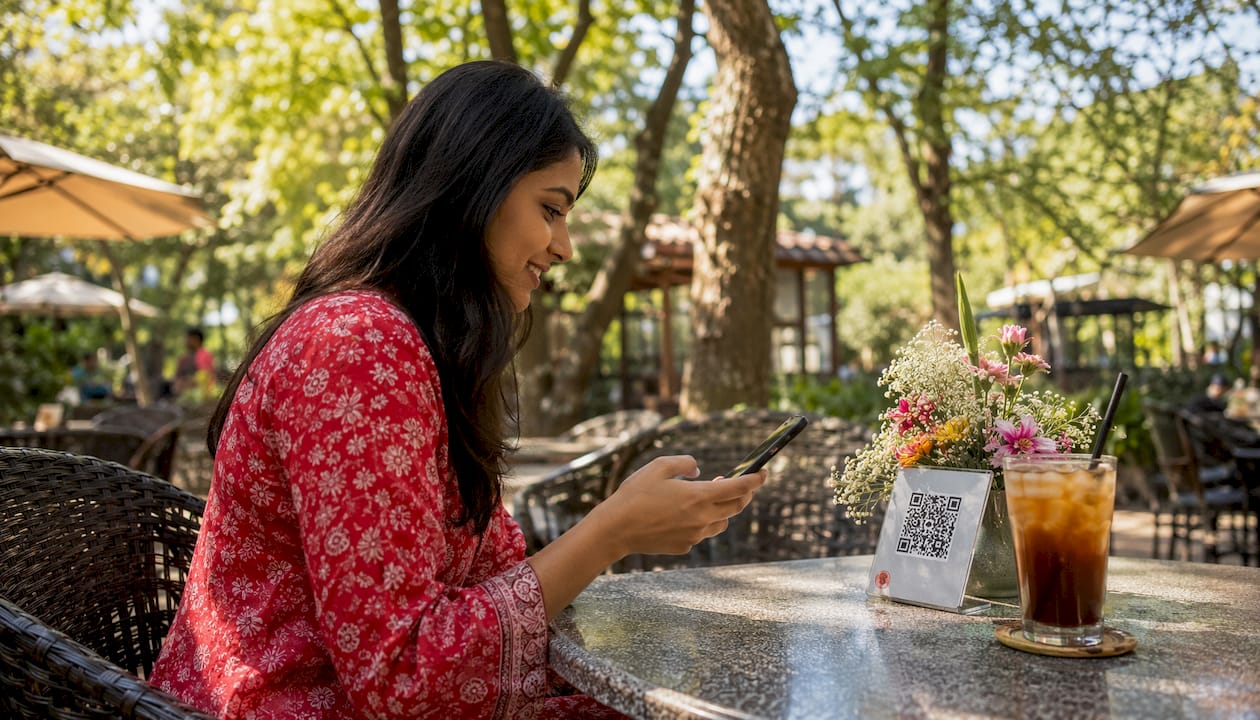
Unlock the la restaurant QR code menu benefits: enhance customer experience, save costs, and boost revenue with real-time updates!