
Blog
Defining Cross-Promotion: A Practical Guide for Marketers
Discover defining cross-promotion strategies that boost brand trust, generate leads, and reduce acquisition costs. Start growing today!

Defining Cross-Promotion: A Practical Guide for Marketers
TL;DR:
- Cross-promotion involves non-competing brands jointly promoting to expand their audiences without direct media costs. Its success depends on genuine collaboration, clear goals, and careful partner selection to maximize brand trust and lead generation. Measuring results through key metrics helps optimize ongoing campaigns and avoid common pitfalls like brand mismatch and misaligned incentives.
Cross-promotion is defined as a marketing arrangement where two or more non-competing brands promote each other’s products or services to mutually expand their reach without direct media spending. Unlike paid advertising, it trades audience access as currency, making it one of the most cost-efficient growth tactics available to marketing professionals and business owners. When executed well, cross-promotion builds brand trust, generates qualified leads, and lowers customer acquisition costs. This guide covers the core definition, proven strategies, a step-by-step implementation framework, common pitfalls, and how to measure results.
What is cross-promotion and how does it work?
Cross-promotion is a low-cost marketing arrangement where brands trade audience access instead of cash. One brand promotes another to its existing customers through email lists, social media, in-store signage, or digital content, and the partner does the same in return. No media budget changes hands. The value exchanged is reach.
Cross-promotion is also distinct from cross-selling. Cross-promotion builds awareness at the top of the funnel across two separate brands, while cross-selling drives additional purchases within a single brand. A restaurant partnering with a local wine shop to co-promote a dinner event is cross-promotion. That same restaurant upselling dessert to a diner who ordered an entrée is cross-selling. Understanding the difference shapes how you structure campaigns and set goals.
The most effective partnerships connect complementary, non-competing brands that share overlapping audiences. A bakery and a specialty coffee roaster serve the same morning customer. A fitness studio and a healthy meal prep service serve the same health-conscious professional. Audience cross-pollination increases reach without creating direct competition between partners.
What are the main benefits of cross-promotion?
Cross-promotion delivers measurable advantages across several business objectives. The core benefits include:
- Audience expansion. Your brand reaches a pre-warmed audience that already trusts your partner. That trust transfers, making new customer conversion faster and cheaper than cold outreach.
- Cost efficiency. Cross-promotion requires zero direct advertising fees in most cases. Brands use channels they already own, so the incremental cost is primarily time and content creation.
- Brand visibility. Appearing in a partner’s email newsletter or social feed puts your brand in front of people who may never have encountered you through paid channels.
- Lead generation. Joint offers, co-branded landing pages, and referral programs capture new contacts directly into your pipeline.
- Lower customer acquisition cost. Shared promotions split the effort of reaching new customers. Each brand benefits from the other’s existing marketing infrastructure.
Cross-promotion also supports longer-term objectives like email list growth and brand equity building. A well-chosen partner lends credibility to your brand by association. That credibility compounds over time, especially when the partnership is ongoing rather than a single campaign. Skipping goal-setting before launching is the most common mistake. Clear goals dictate campaign structure, call-to-action design, and which partner type fits best.
Pro Tip: Set one primary KPI per campaign, whether that is new email subscribers, foot traffic, or direct sales. Trying to measure everything at once produces data that is hard to act on.
Which cross-promotion strategies actually work?
Effective cross-promotion goes well beyond tagging a partner in a social post. The tactics that consistently produce results require genuine creative collaboration.
- Co-branded social media campaigns. Both brands create original content around a shared theme and publish it simultaneously. A restaurant and a local brewery might co-create a “perfect pairing” series, each posting from their own accounts with consistent messaging and visuals.
- Joint webinars or live events. Two brands host a shared event, each promoting it to their own audience. Both lists grow. Both brands gain credibility from the other’s expertise.
- Product bundles. Combining two complementary products into a single offer increases perceived value. A meal kit service bundling with a wine subscription, for example, creates a stronger purchase incentive than either product alone. For food and beverage businesses, wine pairing partnerships are a natural fit for this format.
- Guest content exchanges. Each brand contributes a blog post, newsletter feature, or video to the other’s platform. This drives referral traffic and builds SEO authority for both parties.
- Referral programs with exclusive offers. Each brand gives its audience a unique discount or perk redeemable with the partner. Tracking redemptions also provides clean attribution data.
Social media cross-promotion requires intentional content adaptation per platform, not simple resharing. A caption that works on Instagram reads differently on LinkedIn. Long-term partnerships outperform one-off deals because audiences need repeated exposure to a new brand before they act.
Pro Tip: Prioritize partners you would genuinely recommend to your best customers. If the partnership feels forced to you, it will feel forced to your audience.
How to implement cross-promotion effectively
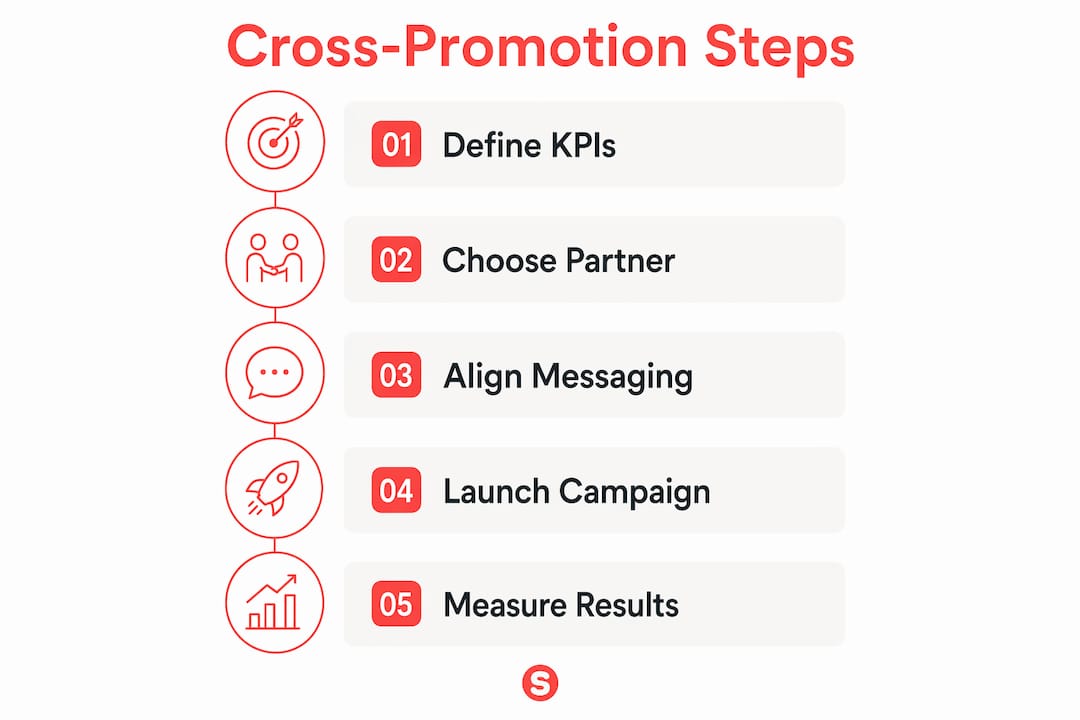
A structured process prevents the most common failures. The five steps below apply whether you are running a local restaurant campaign or a national co-branded launch.

| Step | Action | Key consideration |
|---|---|---|
| 1. Define KPIs | Set one primary metric per campaign | Sales lift, new subscribers, or foot traffic — pick one |
| 2. Vet partners | Conduct a brand audit of potential partners | Audience overlap, brand values, and content quality must align |
| 3. Adapt content | Create platform-specific assets for each channel | Avoid copy-pasting the same message across all formats |
| 4. Execute campaign | Launch with coordinated timing across both brands | Misaligned timing is a leading cause of underperformance |
| 5. Track results | Measure against your defined KPI | Adjust messaging or timing based on early data |
Failing to align messaging or mistiming content launches are the two most common causes of cross-promotion underperformance. Both are preventable with a written campaign brief shared between partners before any content goes live.
Formal agreements matter more than most marketers expect. A written document covering creative approval rights, promotion timelines, exit clauses, and exclusivity terms protects both brands. Verbal agreements create ambiguity when results disappoint or one partner wants to exit.
Pro Tip: Include a creative approval step in your agreement. Both brands should sign off on all content before it publishes. This prevents off-brand messaging from reaching either audience.
For restaurant owners specifically, mobile marketing tactics integrate naturally with cross-promotion campaigns, particularly for driving foot traffic and redemption tracking through SMS or app-based offers.
What common challenges and risks should marketers avoid?
Cross-promotion carries real risks when executed carelessly. The most damaging is brand dilution. If your partner’s brand standards, audience values, or content quality do not match yours, the association harms your reputation rather than building it.
- Poor partner fit. A luxury restaurant partnering with a discount coupon platform sends conflicting signals to both audiences. The mismatch erodes trust on both sides.
- Misaligned incentives. If one partner benefits significantly more than the other, the relationship breaks down quickly. Define the value exchange clearly before launch.
- Offer exploitation. Poorly designed promotions can be gamed by customers in ways that cost far more than anticipated.
- Brand risk from association. If a partner faces a public relations crisis, your brand is adjacent to it. Due diligence before signing any agreement is non-negotiable.
“Rigorous stress-testing of offer mechanics and formalized agreements with creative approvals and exit clauses are the difference between a successful cross-promotion and a costly mistake.” — Wikipedia on cross-promotion
The 1992 Hoover free flights promotion is the most cited cautionary tale in cross-promotional marketing. Hoover offered free transatlantic flights to customers who purchased appliances over £100. The flights cost more than the appliances. The promotion was exploited at massive scale, resulting in costly promotional backfires that damaged the brand and led to legal action. The lesson is simple: stress-test your offer mechanics before launch, not after.
A brand audit of any potential partner should review their content history, customer reviews, social media tone, and any past controversies. This takes a few hours and can prevent months of reputational damage.
How can businesses measure and optimize cross-promotion campaigns?
Measurement starts before the campaign launches. Key metrics for cross-promotion include sales growth, new customer acquisition, engagement levels, and brand awareness indicators. Each maps to a different campaign objective.
- Sales lift. Compare revenue during the campaign period to a comparable baseline period. Use unique promo codes per partner to attribute sales accurately.
- New customer acquisition. Track how many first-time buyers or new email subscribers came through the partner channel specifically.
- Engagement. Monitor likes, shares, comments, and click-through rates on co-branded content. Low engagement signals a messaging or audience fit problem.
- Brand awareness. Survey a sample of your audience before and after the campaign. Ask whether they recognize the partner brand. A lift in recognition confirms reach expansion.
Adjust based on early data rather than waiting until the campaign ends. If a co-branded Instagram post outperforms the email version in the first 48 hours, shift more promotion to that channel. Data-driven adjustments mid-campaign consistently improve final results.
For local restaurants, tracking in-store redemptions of partner offers provides the clearest signal of cross-promotion ROI. Sorbey’s platform supports this kind of campaign tracking alongside social media execution for food and beverage businesses.
Key Takeaways
Cross-promotion works when non-competing brands share audiences intentionally, align on goals before launch, and measure results against a single defined KPI.
| Point | Details |
|---|---|
| Define goals first | Set one primary KPI before choosing a partner or building any content. |
| Vet partners carefully | Conduct a brand audit to confirm audience overlap and value alignment. |
| Adapt content per platform | Resharing the same post across channels underperforms tailored messaging. |
| Formalize the agreement | Written terms covering approvals, timelines, and exit clauses protect both brands. |
| Measure and adjust | Track sales lift, new acquisition, and engagement, then shift resources to what works. |
Why most cross-promotions fail before they start
Cross-promotion is one of those tactics that looks simple until you try to execute it. I have watched well-funded campaigns collapse not because the idea was wrong, but because the two brands never agreed on what success looked like. One partner wanted email subscribers. The other wanted foot traffic. Neither told the other. The campaign ran, both metrics moved slightly, and both teams declared it a disappointment.
The relationship-driven nature of cross-promotion is what makes it genuinely different from paid advertising. You are not buying impressions. You are borrowing trust. That trust is fragile. An audience that follows a brand they love will notice immediately if that brand starts promoting something that feels off. Authenticity is not a soft concept here. It is the mechanism by which the whole thing works.
The brands I have seen succeed consistently treat cross-promotion as a long-term channel, not a campaign. They find two or three partners whose audiences genuinely overlap, build real relationships with those teams, and run coordinated promotions across multiple touchpoints over months. The compounding effect of repeated exposure through a trusted source is far more powerful than any single co-branded post.
My advice: start with one partner, run one campaign, measure it honestly, and decide whether the relationship is worth continuing. Most marketers try to scale before they have proven the model. Prove it first.
— Barthelemy
How Sorbey supports your cross-promotion campaigns
Running cross-promotion well requires coordination across content, timing, tracking, and partner communication. For local restaurants and food and beverage businesses, that coordination is exactly what Sorbey handles.
Sorbey’s restaurant marketing services include co-branded content creation, campaign planning, and performance tracking built specifically for local businesses. Whether you are launching a joint promotion with a neighboring business or building a referral program with a complementary brand, Sorbey provides the tools and support to execute it cleanly. You can also explore influencer partnership examples from the food and beverage sector to see how similar businesses have built cross-promotional campaigns that drive real reservations and revenue.
FAQ
What is cross-promotion in marketing?
Cross-promotion is a marketing arrangement where two non-competing brands promote each other’s products or services to their respective audiences. It trades audience access instead of cash, making it a cost-efficient alternative to paid advertising.
How is cross-promotion different from cross-selling?
Cross-promotion builds awareness across two separate brands at the top of the funnel. Cross-selling drives additional purchases within a single brand from existing customers.
What are the most effective cross-promotion tactics?
Co-branded social campaigns, joint events, product bundles, guest content exchanges, and referral programs with exclusive offers consistently produce results. Platform-specific content adaptation outperforms simple resharing.
How do you measure cross-promotion success?
Track sales lift, new customer acquisition, engagement rates, and brand awareness before and after the campaign. Use unique promo codes per partner to attribute results accurately.
What is the biggest risk in cross-promotion?
Brand dilution from a poorly matched partner is the most damaging risk. A formal brand audit of any potential partner before signing an agreement prevents most reputation-related failures.
Recommended
You might also like

Best Restaurant Loyalty Programs 2026: ROI Guide
Discover the best restaurant loyalty programs 2026 that boost repeat visits. Learn how Sorbey’s platform can transform your guest data strategy!

Why Mobile Marketing Matters for Business Growth
Discover why mobile marketing matters for business growth. Learn how optimizing for mobile drives traffic, conversions, and customer retention.

SF Dim Sum Restaurant Marketing Checklist for 2026
Transform your SF dim sum with our 2026 marketing checklist. Optimize your profile, showcase dishes, and attract customers fast!