
Blog
What is hyperlocal marketing? Strategies for restaurants
Learn what hyperlocal marketing is and discover proven strategies that help restaurants attract nearby customers, increase reservations, and build neighborhood loyalty.
What is hyperlocal marketing? Strategies for restaurants
TL;DR:
- Hyperlocal marketing targets neighborhoods and specific areas for higher engagement and conversion.
- Effective strategies include Google Business Profile optimization, geofencing, and local influencer partnerships.
- Proper execution requires attention to privacy, data accuracy, and consistent community involvement.
Most restaurant owners think showing up in local search results is enough. Run a few Facebook ads targeting your city, keep your hours updated, and customers will come. But that assumption costs real revenue every single week. Hyperlocal marketing operates on a completely different level, one that zeroes in on the blocks, zip codes, and neighborhoods directly surrounding your restaurant. This article breaks down exactly what hyperlocal marketing is, how it differs from standard local marketing, which strategies deliver measurable results, and what pitfalls to watch out for before you spend a dime.
Table of Contents
- Defining hyperlocal marketing for restaurants
- Hyperlocal versus local marketing: What’s the difference?
- Proven hyperlocal marketing strategies for restaurants
- Navigating risks and challenges of hyperlocal marketing
- Why most restaurants undervalue hyperlocal—and how to win
- Supercharge your restaurant’s hyperlocal marketing
- Frequently asked questions
Key Takeaways
| Point | Details |
|---|---|
| Hyperlocal targets micro-areas | Focusing on neighborhoods or even city blocks attracts customers who are ready to dine nearby. |
| Personalization boosts results | Tailoring offers by location leads to higher conversion and engagement for restaurants. |
| Real successes, real numbers | Restaurants see up to 20% more reservations and hundreds of new customers with effective hyperlocal tactics. |
| Balance focus with scale | Start hyperlocal, but be ready to broaden your targeting if the nearby audience is too small for your business goals. |
| Community is key | Authentic, local-focused content and partnerships drive stronger engagement than generic city-wide marketing. |
Defining hyperlocal marketing for restaurants
Hyperlocal marketing is not just a trendier name for local advertising. It is a fundamentally different approach. Hyperlocal marketing focuses on very specific geographic areas like neighborhoods, zip codes, or a 1 to 5 mile radius around your business. That precision is what makes it powerful.
Think about the difference between blasting an ad to everyone in Chicago versus targeting only the people who live within six blocks of your Logan Square bistro. The second approach means your message reaches people who can realistically walk through your door tonight, not someone 14 miles away.
The core mechanics of hyperlocal marketing include geolocation and GPS, IP address tracking, “near me” search optimization, geofencing, local SEO, and push notifications. Each of these tools lets you speak directly to people based on where they are right now, not just where they live in a general sense.
Here is why restaurants benefit specifically:
- Higher conversion rates: People searching “pizza near me” are ready to eat, not just browsing.
- More relevant offers: A Tuesday lunch deal lands differently on someone two blocks away than someone across town.
- Stronger community ties: Consistent neighborhood-level presence builds loyalty that chain restaurants rarely achieve.
- Better ROI on ad spend: Smaller, targeted audiences mean fewer wasted impressions.
- Authentic competitive edge: Chains scale wide. You can go deep.
Pro Tip: Before running any hyperlocal campaign, make sure your Google Business Profile is fully optimized with accurate hours, photos, and categories. It is the foundation every hyperlocal tactic builds on.
The distinction matters because restaurants that treat hyperlocal as simply “local with a smaller map” miss the strategic depth entirely. Hyperlocal is about intent, proximity, and real-time relevance working together.
Hyperlocal versus local marketing: What’s the difference?
Now that we’ve defined hyperlocal marketing, it’s important to understand how it differs from standard local marketing.
Hyperlocal targets micro-locations with high personalization and conversion potential, while local marketing covers broader city or regional areas with less precision. Here is a direct comparison:
| Factor | Local marketing | Hyperlocal marketing |
|---|---|---|
| Area covered | City or metro region | Neighborhood, zip code, 1 to 5 mile radius |
| Cost | Moderate to high | Lower per impression |
| Personalization | General messaging | Highly specific, location-aware |
| Conversion rate | Lower | Significantly higher |
| Best for | Brand awareness | Driving immediate foot traffic |
Local marketing builds name recognition across a wide area. That has value, especially when you are opening a new location or rebranding. But it does not move the needle on Tuesday night walk-ins.
Hyperlocal is where smaller, independent restaurants can genuinely outperform chains. A chain has the budget to dominate city-wide campaigns. You have something they cannot buy: authentic neighborhood presence. When your Google My Business listing shows up with 200 local reviews and your competitor shows up with 12, you win the hyperlocal moment.
“The restaurant down the street is not your only competition. The real competition is the customer’s decision to cook at home. Hyperlocal marketing makes going out feel like the obvious, convenient choice.”
Small and medium businesses that invest in hyperlocal strategies consistently out-convert larger competitors within their immediate area. The reason is simple: relevance beats reach every time when someone is hungry and looking for a place to eat right now. Pairing hyperlocal ads with solid local SEO steps creates a one-two punch that is very difficult for chains to replicate at the neighborhood level.
Proven hyperlocal marketing strategies for restaurants
Once you know the difference, it’s time to ask: what actually works on the ground for restaurant success?
The most effective restaurant strategies combine Google Business Profile optimization, geofencing, geo-targeted ads, micro-influencers, community events, and local partnerships. Each tactic reinforces the others.
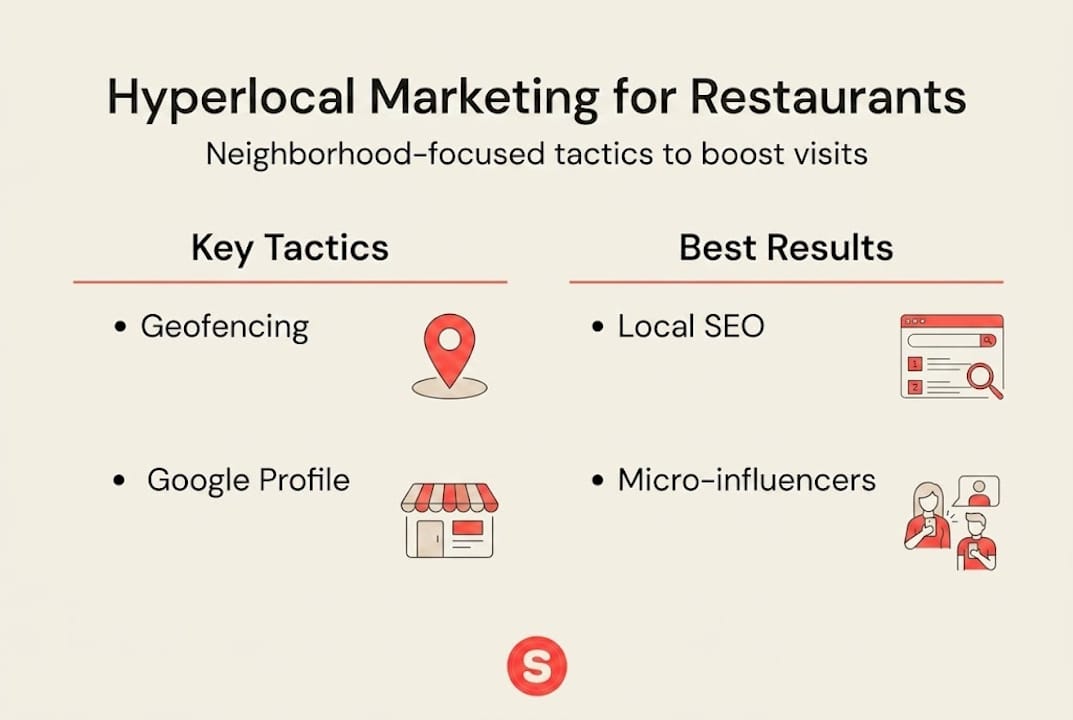
Consider Rosa’s Italian, a neighborhood restaurant that used geofencing around nearby competitors and partnered with micro-influencers active in their specific zip code. The result was a 20% jump in reservations within just a few months. That is not a coincidence. That is a system.
Mission Seafood ran hyperlocal digital ads targeted to residents within a tight radius and brought in 1,100 new customers in 90 days. No massive budget. No city-wide campaign. Just precise targeting and a compelling offer delivered to the right people.
Here are the top hyperlocal tactics worth building into your marketing plan:
- Google Business Profile: Keep it updated daily. Respond to every review. Post weekly specials.
- Geofencing: Set up virtual boundaries around your restaurant, nearby offices, and competitor locations to serve ads to people in those zones.
- Geo-targeted social ads: Run Instagram and Facebook ads filtered by a tight geographic radius, not just your city.
- Micro-influencer partnerships: Find food creators with 2,000 to 15,000 followers who are active specifically in your neighborhood.
- Community events: Sponsor local school fundraisers, farmers markets, or neighborhood block parties.
- Local business partnerships: Offer lunch deals with nearby offices or co-promotions with complementary businesses.
For deeper technical groundwork, pairing these tactics with step-by-step local SEO ensures your restaurant surfaces in organic searches and paid placements simultaneously.
Pro Tip: Micro-influencers in your specific zip code deliver more authentic engagement than larger influencers with regional reach. Their audience trusts them precisely because they are local, not because they are famous.
Navigating risks and challenges of hyperlocal marketing
Of course, hyperlocal marketing isn’t just plug-and-play; navigating its challenges is essential.
Privacy compliance, limited scale, tech demands, and the need for precise data are the recurring challenges that trip up restaurants new to hyperlocal strategies. Here is what to watch:
- Privacy compliance: Geofencing and location-based ads must comply with GDPR and CCPA regulations. Collecting location data without proper consent can expose your business to legal risk. Always use opt-in messaging and work with ad platforms that handle compliance for you.
- Narrow audience size: Targeting a six-block radius sounds powerful, but if your neighborhood only has 3,000 residents, your potential reach may not justify certain ad platforms’ minimum spend requirements. Know your density before committing budget.
- Tool and technology complexity: Geofencing platforms, analytics dashboards, and local ad managers each have learning curves. Many restaurant owners underestimate the time investment to run these tools effectively.
- High content localization workload: Hyperlocal content needs to feel genuinely neighborhood-specific, not just mentioning the zip code. That takes consistent creative effort.
- Data accuracy requirements: Hyperlocal only works if your underlying data, addresses, hours, and targeting parameters, are precisely correct. Small errors have an outsized impact.
Pro Tip: Start with a narrow hyperlocal focus to test your messaging. If your audience size is too small to generate results, expand the radius incrementally rather than abandoning the approach entirely.
Making sure your restaurant’s visibility is fully dialed in before layering on paid hyperlocal tactics prevents wasted spend and sets a stronger baseline for measuring results.
The restaurants that navigate these challenges well treat hyperlocal as a long game. They test, adjust, and build audience trust gradually rather than expecting instant results from day one.
Why most restaurants undervalue hyperlocal—and how to win
Having covered the practical and the pitfalls, here is a perspective from real restaurant marketing experience.
Most restaurant owners stop at “local” because it feels safe. A city-wide ad feels like a bigger swing. It looks impressive in a report. But safe often means average, and average does not fill tables on a slow Wednesday.
The uncomfortable truth is that authentic local content consistently outperforms generic approaches, and privacy and opt-in matter deeply to the neighborhoods you are trying to reach. When your marketing feels manufactured, your neighbors notice. They can tell the difference between a restaurant that actually knows their community and one that is just running ads at them.
Over-personalization carries its own risk. Customers find it unsettling when ads feel like surveillance. The sweet spot is relevance without creepiness: mentioning the neighborhood, the local event, or the shared experience, not tracking individuals.
The deeper insight is this: the restaurant that builds real local relevance offline and online will outperform the best digital ad campaign every single time. Show up at the school fundraiser. Partner with the yoga studio next door. Respond to every Google review like a neighbor, not a corporate account. Then amplify those real community connections through hyperlocal digital tactics. That combination is genuinely hard to replicate.
Explore our guide on restaurant listings to make sure your foundation supports everything built on top of it.
Supercharge your restaurant’s hyperlocal marketing
The strategies in this article work. But knowing what to do and having the systems to execute consistently are two very different things. Most restaurant teams are already stretched thin running daily operations.
Sorbey’s restaurant marketing services are built specifically for local restaurants that want hyperlocal results without hiring a full marketing team. From Google Business Profile management to geo-targeted ad campaigns, every tool is designed for food businesses competing at the neighborhood level. Not sure where to start? Use the free marketing ROI calculator to see what your current efforts are actually returning, or run your numbers through the marketing budget calculator to plan your next campaign with clarity.
Frequently asked questions
How is hyperlocal marketing different from regular local marketing?
Hyperlocal marketing targets small, precise areas like your immediate neighborhood or zip code, while local marketing covers broader city or regional zones with less precision and lower conversion rates.
What are essential tools for restaurant hyperlocal marketing?
Key tools include Google Business Profile, geofencing, geo-targeted ads, local SEO, and partnerships with local influencers, all of which drive measurable foot traffic when used together.
What results can restaurants expect from hyperlocal strategies?
Rosa’s Italian reported a 20% reservations increase using geofencing and micro-influencers, while Mission Seafood gained 1,100 new customers in 90 days through hyperlocal ads.
Are there risks to using hyperlocal marketing?
Yes, the primary risks include privacy law compliance, limited audience size in tight geographies, high content workload, and the need for accurate targeting data.
Recommended
You might also like

Best Restaurant Loyalty Programs 2026: ROI Guide
Discover the best restaurant loyalty programs 2026 that boost repeat visits. Learn how Sorbey’s platform can transform your guest data strategy!

Why Mobile Marketing Matters for Business Growth
Discover why mobile marketing matters for business growth. Learn how optimizing for mobile drives traffic, conversions, and customer retention.

SF Dim Sum Restaurant Marketing Checklist for 2026
Transform your SF dim sum with our 2026 marketing checklist. Optimize your profile, showcase dishes, and attract customers fast!