
Blog
Maximize restaurant marketing: how AI drives engagement
Learn how AI boosts restaurant marketing with automation, local SEO, and personalization tactics built for metro-area owners and marketers in 2026.
Maximize restaurant marketing: how AI drives engagement
TL;DR:
- AI aids restaurant marketing but effective results require human oversight and brand authenticity.
- Local SEO and review management are crucial for gaining visibility in AI-driven search results.
- Combining AI automation with creative human input builds loyal customer relationships in competitive markets.
AI won’t replace the chef’s instinct that makes your regulars feel at home, but ignoring it may cost you their next visit. 44-73% of U.S. restaurants are already using or planning AI for marketing, while 81% are increasing digital spend. For restaurant owners and marketers in metro areas, the noise around AI is loud and often contradictory. Some vendors promise transformative results overnight. Others warn it strips your brand of personality. The truth sits squarely in the middle, and this guide breaks it all down with practical strategies, honest limitations, and tactics built for competitive city markets.
Table of Contents
- AI adoption in restaurant marketing: The current landscape
- How AI automates content and personalizes engagement
- Pitfalls of AI marketing: Authenticity, trust, and integration failures
- AI-powered local search and metro-area optimization tactics
- Our take: Why the smartest restaurants blend AI automation with human creativity
- Next steps: Boost your restaurant marketing with expert AI solutions
- Frequently asked questions
Key Takeaways
| Point | Details |
|---|---|
| AI automates content efficiently | AI tools generate campaigns for emails, texts, and social posts using real-time restaurant data with minimal manual work. |
| Personalization boosts engagement | Integrating AI with POS and CRM enables highly targeted messaging, improving customer response and satisfaction. |
| Human oversight is essential | Owners must review AI-generated marketing to avoid generic messaging and preserve brand authenticity. |
| Local SEO maximizes AI impact | Structured data and regular listing updates enhance AI-driven discoverability in metro areas. |
| Careful integration yields ROI | Restaurants see meaningful results from AI only when automation is combined with human review and local optimization strategies. |
AI adoption in restaurant marketing: The current landscape
The numbers tell a compelling story. Restaurant AI adoption trends show that AI is no longer a novelty reserved for enterprise chains. Independent restaurants and regional groups in metro areas are jumping in fast, and the data reveals why.
According to recent research, 55% of restaurants use AI specifically for marketing content creation. Yet benchmarking ROI stats reveal a striking gap: only 5-9% of restaurants report meaningful ROI from their AI marketing investments. That gap is the story every metro-area restaurant owner needs to understand before spending another dollar on AI tools.
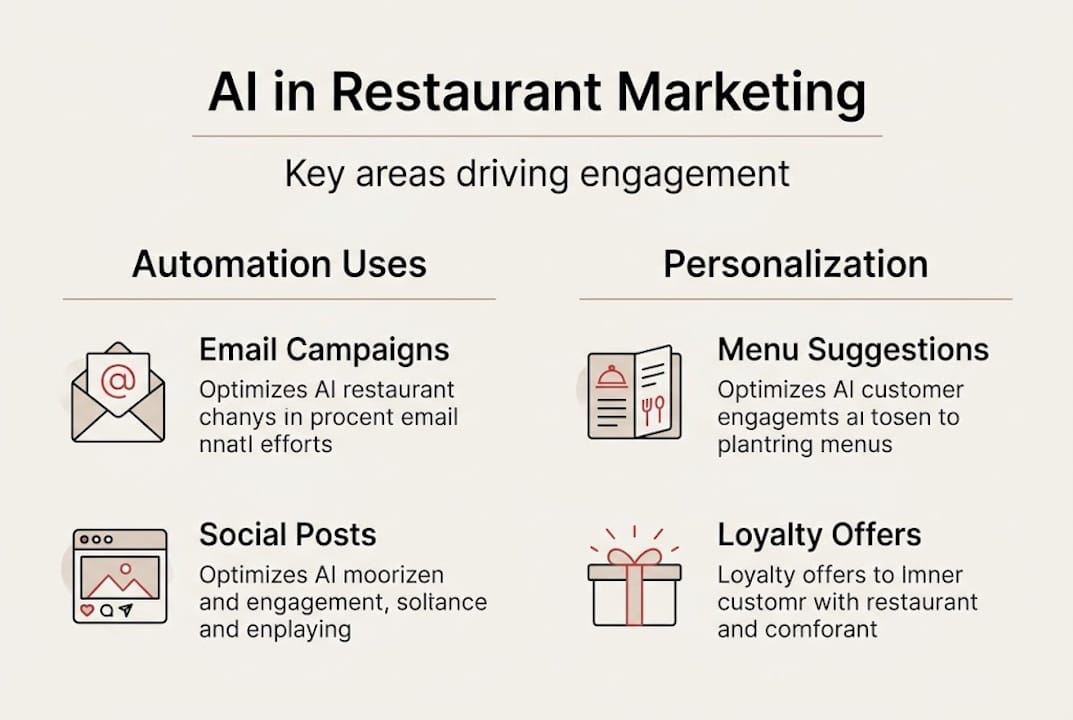
Here is a snapshot of where restaurants stand in 2026:
| AI use case | Adoption rate |
|---|---|
| Marketing content creation | 55% |
| Email and SMS automation | 48% |
| Personalization and targeting | 39% |
| Review management | 31% |
| Social media scheduling | 44% |
The top reasons restaurants adopt AI include:
- Reducing time spent on repetitive content tasks
- Scaling personalized outreach without adding staff
- Improving digital spend efficiency across channels
- Automating review responses and reputation management
Stat spotlight: Email and SMS automation powered by AI can deliver ROI between 15x and 118x when properly integrated. Yet only a small fraction of restaurants get there.
The gap between promise and delivery comes down to one word: integration. Restaurants that plug AI tools into existing POS and CRM systems, maintain human oversight, and treat AI as a workflow tool see results. Those that treat it like a vending machine for content rarely do. Understanding this distinction is the first move any serious metro-area restaurant marketer should make.
How AI automates content and personalizes engagement
Knowing what AI can actually do in practice is far more useful than reading vendor pitch decks. Platforms like Popmenu and HostBuddy are designed specifically for restaurants. They pull data from your menu, recent reviews, upcoming events, and reservation history to generate emails, text messages, and social posts automatically.
The workflow typically looks like this:
- Connect your data sources: Link your POS, reservation system, and review platforms to the AI tool.
- Set content parameters: Define tone, brand guidelines, posting frequency, and target segments.
- AI generates drafts: The platform creates emails, captions, and SMS messages based on live data.
- Owner or marketer reviews: You approve, edit, or reject content before it goes live.
- Schedule and publish: Approved content goes out automatically on your set timeline.
- Analyze performance: Review open rates, click-throughs, and redemption data to refine future content.
The key capability is real-time personalization using POS and CRM data. Instead of sending one generic promotion to your entire list, AI can segment your audience based on visit frequency, order history, or neighborhood. A guest who orders vegetarian dishes twice a week gets a different message than someone who only visits on weekends for brunch.
Here is how leading platforms compare on core features:
| Platform | Content types | Data integrations | Human review step |
|---|---|---|---|
| Popmenu | Email, social, SMS | Menu, reviews, events | Yes |
| HostBuddy | Chat, reservations | Reservation data, POS | Yes |
| Owner.com | Email, loyalty | POS, ordering data | Yes |
AI-generated content covers emails, texts, and social posts using menu and review data, but the human approval step is non-negotiable for quality control. Skipping that step is where most restaurants lose brand voice.

Pro Tip: Before you let any AI tool schedule a post or send an email automatically, read at least 20 of its outputs. If more than 3 feel generic or off-brand, your data inputs need work before you scale.
Also, connecting your content automation to smart restaurant SEO trends means your AI-generated blog posts and event pages can also improve your organic search visibility, not just your email open rates.
Pitfalls of AI marketing: Authenticity, trust, and integration failures
Not every AI marketing story ends with packed dining rooms and glowing reviews. Many metro-area restaurants have quietly shelved AI tools after underwhelming results. The problems tend to fall into predictable categories.
Loss of authentic voice is the most common complaint. When AI writes in a neutral, optimized tone, it strips the personality that made guests choose your restaurant in the first place. A family-owned Italian spot in Chicago does not need to sound like a national chain.
AI-washing by vendors is a real risk. Some platforms slap “AI-powered” on features that are little more than basic templates with dynamic text substitution. Before committing to a tool, ask vendors specifically which AI models they use, how their system learns from your data, and what the human review process looks like.
Common pitfalls to watch for:
- Generic messaging that ignores your restaurant’s unique culture
- Low ROI from pilots because data systems were not properly connected
- Over-automation that removes human context from sensitive situations, like responding to a serious complaint
- Vendor exaggeration of capabilities that do not match real-world results
- Compliance gaps in promotional claims that a human reviewer would catch
“The restaurants that struggle most with AI are not the ones that adopt it too slowly. They are the ones that adopt it without a clear human oversight plan.” — AI marketing paradox
Research shows that 95% of generative AI pilots fail when human oversight is absent or rushed. The data is consistent: AI needs a human partner to produce marketing that actually converts.
Understanding how AI content affects search engine ranking is also critical. Thin, generic AI content can hurt your local SEO if search engines detect low-value pages. And balancing automation with human touch is what separates restaurants with loyal followings from those that feel transactional.
AI-powered local search and metro-area optimization tactics
Local search is where metro-area restaurants fight their fiercest battles. A restaurant in Austin, Seattle, or Miami is not just competing with the place down the street. It is competing with AI-powered search results, curated recommendation lists, and platforms like ChatGPT that 20% of consumers now use when searching for where to eat.
This shift means your restaurant’s visibility is no longer determined only by traditional SEO. AI search tools pull structured data, reviews, and real-time information to generate recommendations. If your data is outdated or poorly structured, you simply do not appear.
Here are the steps to win local AI search in a competitive metro market:
- Claim and fully complete your Google Business Profile. Include hours, menu links, photos, and attributes like outdoor seating or private dining.
- Add schema markup to your website. Restaurant schema tells AI search tools exactly what you serve, where you are, and when you are open.
- Keep menu data current. Seasonal changes, price updates, and new dishes should be reflected on your website and Google profile within days, not months.
- Actively manage reviews. Local SEO and structured data are essential for AI-driven discoverability, and review velocity is a major signal.
- Use a search engine optimization guide designed for restaurants to audit your current local search presence and close gaps fast.
- Build consistent citations. Make sure your name, address, and phone number match exactly across Yelp, TripAdvisor, OpenTable, and your website.
Pro Tip: Update your Google Business Profile menu and upcoming events at least once every two weeks. AI search platforms crawl for freshness signals, and active profiles rank significantly higher in recommendation outputs.
For metro-area restaurants, this level of optimization is not optional. It is the floor, not the ceiling.
Our take: Why the smartest restaurants blend AI automation with human creativity
Here is the uncomfortable truth most AI vendors will not tell you: automation alone never built a loyal restaurant following. The balance of automation and human touch is what converts first-time visitors into regulars who bring their friends.
The metro-area restaurants we see winning in 2026 use AI as infrastructure, not as a replacement for creative thinking. They let AI handle the schedule, the segmentation, and the first draft. Then a real person, someone who knows the restaurant’s story, edits the message until it sounds like the brand. That combination is almost impossible to replicate with either tool alone.
Conventional wisdom says automate everything you can. We disagree. Automate everything repeatable, and keep a human hand on everything that touches guest emotion. A birthday offer, a response to a one-star review, an announcement about a chef’s departure: these moments require human judgment.
Following restaurant marketing trends matters, but chasing every new tool without a clear human strategy is a fast way to sound like every other restaurant in your city.
Next steps: Boost your restaurant marketing with expert AI solutions
You now have a clear picture of what AI can do, where it falls short, and how metro-area restaurants can use it to grow. The next move is connecting these strategies to tools and support built for your specific market.
At Sorbey, we work with restaurant owners and marketers who are ready to stop guessing and start seeing real results from their marketing investment. Our restaurant marketing services are designed for the realities of competitive local markets, blending AI efficiency with the human creativity your guests actually respond to. Whether you are starting from scratch or refining an existing strategy, we can help you build a system that works.
Frequently asked questions
How can AI help a restaurant with limited marketing staff?
AI tools automate content creation for emails, texts, and social posts, freeing your small team to focus on guest experience and strategic decisions rather than repetitive tasks.
Is it safe to automate restaurant marketing with AI?
Yes, provided owners consistently review AI-generated content to preserve authenticity and prevent loss of brand voice that erodes customer trust over time.
How can restaurants optimize for AI search platforms like ChatGPT?
Use structured data markup, keep local listings and menus updated regularly, and manage reviews actively to improve visibility on AI-powered search tools.
What is the biggest challenge when integrating AI into restaurant marketing?
The biggest challenge is balancing automation with human oversight. Over-reliance on AI risks eroding the brand authenticity that keeps guests coming back.
Do most restaurants see ROI from AI marketing?
No. Research shows only 5-9% report meaningful ROI from AI marketing, and 95% of AI pilots fail without proper human integration and oversight.
Recommended
You might also like

Best Restaurant Loyalty Programs 2026: ROI Guide
Discover the best restaurant loyalty programs 2026 that boost repeat visits. Learn how Sorbey’s platform can transform your guest data strategy!

Why Mobile Marketing Matters for Business Growth
Discover why mobile marketing matters for business growth. Learn how optimizing for mobile drives traffic, conversions, and customer retention.

SF Dim Sum Restaurant Marketing Checklist for 2026
Transform your SF dim sum with our 2026 marketing checklist. Optimize your profile, showcase dishes, and attract customers fast!