
Blog
Location-based marketing that drives real restaurant traffic
Discover what location-based marketing is and how it can transform your restaurant traffic. Learn effective strategies to engage nearby customers!
Location-based marketing that drives real restaurant traffic
TL;DR:
- Many restaurant owners mistakenly believe that basic online presence alone suffices to attract dine-in customers. Location-based marketing uses real-time proximity data to deliver timely, relevant offers that effectively drive foot traffic. Successful strategies involve targeted campaigns, proper data collection, and integration into broader marketing systems while respecting customer privacy.
Most restaurant owners believe that having a Google Business profile, a tidy website, and a few Instagram posts is enough to fill seats. It is not. Online visibility gets you found, but it does not get people off their couch and through your door. Location-based marketing bridges that gap by connecting with potential customers at the exact moment they are nearby and ready to eat. In this guide, you will learn what location-based marketing is, how it works in practice, which strategies actually move the needle, and the common mistakes that quietly drain your marketing budget.
Table of Contents
- What is location-based marketing?
- How location-based marketing works for restaurants
- Location-based marketing strategies and real-world examples
- Common pitfalls and how to avoid them
- What most restaurant owners get wrong about location-based marketing
- Start driving more diners with Sorbey’s restaurant marketing tools
- Frequently asked questions
Key Takeaways
| Point | Details |
|---|---|
| Target nearby customers | Location-based marketing helps restaurants reach people who are likely to visit due to proximity. |
| Boost dining engagement | Personalized, timely campaigns increase response rates and drive more diners through the doors. |
| Avoid common mistakes | Respect privacy, avoid over-targeting, and always provide customer value to ensure success. |
| Integrate with other channels | Location targeting works best when combined with remarketing and content strategies. |
What is location-based marketing?
Location-based marketing is exactly what it sounds like. It is a strategy that uses a customer’s real-world physical location to deliver more relevant, timely, and personalized messages. Instead of broadcasting a generic ad to everyone in a zip code, you reach someone who is two blocks from your restaurant at 11:45 a.m. on a Tuesday. That context changes everything.
This approach differs sharply from traditional restaurant marketing. A flyer stuffed in a mailbox or a radio spot during morning drive time reaches a wide audience, most of whom are not near you and not thinking about food. Even standard digital marketing, like boosting a Facebook post to people aged 25 to 45, is still a broad guess. Hyperlocal marketing for restaurants goes further by layering geographic precision on top of behavioral data, so every message lands with a higher chance of prompting action.
Here are the main location data sources restaurants use today:
- GPS signals from smartphones, which track movement and proximity in real time
- WiFi networks, including your in-restaurant WiFi, which captures when a device enters range
- Check-ins on platforms like Google Maps, Yelp, or Instagram, which reveal where people spend time
- Geo-fencing, which draws a virtual boundary around a specific area and triggers ads or notifications when someone enters or exits
“Location-based marketing lets restaurants target nearby customers based on their physical location, increasing relevance and engagement.”
The reason location context matters so much for local businesses is simple. Restaurants are hyper-local by nature. You are not competing with every dining option in the country. You are competing with the five other places someone can walk to in ten minutes. When your marketing reflects that reality, it stops feeling like an ad and starts feeling like a helpful nudge at the right time.
How location-based marketing works for restaurants
Knowing what location-based marketing is does not automatically show you how to run it. Let’s break down the process step by step, from data collection to a customer walking through your door.
- Collect location signals. A diner opts in to your loyalty app or connects to your in-house WiFi. Their device begins sharing location data with permission. Some restaurants also run geo-fencing campaigns through ad platforms that do not require an app at all.
- Segment and analyze the data. You group customers by behavior patterns. Who visits on weekdays? Who comes for lunch but never dinner? Analyzing marketing results at this stage helps you see which segments are most valuable and which need a stronger offer to convert.
- Build targeted campaigns. Using what you know, you create specific messages. A proximity push notification might say “Lunch specials end at 2 p.m. and we are one block away.” A geo-targeted ad on Google or Meta reaches people who entered a competitor’s parking lot yesterday.
- Deliver the message at the right moment. Timing is everything in restaurant marketing. A notification sent at 10:30 a.m. catches people before they commit to a lunch spot. One sent at 3 p.m. is useless for lunch and too early for dinner.
- Measure and refine. Track offer redemptions, table covers during campaign windows, and repeat visits. Local advertising strategy for restaurants works best when you treat every campaign as a learning opportunity.
Here is a quick comparison of the most common location-based campaign types:
| Campaign type | Trigger | Best use case | Typical cost range |
|---|---|---|---|
| Proximity push notification | Customer within set radius | Lunch and dinner rush alerts | Low (app-based) |
| Geo-fenced social ad | User enters defined area | Weekend specials, events | Low to medium |
| WiFi marketing | Customer connects on-site | Re-engagement after visit | Very low |
| Competitor geo-targeting | User visits rival location | Conquest campaigns | Medium |
According to personalized offer delivery, restaurants that collect and analyze customer location data can deliver timely notifications that drive measurable ROI. The key word is timely. A great offer sent at the wrong moment performs no better than no offer at all.
Pro Tip: Always use opt-in methods to collect location data. A simple prompt when customers join your WiFi or loyalty program is all you need. Not only does this keep you compliant with privacy laws, it also builds trust, which makes customers more likely to act on your messages.
Location-based marketing strategies and real-world examples
Understanding the process is important, but what does success actually look like? Let’s walk through the strategies that produce real results, backed by examples you can adapt.
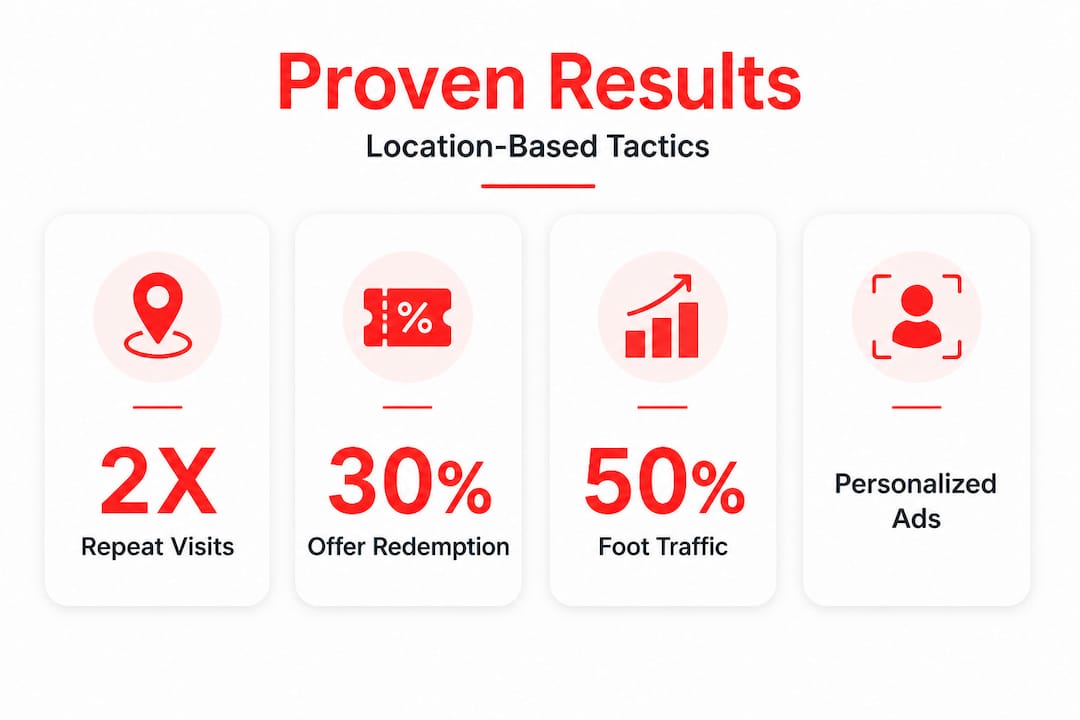
Proximity-based coupon campaigns are one of the highest-converting tactics available to restaurants. When someone walks within a quarter mile of your location, they receive a mobile coupon for a limited-time offer. A pizza restaurant in a busy downtown area reported a 22% increase in walk-in traffic during slow Tuesday lunch slots after launching a proximity coupon campaign offering a free drink with any entrée. The offer was only valid for 90 minutes, which created urgency.

Event-driven geo-ads take advantage of large gatherings near your restaurant. Think concert venues, sports arenas, convention centers, or farmers markets. When a major event is happening nearby, you create a geo-fence around that venue and run ads targeting attendees. A burger spot near a convention center, for example, ran geo-targeted Instagram ads during a three-day tech conference and saw a 35% spike in weekday dinner covers compared to the same period the previous month.
Local event promotions on social media work well when paired with location targeting. Announcing a trivia night or live music event to people within two miles is far more effective than announcing it to your entire follower base. Social media marketing for restaurants becomes significantly more powerful when the audience is geographically relevant.
Content-driven local SEO is often overlooked as a form of location-based marketing, but it belongs in this conversation. Blog posts and menu pages optimized for neighborhood-specific keywords draw in searches like “best tacos near [neighborhood name].” Pairing this with restaurant content marketing strategies compounds your reach over time without ongoing ad spend.
Here is a summary of the most effective strategies for local restaurants:
- Proximity coupons for high-traffic slow periods
- Competitor geo-targeting to reach customers who visited a rival within the past 30 days
- Re-engagement WiFi campaigns that email a returning offer after a customer visits
- Event-adjacent geo-fencing during local sports, festivals, or conferences
- Hyperlocal social ads targeted to neighborhoods within a one to two mile radius
Proximity-based offers, local events, and personalized ads consistently outperform broad digital campaigns for restaurants because the message matches both the moment and the person receiving it. When someone is standing near your block and feeling hungry, a well-timed offer from your restaurant is not an interruption. It is a solution.
Common pitfalls and how to avoid them
Even the best strategy can stumble. Location-based marketing has a few common failure modes that restaurant owners need to recognize before they waste time or money.
Sending irrelevant messages. Pushing a breakfast coupon at 8 p.m. or advertising a happy hour to someone who never visits on weekdays is noise. It trains your audience to ignore you. Every message should match the time, the person’s history, and what they likely want in that moment.
Over-targeting and message fatigue. This is one of the most common mistakes. Sending too many notifications in a short period drives opt-outs faster than almost anything else. A good rule of thumb is no more than two to three location-triggered messages per week per customer. Less is more when the messages are highly relevant.
Ignoring data privacy. Over-targeting or ignoring data privacy erodes customer trust and results in poor engagement. This is not just an ethical issue. It is a practical one. Customers who feel surveilled without consent do not come back.
Failing to test and optimize. Many restaurants set up a geo-fencing campaign, run it for a month, and assume the results are the results. In reality, small changes to the ad copy, offer value, or timing window can double your redemption rate. Build testing into your process from day one.
Here is a quick checklist for running location-based campaigns the right way:
- Always obtain explicit opt-in before collecting location data
- Set clear frequency caps to prevent message overload
- Personalize offers based on past visit behavior, not just proximity
- Use restaurant marketing automation to handle segmentation and timing without manual effort
- Pair location campaigns with restaurant remarketing to re-engage customers who responded once but did not return
Pro Tip: Include a simple one-tap opt-out in every message you send. Counterintuitively, making it easy to leave actually keeps more people subscribed, because they feel in control rather than trapped. Customers who stay by choice are far more likely to act on your offers.
What most restaurant owners get wrong about location-based marketing
Here is the uncomfortable truth we see again and again. Restaurant owners treat location-based marketing as a button to push when business is slow. They set up a geo-fence, send a few offers, see a small bump, and then stop. Three months later, they wonder why foot traffic is back to where it started.
Location-based marketing is not a faucet. It is infrastructure. The restaurants that see sustained growth are the ones that connect their location campaigns to a broader system. They use location to pull someone in the first time, and then they use restaurant remarketing to bring that same person back a second and third time. They pair location ads with strong restaurant content marketing tips so that when someone sees their ad and searches them online, they find compelling content that seals the decision.
We have seen restaurants double their month-over-month repeat visit rates not by running more location campaigns, but by building a proper follow-up sequence after the first location-triggered visit. The first visit is the lead. What happens after is the sale.
The other mistake is treating all nearby customers as identical. A person who lives four blocks away and visits every Friday is a completely different customer than a tourist who happens to be near your block for one afternoon. Your messaging, your offer, and your desired outcome should be completely different for each. Without that nuance, you are spending money on the right channel with the wrong message.
Location-based marketing works. But it works best as one layer in an integrated marketing system, not as a standalone tactic you fire and forget.
Start driving more diners with Sorbey’s restaurant marketing tools
If this article has shown you one thing, it is that location-based marketing requires the right tools to execute well. Setting up geo-fencing, automating personalized offers, tracking ROI, and managing customer segments manually is a full-time job.
Sorbey’s restaurant marketing services are built specifically for local restaurants that want to run sophisticated, data-driven campaigns without needing a dedicated marketing team. From location-triggered campaigns to automated follow-up sequences, every tool is designed to drive foot traffic and measurable results. You can also use Sorbey’s free marketing ROI calculator to see exactly what your campaigns should be returning, and the marketing budget calculator to plan your spend with confidence. Start with the tools, build the system, and watch your dining room fill up.
Frequently asked questions
What are the main benefits of location-based marketing for restaurants?
It increases foot traffic, drives engagement with timely offers, and lets restaurants reach nearby customers using proximity-based offers, local events, and personalized ads more effectively than broad digital campaigns.
Are location-based ads expensive for local restaurants?
No, many platforms offer affordable geo-targeted ad options, often costing less than broad digital advertising while delivering higher local relevance and better conversion rates.
What’s the difference between location-based and traditional restaurant marketing?
Location-based marketing targets customers in real time based on their physical location, while traditional marketing reaches a broader, far less targeted audience regardless of where they are or what they need.
How can I measure the success of my location-based marketing?
Track offer redemption rates, increased foot traffic, and sales spikes during campaign windows. Collecting and analyzing location data lets you deliver personalized offers and measure their direct impact on ROI.
Is customer privacy a concern with location-based campaigns?
Yes, always use opt-in methods and be transparent about data use, because over-targeting or ignoring privacy erodes customer trust and leads to poor engagement and high opt-out rates.
Recommended
- Boost local restaurant success with strategic local advertising | Sorbey Blog | Sorbey
- Content marketing tips for restaurants: attract more local diners | Sorbey Blog | Sorbey
- Local advertising guide for restaurants: boost visibility | Sorbey Blog | Sorbey
- Why use paid ads locally? Boost restaurant sales | Sorbey Blog | Sorbey
You might also like

Best Restaurant Loyalty Programs 2026: ROI Guide
Discover the best restaurant loyalty programs 2026 that boost repeat visits. Learn how Sorbey’s platform can transform your guest data strategy!

Why Mobile Marketing Matters for Business Growth
Discover why mobile marketing matters for business growth. Learn how optimizing for mobile drives traffic, conversions, and customer retention.

SF Dim Sum Restaurant Marketing Checklist for 2026
Transform your SF dim sum with our 2026 marketing checklist. Optimize your profile, showcase dishes, and attract customers fast!