
Blog
Restaurant Lead Generation Workflow: Your 2026 Guide
Master the restaurant lead generation workflow in 2026. Discover essential tools and strategies to attract and convert diners effectively.

Restaurant Lead Generation Workflow: Your 2026 Guide
TL;DR:
- A restaurant lead generation workflow uses tools like WiFi portals and segmentation to attract and retain guests. Building and automating this system improves repeat visits by 12 to 25 percent and increases customer loyalty. Implementing it transforms marketing from a cost into a steady revenue engine.
A restaurant lead generation workflow is a structured sequence of tactics and tools designed to consistently attract, capture, and convert potential diners into paying customers. US restaurants lose 25–30% of first-time guests every year, which means your customer acquisition process cannot be a one-time effort. The restaurants that grow predictably treat lead generation as an operational system, not a marketing afterthought. This guide walks you through the tools, steps, and automation techniques that make that system work, including WiFi email capture, Apple and Google Wallet passes, RFM segmentation, and local SEO.
What tools and data do you need to start?
Building a restaurant lead generation workflow starts with the right infrastructure. Without it, even the best offer falls flat because you have no way to capture, store, or follow up with potential guests.
Core tools you need:
- A branded landing page with a clear first-visit offer (discount, free appetizer, or loyalty signup)
- An email marketing platform that supports automated sequences (welcome, win-back, VIP)
- A push notification system tied to Apple and Google Wallet passes
- A WiFi login portal that captures guest emails passively at the point of connection
- A Google Business Profile, fully optimized with photos, hours, and review responses
Lead capture methods compared:
| Method | Cost per lead | Staff effort | Monthly volume |
|---|---|---|---|
| WiFi email portal | $0.22 per email | None | 200–300 per location |
| QR code signup | Low | Minimal | Varies |
| Birthday reward signup | Low | Low | Moderate |
| Manual paper signup | Near zero | High | Low |
Passive WiFi portals generate 200–300 emails per month per location at $0.22 per email with zero staff involvement. That cost per lead is lower than almost any paid digital channel. The data you collect through these portals also feeds directly into your segmentation engine.
For segmentation, you need Recency, Frequency, and Monetary data, commonly called RFM. Recency tells you when a guest last visited. Frequency tells you how often they come. Monetary tells you how much they spend. Together, these three data points let you send the right message to the right guest at the right time, rather than blasting everyone with the same offer.
Google Business Profile optimization can increase your repeat visit rate by 4–8 points in a single quarter. That makes it one of the highest-return, lowest-cost steps in your entire customer acquisition process. Claim your profile, add photos weekly, and respond to every review within 24 hours.
Pro Tip: Set up your WiFi portal before you run any paid ads. You will build an owned email list from guests who are already in your restaurant, and those leads convert far better than cold traffic.
How do you execute a restaurant lead generation workflow step by step?
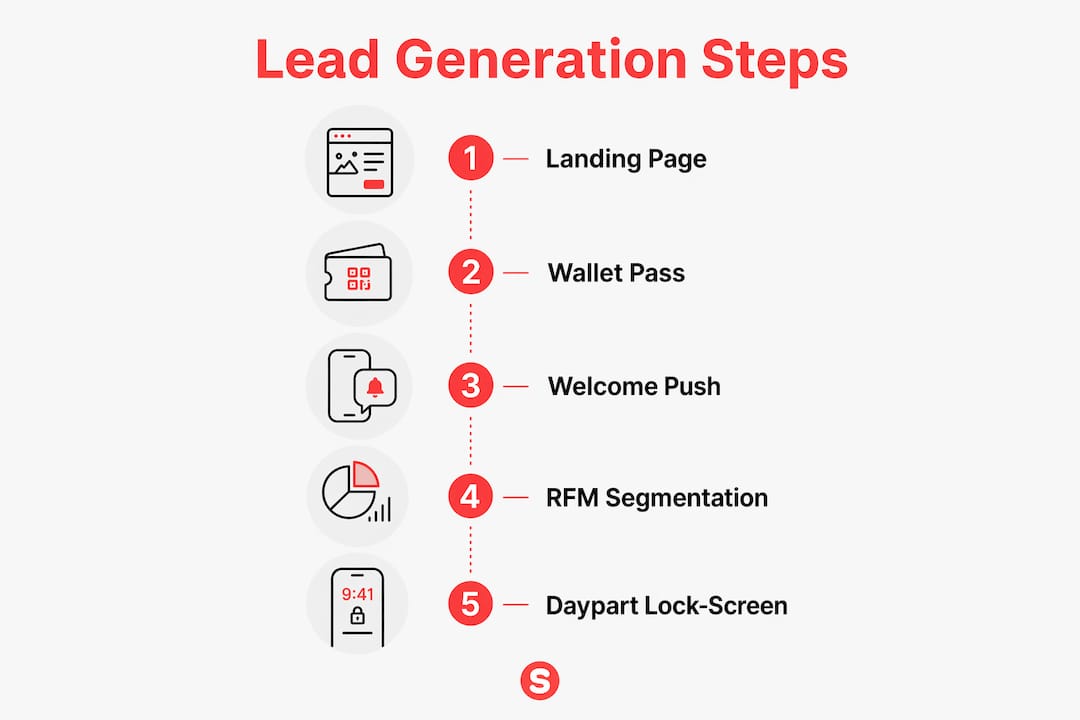
The workflow has five stages. Each stage builds on the previous one, so skipping steps creates gaps that kill conversion.
Step 1: Build a branded landing page with a compelling offer. Your landing page is the first conversion point. It should load in under three seconds, display your restaurant’s branding clearly, and present one specific offer. “Get 20% off your first visit” outperforms vague promises every time. Collect name, email, and birthday at minimum.

Step 2: Install wallet passes as your bottom-funnel conversion event. Once a guest submits their email, prompt them to add your loyalty or offer card to their Apple or Google Wallet. This step is critical. Wallet pass push notifications reach 4–8% redemption per send with no per-message cost after install. That redemption rate beats most email campaigns by a wide margin.
Step 3: Send an immediate welcome push notification. The moment a guest installs your wallet pass, trigger a push notification with their redemption offer. Speed matters here. A welcome message sent within five minutes of signup converts at a dramatically higher rate than one sent hours later. Keep the message short: one offer, one call to action.
Step 4: Segment your list using RFM data and target your campaigns. After your first 30 days, you will have enough data to segment. Guests who visited once in the last 30 days are “new.” Guests who visited three or more times are “regulars.” Guests who have not returned in 60 days are “at risk.” Each segment gets a different message. RFM-based push campaigns drive a 12–25% lift in repeat visits compared to unsegmented sends.
Step 5: Use daypart-targeted lock-screen notifications to drive same-day visits. Send lunch offers at 10:30 a.m. Send dinner offers at 4:00 p.m. Wallet passes let you schedule notifications by time of day without any additional cost. This is the single most underused tactic in restaurant marketing. A guest who sees your offer on their lock screen at the exact moment they are deciding where to eat is far more likely to act.
Pro Tip: Test two subject lines or notification texts every week. After 90 days, you will know exactly which words drive your guests to act. Most restaurants never test, which means they never improve.
How do you automate lead nurturing and keep guests coming back?
Automation turns a one-time visit into a long-term relationship. The goal is to build trigger-based sequences that run without manual effort, so your team can focus on the dining experience.
Active vs. passive nurturing approaches
| Approach | Trigger | Channel | Best use case |
|---|---|---|---|
| Welcome sequence | New signup | Email + push | First-visit conversion |
| Win-back campaign | 45-day no-visit | Email + push | Lapsed guest recovery |
| VIP recognition | 5th visit milestone | Push | Loyalty reinforcement |
| Birthday reward | Annual date | High-intent conversion | |
| Daypart push | Time of day | Push | Same-day traffic |
Automated email sequences boost order frequency by 15% for both new and returning customers. That lift compounds over time because each additional visit increases the probability of a guest becoming a regular. The welcome and win-back series are the two highest-impact automations to build first.
Birthday rewards deserve special attention. Birthday offers convert 3–4 times better than generic email signups, with redemption rates above 30%. The reason is simple: a birthday offer feels personal, and it arrives at a moment when the guest is already planning to celebrate. Collecting a birthday date at signup costs you nothing and pays off every year.
Owned channels like email and wallet passes outperform social media for restaurant retention because you control the delivery. An Instagram algorithm change can cut your organic reach overnight. A wallet pass notification lands on a lock screen every time. Build your list, protect it, and use it consistently.
Pro Tip: Layer your birthday capture on top of your WiFi portal signup. Ask for the birthday date as an optional field. You will be surprised how many guests provide it, and that single data point unlocks your highest-converting annual campaign.
For building your email list with both passive and active methods, combining WiFi capture with birthday reward signups gives you the best database quality. Passive capture fills volume. Active capture adds intent signals. Together, they create a list that is both large and actionable.
What mistakes kill a restaurant lead generation workflow?
Most restaurants that struggle with lead generation make the same five mistakes. Recognizing them early saves months of wasted effort.
- Treating marketing as a pure expense. Marketing is a system that produces revenue. Every dollar spent on email capture or push notifications should be tracked against guest visits and average check size. If you cannot measure it, you cannot improve it.
- Capturing leads and never following up. A WiFi portal that collects emails but sends no automated sequence is a missed opportunity. The capture step is worthless without the nurture step.
- Sending the same message to every guest. A lapsed guest who has not visited in 90 days needs a win-back offer. A regular who visits weekly needs VIP recognition. One-size-fits-all messaging produces one-size-fits-all results, which means mediocre performance across every segment.
- Ignoring Google Business Profile. Local SEO is the top of your funnel. Guests who find you on Google Maps are already searching for a restaurant. An incomplete or unresponsive profile sends them to a competitor.
- Chasing social media reach instead of owned channels. Social platforms are rented land. Effective restaurant marketing depends on owning your engagement channels, not borrowing them from an algorithm.
If your open rates are low, check your subject lines and send times. If your redemption rates are low, check your offer strength and your notification timing. If your list is not growing, check whether your WiFi portal is active and whether your landing page offer is compelling enough to earn an email address.
For a deeper look at urban restaurant lead generation tactics that address high-competition markets specifically, the principles above apply with even greater urgency when you have dozens of competitors within walking distance.
Key Takeaways
A restaurant lead generation workflow succeeds when it combines passive capture tools, RFM segmentation, and automated push sequences into one connected system that runs without constant manual effort.
| Point | Details |
|---|---|
| Passive capture scales fastest | WiFi portals generate 200–300 emails per month at $0.22 each with no staff effort. |
| Wallet passes beat email on redemption | Daypart-targeted push notifications reach 4–8% redemption per send at zero per-message cost. |
| RFM segmentation drives repeat visits | Segmented campaigns produce a 12–25% lift in repeat visits over unsegmented sends. |
| Birthday rewards are your best converter | Birthday offers redeem at 30%+ and convert 3–4 times better than generic signups. |
| Owned channels protect your reach | Email and wallet passes deliver every time; social algorithms do not. |
Why I think most restaurants are one workflow away from real growth
Restaurants are operationally excellent and marketing-poor. I have seen owners who run a flawless kitchen but have no idea how many guests they lost last month or why. The answer is almost always the same: there is no system. There is a Facebook page, maybe some Instagram posts, and a hope that word of mouth fills the room.
The shift that changes everything is treating marketing the way you treat your prep schedule. It runs on a system, it has triggers, and it produces a predictable output. When you install a WiFi portal, build a welcome sequence, and set up daypart push notifications, you are not doing marketing. You are building a revenue engine that runs while you focus on the food.
The restaurants I respect most are the ones that own their guest data. They know who visited last week, who has not come back in 60 days, and who is about to have a birthday. That knowledge is not magic. It is the output of a workflow that someone took the time to build. The restaurant marketing workflow is not complicated. Most owners just never start it.
Stop waiting for a slow season to figure this out. Build the workflow now, let it run for 90 days, and then look at your repeat visit numbers. The data will tell you everything you need to know.
— Barthelemy
How Sorbey helps you build this workflow faster
Sorbey is an all-in-one marketing platform built specifically for local restaurants. It handles the pieces that most owners never get around to: branded landing pages, WiFi email capture, wallet pass push notifications, and RFM-based segmentation, all connected in one place.
You do not need to stitch together five different tools or hire a marketing agency to run a professional lead generation system. Sorbey builds it for you and keeps it running. Restaurant owners who use Sorbey’s restaurant marketing services get the full workflow, from first capture to automated re-engagement, without the technical setup. If you are ready to turn your guest list into a predictable revenue channel, Sorbey is where you start.
FAQ
What is a restaurant lead generation workflow?
A restaurant lead generation workflow is a structured system of tools and steps that captures guest contact information, nurtures those guests through automated messages, and converts them into repeat customers. It typically includes email capture, push notifications, and segmented campaigns.
How do WiFi portals help with lead capture?
WiFi login portals collect guest emails automatically when guests connect to your restaurant’s network. They generate 200–300 emails per month per location at roughly $0.22 per email with no staff involvement required.
What is RFM segmentation and why does it matter?
RFM stands for Recency, Frequency, and Monetary value. It groups your guests by how recently they visited, how often they come, and how much they spend. Campaigns built on RFM data produce a 12–25% lift in repeat visits compared to unsegmented sends.
Are wallet pass push notifications better than SMS?
Wallet pass push notifications deliver to a guest’s lock screen at no per-message cost after the pass is installed. They reach 4–8% redemption per send, which outperforms most SMS and email campaigns on a cost-per-redemption basis.
How long does it take to see results from a lead generation workflow?
Most restaurants see measurable improvement in repeat visit rates within 60–90 days of activating a full workflow. Birthday reward campaigns and win-back sequences typically show results within the first 30 days of launch.
Recommended
- Lead Generation Strategies for Urban Restaurants in 2026 | Sorbey Blog | Sorbey
- Build a restaurant email marketing workflow that drives results | Sorbey Blog | Sorbey
- How to Build a Restaurant Email List in 2026 | Sorbey Blog | Sorbey
- Restaurant marketing trends for explosive growth in 2026 | Sorbey Blog | Sorbey
You might also like
Best Restaurant Loyalty Programs 2026: ROI Guide
Discover the best restaurant loyalty programs 2026 that boost repeat visits. Learn how Sorbey’s platform can transform your guest data strategy!

Why Mobile Marketing Matters for Business Growth
Discover why mobile marketing matters for business growth. Learn how optimizing for mobile drives traffic, conversions, and customer retention.

SF Dim Sum Restaurant Marketing Checklist for 2026
Transform your SF dim sum with our 2026 marketing checklist. Optimize your profile, showcase dishes, and attract customers fast!