
Blog
What is PPC for restaurants? A practical guide for owners
Learn how PPC for restaurants works, what results to expect, and how to launch campaigns that bring local diners through your door fast and affordably.

What is PPC for restaurants? A practical guide for owners
TL;DR:
- PPC allows restaurants to target nearby diners actively searching for food, ensuring immediate visibility.
- Key campaign elements include geo-targeting, keyword selection, ad scheduling, and conversion tracking for effectiveness.
- Combining PPC with SEO provides both quick results and long-term organic growth, maximizing restaurant visibility.
Running a restaurant in a competitive city means fighting for attention every single day. Traditional advertising—print flyers, radio spots, billboard rentals—costs a fortune and offers almost no way to measure results. PPC, or pay-per-click advertising, flips that model entirely. You only pay when a hungry diner actually clicks your ad. Better yet, those ads appear precisely when someone nearby types “best tacos near me” or “Italian restaurant open now.” This guide breaks down exactly how PPC works for restaurant owners, what kind of results you can realistically expect, and how to launch a campaign that brings paying customers through your door.
Table of Contents
- What is PPC and why does it matter for restaurants?
- Core mechanics: How restaurant PPC campaigns actually work
- Benchmarks and performance: What results can restaurants expect?
- PPC vs. SEO for restaurants: When to prioritize each
- Practical steps: Launching an effective PPC campaign for your restaurant
- Our expert take: What most restaurant marketers get wrong with PPC
- Put PPC to work for your restaurant with expert support
- Frequently asked questions
Key Takeaways
| Point | Details |
|---|---|
| PPC drives foot traffic | Pay-per-click advertising sends local diners to your restaurant at the exact moment they’re hungry and searching nearby. |
| Targeted, measurable campaigns | You can focus your ad spend on high-intent searches and track true results—reservations, orders, or calls. |
| ROI you can control | With benchmarks for cost and returns, restaurants can set budgets and scale what works for maximum return on ad spend. |
| Best with integrated strategy | Combine PPC for instant traffic and SEO for long-term visibility to maximize your digital presence and revenue. |
What is PPC and why does it matter for restaurants?
PPC stands for pay-per-click. Instead of paying a flat fee to run an ad whether anyone sees it or not, you only pay when someone clicks. That single mechanic changes everything about how you think about advertising spend. Every dollar you put in is tied to a real action from a real person.
For restaurants, the most important PPC platform is Google Ads. When someone searches “pizza delivery downtown Chicago” or “brunch spots near me,” Google shows a mix of organic results and paid ads at the top of the page. Your restaurant can appear in that prime real estate instantly, without waiting months for SEO to kick in. Facebook and Instagram ads also play a role, especially for promoting limited-time offers, events, or new menu launches to a local audience.
What makes PPC especially powerful for restaurants is local intent. The people searching these terms are not browsing casually. They are hungry, they are nearby, and they are ready to make a decision. Restaurant PPC basics confirm that this combination of immediate intent and geographic proximity makes PPC one of the highest-converting digital channels available to food businesses.
Here is what sets PPC apart from traditional advertising for restaurants:
- Trackable results: You see exactly how many clicks turned into calls, reservations, or orders
- Local targeting: Ads only show to people within a radius you define
- Flexible budgets: Start with $300 a month and scale as results come in
- Immediate visibility: Campaigns go live within hours, not weeks
- Full control: Pause, adjust, or stop at any time without penalty
“The biggest advantage PPC gives restaurants is the ability to show up at the exact moment a diner is deciding where to eat. No other channel does that as efficiently.”
If you want a deeper look at how restaurant PPC basics apply to your specific type of location and cuisine, the fundamentals stay consistent whether you run a fast-casual spot or a fine dining establishment.
Core mechanics: How restaurant PPC campaigns actually work
Knowing what PPC is gets you started. Understanding how the mechanics work is what separates restaurants that waste money from those that grow. Let us walk through the key levers you control.
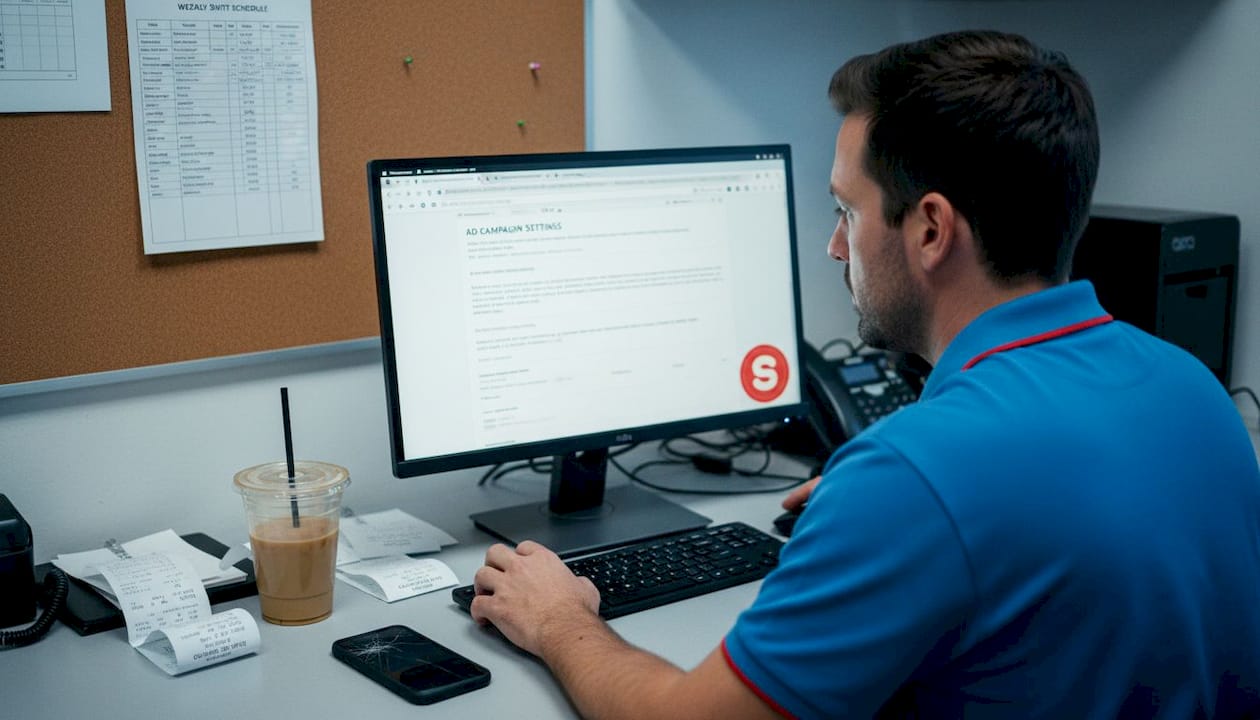
1. Geo-targeting You set a radius around your restaurant, say 3 to 5 miles in a dense city, and your ads only appear to people searching within that zone. This prevents spending money on clicks from people who will never make the trip.
2. Keyword selection You choose the search terms that trigger your ads. For a sushi restaurant in Austin, that might include “sushi Austin TX,” “Japanese food near downtown,” and “best omakase Austin.” You also add negative keywords, terms you do NOT want to trigger your ads. “Sushi recipe” or “how to make sushi at home” are searches from people who want to cook, not dine out.
3. Ad scheduling You can run ads only during hours when your restaurant is open or when demand peaks. A breakfast diner might run ads from 6 a.m. to 11 a.m. A bar and grill might focus on Thursday through Saturday evenings.
4. Mobile optimization Most local restaurant searches happen on phones. Your ads and the landing page they lead to must load fast and make it easy to call, get directions, or book a table with one tap.
5. Conversion tracking This is where most restaurants fall short. Setting up local PPC campaign tips alongside proper conversion tracking lets you see which ads drove actual reservations, not just clicks. Without it, you are flying blind.
PPC campaign mechanics for restaurants also include ad extensions, which are free additions that show your address, phone number, menu link, or current promotions directly in the ad.
Pro Tip: Set up at least three conversion goals before you spend a single dollar: phone calls, direction requests, and online reservations. These tell you what is actually making money, not just what is getting attention.
| Campaign element | What it controls | Why it matters for restaurants |
|---|---|---|
| Geo-targeting | Who sees your ads | Eliminates wasted spend on distant users |
| Keywords | When ads trigger | Captures diners with buying intent |
| Ad scheduling | When ads run | Focuses budget on peak demand hours |
| Mobile optimization | User experience | Converts phone searches into visits |
| Conversion tracking | Measurable outcomes | Proves ROI beyond clicks |
Paired with a strong Google business listing strategies setup, these mechanics create a system that keeps your tables filled consistently.
Benchmarks and performance: What results can restaurants expect?
Before you launch, you need to know what good looks like. Here are the key metrics and what the numbers actually mean for your bottom line.
Click-through rate (CTR) measures how often people who see your ad actually click it. For restaurants, a healthy CTR sits around 5 to 7 percent on Google Search. If yours is lower, your ad copy or targeting needs work.
Cost per click (CPC) is what you pay each time someone clicks. Restaurant industry benchmarks show the average CPC for restaurants in 2026 is around $1.95, though competitive city markets like New York or Los Angeles can push that higher.
Conversion rate (CVR) tells you what percentage of clicks turn into a real action like a reservation or order. Restaurant campaigns typically convert at 3 to 5 percent. A well-optimized campaign with a strong offer can hit 8 percent or more.
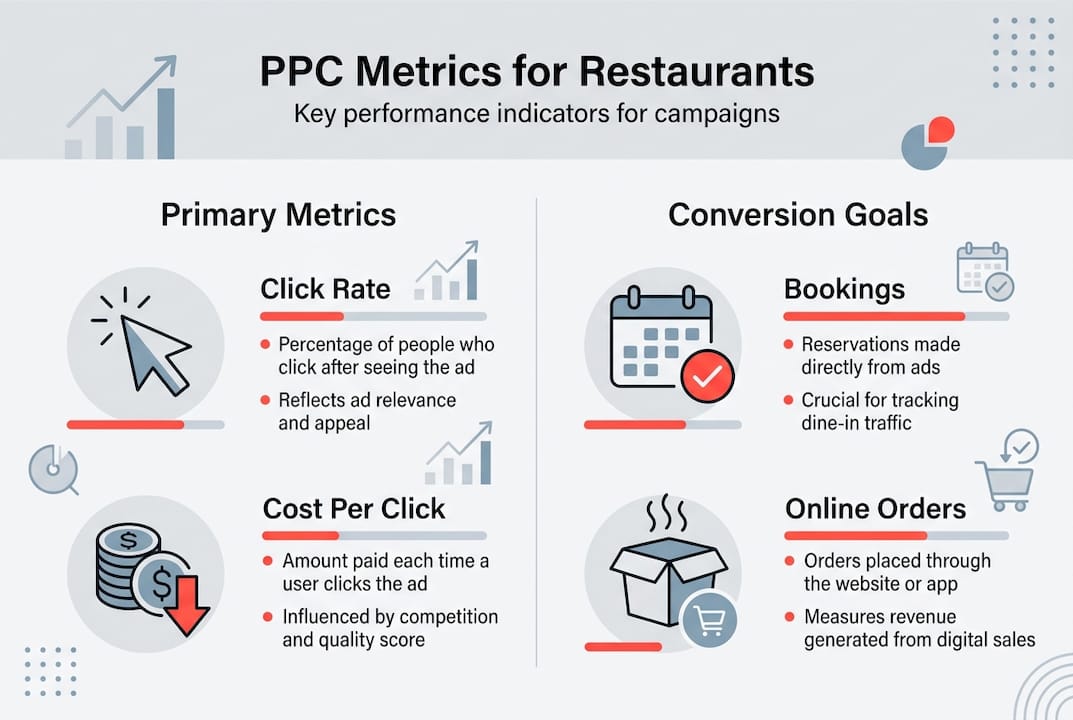
Cost per acquisition (CPA) is what you spend to get one new customer. For restaurants, a CPA under $15 is solid. Under $8 is excellent.
Return on ad spend (ROAS) is the big one. If you spend $500 on ads and generate $3,500 in revenue, your ROAS is 7x. Industry data shows that 7x ROAS is considered excellent for restaurants, with 4x to 5x being a profitable baseline.
| Metric | Average | Good | Excellent |
|---|---|---|---|
| CTR | 3-4% | 5-7% | 8%+ |
| CPC | $1.95 | $1.50 | Under $1.20 |
| CVR | 2-3% | 4-6% | 7%+ |
| CPA | $20-25 | $12-15 | Under $8 |
| ROAS | 3x | 5x | 7x+ |
Three factors move these numbers the most: the strength of your offer, the speed and clarity of your landing page, and how precisely you have defined your audience. Restaurant PPC case studies consistently show that restaurants with a specific, compelling offer outperform those running generic “come eat here” ads by a wide margin.
PPC vs. SEO for restaurants: When to prioritize each
This question comes up constantly, and the honest answer is that framing it as a competition misses the point entirely. PPC and SEO serve different purposes and work best together.
PPC gives you immediate visibility. You can launch a campaign today and have new customers walking in tonight. That speed is invaluable when you open a new location, launch a seasonal menu, or need to fill tables during a slow week. The tradeoff is that the moment you stop spending, the traffic stops.
SEO builds organic search rankings over time. It takes months of consistent effort, but once you rank for “best brunch in Denver,” that traffic is essentially free. Restaurant SEO strategies also compound over time, meaning the value grows the longer you invest.
“PPC and SEO are not rivals. PPC is your sprint; SEO is your marathon. The restaurants winning online are running both races at once.”
Here is when to prioritize each:
- Prioritize PPC when: You need immediate results, you are testing a new market, or you are promoting a time-sensitive event
- Prioritize SEO when: You want long-term, sustainable traffic without ongoing ad spend
- Use both when: You want to dominate search results, capturing both paid and organic clicks
The hybrid approach benefits are real and measurable. Restaurants that run PPC alongside SEO often see lower CPCs because their organic authority signals quality to Google.
Pro Tip: Use your PPC conversion data to inform your SEO keyword strategy. If a paid keyword is generating reservations at a low CPA, it is worth building organic content around that same term.
Practical steps: Launching an effective PPC campaign for your restaurant
Ready to run your first campaign? Here is a straightforward framework that works even if you have never opened Google Ads before.
- Start with Search campaigns. These target people actively searching for restaurants like yours. They convert better than display or social ads for new campaigns because the intent is already there.
- Build a tight keyword list. Focus on 10 to 20 high-intent terms: your cuisine type, neighborhood, and occasion-based searches like “anniversary dinner” or “family restaurant.” Avoid broad terms that attract the wrong clicks.
- Set your geo-target carefully. In a dense city, a 2 to 3 mile radius is often enough. In suburban areas, expand to 5 to 10 miles.
- Write ads with a specific offer. “Free dessert with any entree this weekend” outperforms “Great food, great prices” every time. Specificity drives clicks and filters for serious diners.
- Add all relevant ad extensions. Location, call, sitelink to your menu, and promotion extensions are free and increase your ad’s real estate on the page.
- Add Performance Max (PMax) after 30 days. Once you have conversion data from Search, PPC best practices recommend layering in PMax campaigns to extend reach across Google’s full network.
- Review performance weekly. Check ROAS, CPA, and conversion volume. Pause underperforming ads. Put more budget behind what is working.
Pro Tip: Never send PPC traffic to your homepage. Create a dedicated landing page for each campaign with a single clear action: book a table, call now, or order online. This alone can double your conversion rate.
For real PPC examples from restaurants in similar markets, studying what others have done successfully cuts your learning curve significantly.
Our expert take: What most restaurant marketers get wrong with PPC
After working with dozens of restaurants across major U.S. cities, one pattern stands out: most owners obsess over clicks and completely ignore what happens after the click. A campaign with a 10 percent CTR is worthless if the landing page is slow, confusing, or sends people to a generic homepage with no clear next step.
The second big mistake is skipping offer testing. Generic ads perform generically. Restaurants that test bold, specific offers like “Half-price happy hour, 4 to 6 p.m. weekdays” see dramatically better results than those running brand awareness campaigns. Bold offers filter for diners who are ready to act now.
The third mistake is treating PPC as a standalone tool. The restaurants seeing real PPC wins connect their digital campaigns to the in-restaurant experience. If your ad promises a warm, fast, welcoming meal and the reality falls short, no amount of ad spend will build a loyal customer base. PPC brings people in once. Your food and service bring them back.
Put PPC to work for your restaurant with expert support
Understanding PPC is one thing. Building campaigns that consistently fill tables while staying within budget is another challenge entirely. That is where having the right partner makes a real difference.
Sorbey offers PPC services for restaurants designed specifically for local food businesses in competitive markets. From keyword research and geo-targeting to weekly performance reviews and offer testing, the platform handles the complexity so you can focus on running your restaurant. Explore AI-powered marketing solutions built for local businesses, and see how Sorbey can help you turn ad spend into a predictable stream of new customers starting this week.
Frequently asked questions
What does PPC mean for restaurants?
PPC for restaurants means paying only when local diners click your ad, typically targeting people searching nearby who are ready to eat. You set the budget, the location radius, and the keywords that trigger your ads.
How much should a restaurant budget for PPC ads?
Most restaurants start with $300 to $500 per month. With an average CPC of $1.95 in 2026, that budget generates meaningful traffic and enough data to optimize your campaigns within the first 30 days.
How quickly can PPC bring in new customers?
PPC can generate new customers the same day you launch. Unlike SEO, which takes months to build, PPC offers immediate demand capture the moment your campaign goes live and your targeting is set correctly.
Is PPC or SEO better for my restaurant?
Neither is universally better. PPC delivers instant results but requires ongoing spend, while SEO builds free traffic over time. Most restaurants benefit from running both strategies together for maximum search visibility and sustainable growth.
Recommended
- What is restaurant PPC? Boost local visibility with smart ads | Sorbey Blog | Sorbey
- Qu’est-ce que le PPC pour restaurants ? Boostez votre visibilité locale avec des publicités intelligentes | Sorbey Blog | Sorbey
- Blog - Sorbey | Restaurant Marketing Insights | Sorbey
- Streamline restaurant ops with smart POS: 20% gains
You might also like

Best Restaurant Loyalty Programs 2026: ROI Guide
Discover the best restaurant loyalty programs 2026 that boost repeat visits. Learn how Sorbey’s platform can transform your guest data strategy!

Why Mobile Marketing Matters for Business Growth
Discover why mobile marketing matters for business growth. Learn how optimizing for mobile drives traffic, conversions, and customer retention.

SF Dim Sum Restaurant Marketing Checklist for 2026
Transform your SF dim sum with our 2026 marketing checklist. Optimize your profile, showcase dishes, and attract customers fast!