
Blog
What is search engine ranking for restaurants in 2026
Learn what search engine ranking means for restaurants, why the Google Local Pack matters, and proven strategies to improve your local search visibility in 2026.

What is search engine ranking for restaurants in 2026
Restaurant owners face a digital landscape where ‘near me’ searches for restaurants have grown over 500%, fundamentally changing how diners discover places to eat. Understanding search engine ranking is no longer optional for restaurants aiming to capture local customers online. This guide breaks down what search engine ranking means specifically for restaurants, why it matters for your bottom line, and actionable strategies to improve your position in local search results so nearby diners find you first.
Table of Contents
- What Is Search Engine Ranking And Why It Matters For Restaurants
- How The Google Local Pack Shapes Restaurant Search Results
- Key Strategies To Improve Your Restaurant’s Search Engine Ranking In 2026
- Understanding Relevance, Prominence, And Proximity In Local Seo
- Boost Your Restaurant’s Search Ranking With Sorbey’s Ai Marketing Solutions
- Frequently Asked Questions
Key takeaways
| Point | Details |
|---|---|
| Local ranking drives discovery | Higher search engine ranking means more nearby diners find your restaurant when searching online. |
| Google Local Pack dominates | The top three Local Pack results receive the majority of clicks, calls, and direction requests from hungry customers. |
| Reviews boost visibility | Positive customer reviews directly influence your search ranking and build trust with potential diners. |
| Optimization is ongoing | Regular updates to your Google Business Profile and consistent local SEO efforts maintain and improve rankings. |
| Professional help accelerates results | Expert local SEO services can fast-track your restaurant’s visibility and customer acquisition. |
What is search engine ranking and why it matters for restaurants
Search engine ranking refers to the position where your restaurant appears in search results when potential customers type queries like “Italian restaurant near me” or “best brunch downtown.” The higher your ranking, the more visible you are to hungry diners actively looking for places to eat. For restaurants, this visibility translates directly into phone calls, online reservations, and foot traffic through your doors.
Local searches have become the primary way diners discover restaurants. When someone searches for dining options, they typically choose from the first few results they see. If your restaurant ranks on page two or three, you might as well be invisible. The connection between ranking position and business outcomes is straightforward: higher rankings generate more customer interactions.
Several key factors determine where your restaurant appears in search results:
- Relevance: How well your restaurant matches what the searcher is looking for
- Prominence: Your restaurant’s reputation based on reviews, ratings, and online mentions
- Proximity: How close your restaurant is to the searcher’s location
Google’s Local Pack represents the prime real estate in local restaurant searches. This box displays the top three local businesses with maps, ratings, and contact information right at the top of search results. Landing in this coveted space means potential customers see your restaurant before they scroll to any other results.
Understanding why optimize for search engines becomes critical when you realize most diners never look beyond the first page of results.
The stakes are high because local search behavior drives immediate action. Unlike general web browsing, people searching for restaurants have high intent. They want to eat soon, and they’re comparing options to make a quick decision. Your ranking position directly impacts whether they consider your restaurant or choose a competitor instead.
How the Google Local Pack shapes restaurant search results
The Google Local Pack appears as a prominent box at the top of search results, displaying three local businesses with their ratings, addresses, and quick action buttons. For restaurant searches, this feature dominates both mobile and desktop screens, pushing traditional organic results far down the page. The Local Pack appears for virtually all location-based restaurant queries and captures the majority of user attention and clicks.

Mobile users see the Local Pack occupying almost their entire first screen, making it nearly impossible to ignore. The format includes a map showing restaurant locations, star ratings, review counts, and buttons for calling, getting directions, or viewing the website. This design prioritizes immediate action, which is exactly what hungry diners want.
The top three positions in the Local Pack receive disproportionate engagement compared to restaurants ranked fourth or lower. Data shows these prime spots generate the most:
- Direct phone calls from potential customers
- Direction requests from people ready to visit
- Website clicks for menu browsing and online ordering
- Booking inquiries through reservation platforms
Optimizing your Google My Business profile becomes essential because the Local Pack pulls information directly from these profiles. Your business name, category, hours, photos, and reviews all influence whether you make the top three.
Why ranking in the Local Pack transforms restaurant success:
- Immediate visibility: Your restaurant appears before any competitor not in the pack
- Trust signals: Star ratings and review counts build instant credibility
- Reduced friction: One-click calling and directions remove barriers to customer action
- Mobile dominance: The Local Pack owns the mobile search experience where most local searches happen
- Competitive advantage: Being in the pack while competitors aren’t means you capture their potential customers
Restaurants outside the Local Pack face an uphill battle. Even if you rank fourth, potential customers must click “More places” and scroll to find you, creating significant drop-off. The behavioral pattern is clear: diners compare the three Local Pack options and make their choice without exploring further unless none of the three appeal to them.
Key strategies to improve your restaurant’s search engine ranking in 2026
Optimizing your Google Business Profile stands as the single most impactful action for improving local search rankings. Your profile needs complete, accurate information across every field Google provides. This means going beyond basic name and address to include business hours, phone number, website, menu links, and a detailed business description that naturally incorporates what you offer.
Your NAP (name, address, phone number) must remain consistent across your website, social media profiles, and directory listings. Inconsistencies confuse search engines and dilute your ranking signals. Add high-quality photos regularly because profiles with photos receive significantly more engagement and appear more trustworthy to both Google and potential customers.
Reviews carry enormous weight in local search rankings and customer decision-making. Research shows 86% of consumers trust businesses with strong positive reviews as much as personal recommendations. Actively encourage satisfied customers to leave reviews, and respond professionally to all feedback, both positive and negative.
The impact of systematic local SEO becomes clear when examining real results. Black Tap Miami implemented comprehensive local SEO strategies and saw measurable improvements:
| Metric | Before Local SEO | After Local SEO | Change |
|---|---|---|---|
| Monthly direction requests | 850 | 1,420 | +67% |
| Monthly phone calls | 320 | 580 | +81% |
| Google Business Profile views | 12,500 | 21,800 | +74% |
| Website clicks | 1,100 | 1,950 | +77% |
These numbers demonstrate how step by step local SEO drives tangible business results through improved search visibility.
Pro Tip: Update your menu and business hours every few weeks, even if nothing changes. These regular profile updates signal to Google that your information is current and actively maintained, which can provide a small ranking boost.
Avoid these common mistakes that undermine your ranking efforts:
- Stuffing your business description with repetitive keywords
- Maintaining inconsistent business information across platforms
- Ignoring negative reviews instead of responding professionally
- Using low-quality or outdated photos
- Selecting incorrect or too many business categories
- Neglecting to add posts and updates to your profile
Local SEO requires ongoing attention rather than one-time setup. Search algorithms evolve, competitors improve their optimization, and customer behavior shifts. Restaurants that consistently refine their local SEO maintain and improve their rankings over time.
Understanding relevance, prominence, and proximity in local SEO
Google evaluates three primary factors when determining local search rankings: relevance, prominence, and proximity. Understanding how each factor works helps you focus optimization efforts where they’ll have the most impact on your restaurant’s visibility.
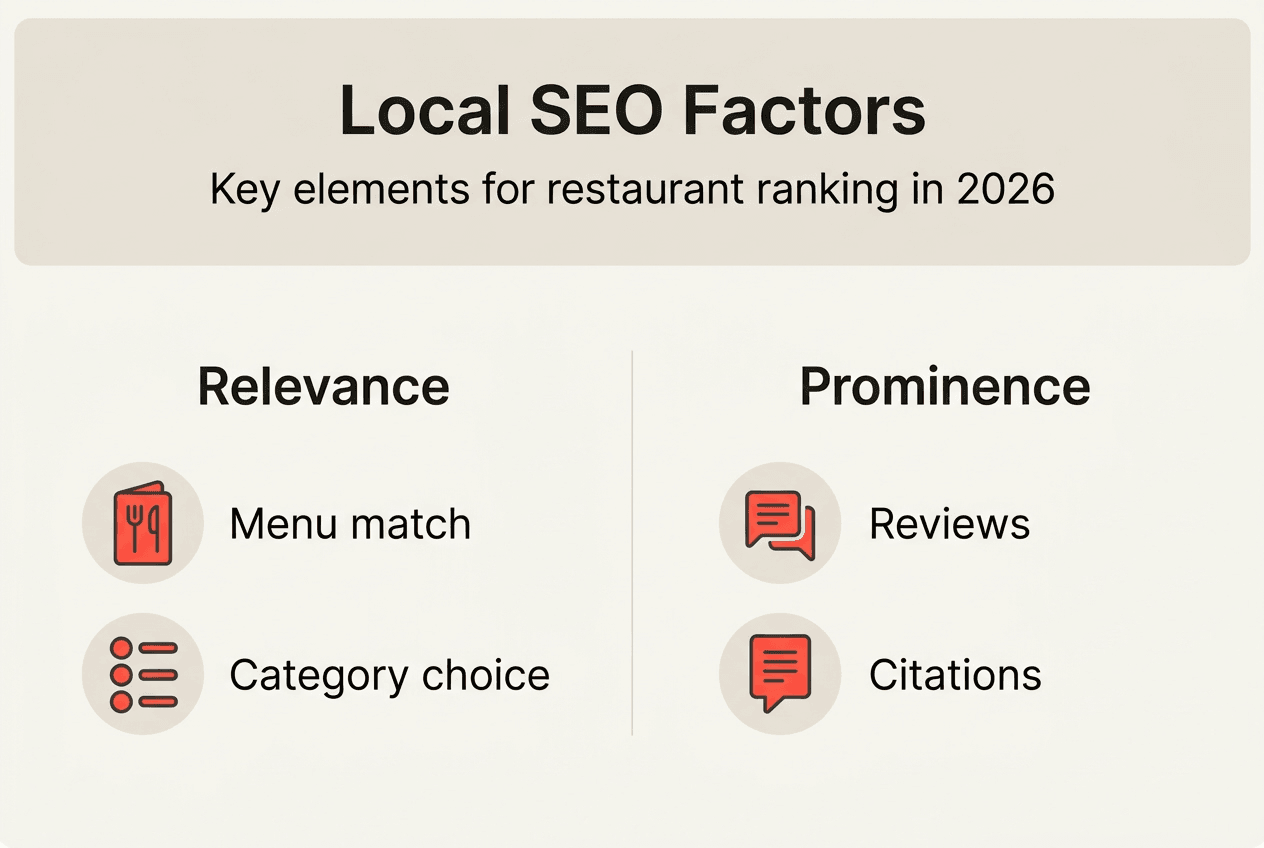
| Factor | What It Means | How To Optimize |
|---|---|---|
| Relevance | How well your restaurant matches the search query | Complete your Google Business Profile thoroughly, use accurate categories, add detailed descriptions |
| Prominence | Your restaurant’s reputation and authority online | Accumulate positive reviews, earn local citations, get mentioned on food blogs and local media |
| Proximity | Physical distance between your restaurant and the searcher | Focus on neighborhood-specific content, optimize for nearby landmarks, can’t directly control |
Relevance measures how closely your restaurant aligns with what someone is searching for. When a diner searches “vegan Mexican restaurant,” Google evaluates whether your business category, description, menu, and other signals indicate you serve vegan Mexican food. Optimizing the Google Business Profile directly improves relevance by providing clear, comprehensive information about what you offer.
Your business category selection plays a crucial role in relevance. Choose your primary category carefully to match your core offering, then add secondary categories that reflect other aspects of your restaurant. A breakfast cafe might select “Breakfast Restaurant” as primary and add “Coffee Shop” and “Brunch Restaurant” as secondary categories.
Prominence reflects how well-known and reputable your restaurant appears online. Google assesses this through multiple signals including review quantity and quality, ratings, mentions on other websites, local news coverage, and food blogger features. Building prominence takes time but creates lasting ranking benefits.
Reviews impact prominence significantly. A restaurant with 200 reviews averaging 4.5 stars demonstrates greater prominence than one with 20 reviews at 4.8 stars. The volume of feedback signals popularity and gives Google more confidence in your restaurant’s quality. Encourage customers to leave detailed reviews that mention specific dishes, service quality, and atmosphere.
Local citations, which are mentions of your restaurant’s name, address, and phone number on other websites, also build prominence. Getting listed on Yelp, TripAdvisor, local dining guides, and chamber of commerce directories strengthens your prominence signals. Ensure your information matches exactly across all citations.
Proximity measures physical distance between your restaurant and the person searching. If someone searches “pizza near me” from downtown, restaurants in that neighborhood naturally rank higher than those across town. You can’t change your location, but you can optimize around it by creating content that mentions nearby landmarks, neighborhoods, and local events.
Pro Tip: Balance all three factors rather than obsessing over one. A restaurant with perfect relevance but weak prominence and unfavorable proximity will struggle to rank. Focus on what you can control (relevance and prominence) while acknowledging proximity’s role.
Successful local SEO requires understanding how these factors interact. Your Google Business Profile optimization impacts relevance most directly, while your review strategy and local partnerships build prominence over time. Together, these efforts compound to improve your overall search engine ranking.
Boost your restaurant’s search ranking with Sorbey’s AI marketing solutions
Mastering local SEO and maintaining top search rankings requires expertise, consistent effort, and staying current with algorithm changes. Many restaurant owners lack the time to manage these technical details while running their business daily. That’s where specialized marketing support makes a measurable difference.
Sorbey’s AI-powered marketing platform is built specifically for local businesses like restaurants, combining automation with proven local SEO strategies. Our services handle the ongoing optimization work that keeps your restaurant visible in local searches, from Google Business Profile management to review monitoring and response.
Our restaurant marketing services take the complexity out of local search optimization, letting you focus on creating exceptional dining experiences while we ensure nearby customers can find you online. Whether you’re struggling to appear in the Local Pack or want to maintain your competitive edge, our AI restaurant marketing solutions provide the expertise and technology to drive more local customers to your restaurant in 2026.
Frequently asked questions
Why does my restaurant not appear in local search results?
Your restaurant likely has an incomplete or unverified Google Business Profile, or your information is inconsistent across online platforms. Google needs clear signals about your business category, location, and offerings to match you with relevant searches. Start by claiming and fully completing your profile, then ensure your name, address, and phone number match exactly everywhere they appear online.
How long does it take to improve search engine ranking?
Most restaurants see initial improvements within 4 to 8 weeks of implementing consistent local SEO practices, with more substantial ranking gains appearing after 3 to 6 months. The timeline depends on your starting position, competition level, and how thoroughly you optimize. Quick wins come from completing your profile and earning reviews, while sustained ranking growth requires ongoing content updates and reputation management.
Can reviews really influence my restaurant’s search ranking?
Absolutely. Reviews directly impact both your prominence score and click-through rates from search results. Google considers review quantity, quality, recency, and your responses when determining rankings. Restaurants with more positive recent reviews typically rank higher than competitors with fewer or older reviews, and the star rating displayed in search results heavily influences whether diners click on your listing.
What simple daily actions can help maintain my search ranking?
Respond to new reviews within 24 hours, post weekly updates or specials to your Google Business Profile, and monitor your listing for unauthorized edits. These small consistent actions signal to Google that your business is active and engaged. Monthly tasks should include adding fresh photos, updating your menu if it changes, and checking that your business information remains accurate across all platforms.
Is professional SEO help worth the investment for small restaurants?
For most small restaurants, professional SEO delivers strong return on investment because improved local rankings directly generate more calls, reservations, and walk-ins. The cost of expert help is typically far less than traditional advertising while producing more targeted results. If you lack time or technical knowledge to handle search engine optimization yourself, professional services can accelerate your visibility and let you focus on restaurant operations.
Recommended
- 7 Key Restaurant SEO Trends in 2026 for Urban Managers | Sorbey Blog | Sorbey
- Blog - Sorbey | Restaurant Marketing Insights | Sorbey
- Why invest in local search for restaurants in 2026 | Sorbey Blog | Sorbey
- Types of restaurant refrigeration for efficient food storage in 2026
- Tendencias en Hamburgueserías 2026 – Innovación y Experiencia Gourmet
You might also like

Best Restaurant Loyalty Programs 2026: ROI Guide
Discover the best restaurant loyalty programs 2026 that boost repeat visits. Learn how Sorbey’s platform can transform your guest data strategy!

Why Mobile Marketing Matters for Business Growth
Discover why mobile marketing matters for business growth. Learn how optimizing for mobile drives traffic, conversions, and customer retention.

SF Dim Sum Restaurant Marketing Checklist for 2026
Transform your SF dim sum with our 2026 marketing checklist. Optimize your profile, showcase dishes, and attract customers fast!