
Blog
Why Email Marketing Works: Proof and Strategy
Discover why email marketing works and unlock its potential for high conversions. Learn strategies to grow your audience effectively!

Why Email Marketing Works: Proof and Strategy
TL;DR:
- Email remains the most effective digital channel because it offers businesses ownership, control, and trust-based relationships. Personalization and automation significantly enhance conversion rates, revenue, and long-term engagement, making strategic implementation essential. Focusing on list quality over size and evolving subscriber experience leads to sustained success in email marketing programs.
Email is not a relic. It is the highest-converting digital channel most businesses are underusing. Understanding why email marketing works matters more now than it did five years ago, because the evidence has only gotten stronger while the skeptics have gotten louder. Social media reach has collapsed for organic content, paid ads keep getting more expensive, and search rankings feel increasingly unpredictable. Your email list, by contrast, is yours. No algorithm can take it from you, no platform update can bury it, and no bidding war can price you out of reaching it.
Table of Contents
- Key Takeaways
- Why email marketing works: the owned channel advantage
- How personalization and automation transform results
- The numbers behind email marketing effectiveness
- Strategies that maximize email performance
- B2B vs. B2C: how the approach differs
- My take on what actually drives email marketing success
- How Sorbey helps you put this into practice
- FAQ
Key Takeaways
| Point | Details |
|---|---|
| Owned channel advantage | Email gives you direct access to your audience without depending on third-party algorithms or paid distribution. |
| Automation multiplies returns | Automated sequences convert 31% better than standard campaigns, making workflows a must-have. |
| Personalization drives revenue | Segmented, personalized emails generate dramatically higher revenue than generic broadcasts sent to your whole list. |
| List quality beats list size | A smaller, engaged list outperforms a bloated one by protecting deliverability and keeping sender reputation intact. |
| B2B and B2C need different plays | Business buyers need nurture sequences; consumer buyers need timely offers. One strategy does not fit both audiences. |
Why email marketing works: the owned channel advantage
Most marketing channels rent you an audience. Email marketing gives you one you actually own.
When you post on social media, the platform decides how many of your followers see it. When you run paid ads, you pay every time you want to reach someone. Email is an owned media channel, which means you control the audience, the timing, and the message. That is a fundamentally different kind of leverage.
There is also a trust element that no other channel replicates quite the same way. When someone gives you their email address, they are making a deliberate choice. They are saying, “Yes, I want to hear from you.” That permission-based relationship creates a baseline of goodwill before you even send a single message. Compare that to a banner ad interrupting someone mid-article, and the difference in receptivity becomes obvious.
“Your email list is the only audience you own. Every other platform is borrowed.”
This is not just a philosophical point. It has real business implications. A restaurant with 5,000 email subscribers can send a slow-Tuesday promotion and fill tables within hours, at essentially zero cost. The same restaurant spending on social ads might reach more people, but with far less predictability and far higher expense. The benefits of email marketing come down to control, and control compounds over time.
How personalization and automation transform results
The gap between basic email blasts and a well-built email program is enormous. The difference comes from personalization and automation working together.
Behavioral segmentation is where modern email marketing separates itself from older approaches. Rather than sending the same message to everyone on your list, you send different messages based on what people have actually done. Did a customer visit your menu page three times without ordering? That behavior tells you something. Did someone open your last four emails but never click? That tells you something different.
Here is how the most effective automated workflows play out in practice:
- Welcome series: New subscribers get a 3-5 email sequence introducing your brand, your best offerings, and a first-purchase incentive. This sequence alone often generates more revenue per send than any single campaign.
- Abandoned cart or inquiry recovery: A customer showed strong intent and stopped. An automated follow-up sent within one hour captures a significant portion of those near-misses.
- Re-engagement campaigns: Subscribers who have gone quiet for 90 days get a targeted sequence designed to win back their attention or cleanly remove them from the list.
- Post-purchase sequences: Follow-ups after a transaction build loyalty, generate reviews, and set up the next purchase cycle.
Automated email sequences achieve a 31% higher average conversion rate than standard campaigns, converting at 0.42% versus 0.32% for manual sends. That gap compounds quickly across a full year of sends.
Pro Tip: Set up your automated sequences first before focusing on newsletter frequency. One well-built welcome series will outperform a year of weekly broadcasts for most businesses.
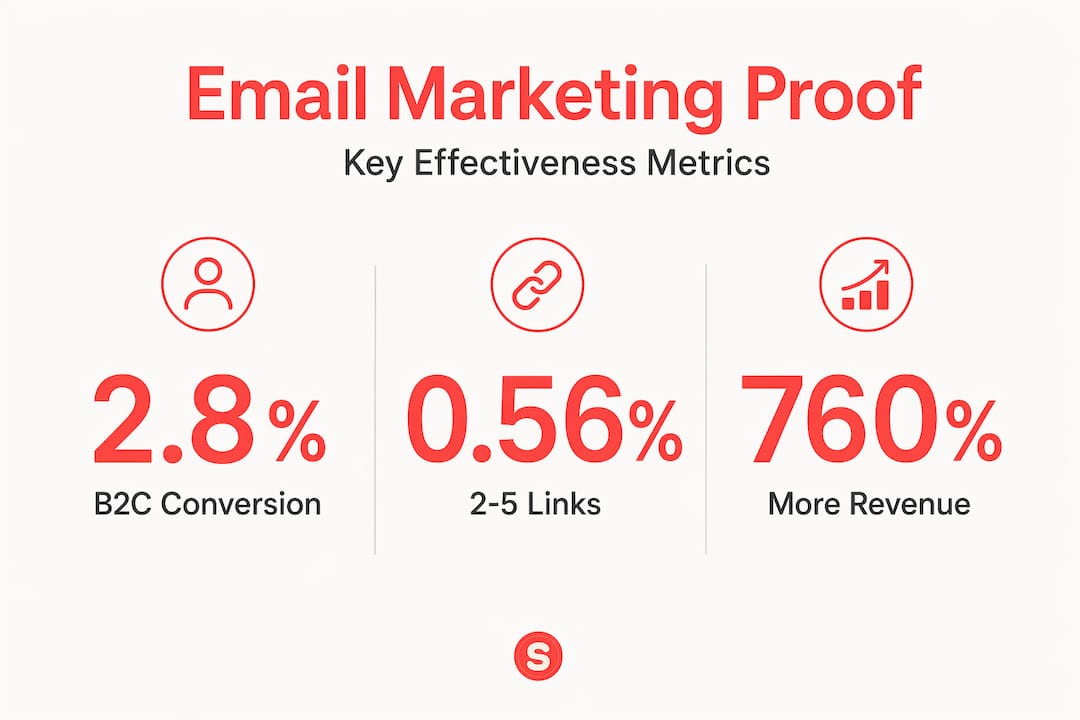
The revenue impact of segmentation goes beyond automation. Segmented, personalized campaigns can generate up to 760% more revenue than non-segmented broadcasts. That statistic tends to stop people in their tracks, and it should.
| Tactic | Impact |
|---|---|
| Standard broadcast | Baseline conversion rate of 0.32% |
| Automated sequence | 31% lift, converting at 0.42% |
| Segmented campaign | Up to 760% more revenue vs. non-segmented |
| Emails with 2-5 links | Conversion rate of 0.56%, over double the average |
The numbers behind email marketing effectiveness
If you want to make a case for email investment internally, the data makes it easy.
B2C email marketing conversion rates average around 2.8%, which outperforms both paid and organic social channels. For context, organic social media conversion rates typically sit well below 1%. Email is not competing with social. It is in a different weight class.

The structure of each email also matters more than most marketers realize. Emails with 2 to 5 links convert at 0.56%, more than double the average. This finding has a direct implication for how you build campaigns. Cramming seven offers and three CTAs into one email does not create more opportunity. It creates confusion. The email that wins is the one with a single clear purpose and a focused set of links that support it.
Beyond conversion rates, list quality is the silent driver of long-term email marketing effectiveness. A large unengaged list is not an asset. It is a liability. Unengaged subscribers damage sender reputation, push your emails into spam folders, and inflate your costs without contributing revenue. The businesses with the strongest email programs obsess over engagement metrics, not vanity metrics like raw subscriber count.
For restaurant email marketing specifically, the ROI data is particularly compelling. When every dollar of email spend is tied to measurable table reservations, online orders, or repeat visits, the case for investment becomes nearly impossible to argue against.
Strategies that maximize email performance
Knowing why email works is one thing. Applying it consistently is another. The most common failure in email marketing is not a tactical mistake. It is a strategic one: treating email as a broadcast tool rather than a relationship-building system.
Here are the practices that separate high-performing programs from average ones:
- Set one goal per email. Single-goal emails consistently outperform multi-purpose sends. Every email should have one primary job, whether that is driving a reservation, promoting a new menu item, or collecting a review.
- Clean your list regularly. Remove subscribers who have not opened or clicked in 120 days after attempting a re-engagement sequence. Smaller active lists outperform larger dormant ones on every measurable metric.
- Test subject lines systematically. Subject line performance varies more than most marketers expect. A 5-point lift in open rate from a better subject line compounds across hundreds of campaigns per year.
- Review automated sequences quarterly. Automation requires ongoing updates to stay relevant. A welcome email promoting last year’s seasonal menu damages trust instead of building it.
- Segment by lifecycle stage. New subscribers, active customers, lapsed customers, and loyal regulars all need different messaging. One-size-fits-all campaigns underperform every time.
Pro Tip: Build a restaurant email workflow before your busy season, not during it. Automation built under pressure tends to skip the personalization that makes it work.
The long-term compounding effect of consistent testing and segmentation is where serious programs pull away from the competition. Each small improvement in open rates, click rates, and conversion rates stacks on top of previous gains. After 12 months of disciplined optimization, you are operating a fundamentally different email program than where you started.
B2B vs. B2C: how the approach differs
Email marketing works for both B2B and B2C audiences, but the mechanics look very different.
In B2B, the buying cycle is longer, the decision involves multiple stakeholders, and the content needs to educate before it can sell. B2B email marketing excels at nurturing complex sales cycles by delivering tailored content to different roles over time. A CFO cares about cost justification. A department head cares about implementation effort. A user cares about daily workflow. Effective B2B email programs speak to all three at the right moments.
Behavioral signals like pricing page visits, repeated email opens, or content downloads serve as real-time qualification signals when integrated with a CRM. A sales rep who gets notified that a prospect opened three emails in 48 hours and visited the pricing page is armed with information that changes how they approach the next conversation.
| Dimension | B2B | B2C |
|---|---|---|
| Sales cycle | Long (weeks to months) | Short (hours to days) |
| Content type | Educational, case studies, ROI data | Offers, emotion, urgency |
| Decision makers | Multiple stakeholders | Usually individual |
| Best automation | Lead nurture sequences | Abandoned cart, post-purchase |
| Key metric | Pipeline contribution | Direct revenue per campaign |
For B2C businesses like restaurants and local retailers, the advantages of email newsletters and customer engagement strategies center on timing and relevance. A well-timed birthday offer or a last-minute happy hour promotion sent to the right segment generates immediate, measurable foot traffic in a way that a social post rarely matches.
My take on what actually drives email marketing success
I have reviewed email programs at businesses ranging from solo operators to regional chains, and the pattern I keep seeing is this: the programs that fail are not failing because of bad tactics. They are failing because of a wrong mental model.
Most operators treat email like a megaphone. They think about what they want to say, not about where the subscriber is in their relationship with the business. That shift in framing, from “what are we sending today” to “what does this subscriber need to hear at this point in their journey,” is what separates a $200 monthly email program from one generating five figures in attributable revenue.
The set-and-forget myth also causes real damage. I have seen welcome sequences promoting products that were discontinued two years ago, with links leading to 404 pages. That does not just underperform. It actively erodes trust. Email programs that evolve the subscriber experience with a coherent narrative and increasing relevance over time build the kind of loyalty that no paid ad can manufacture.
My honest advice: stop chasing list size and start measuring list engagement. The business with 800 subscribers who open 40% of emails will consistently beat the one with 8,000 subscribers opening 6%. The math is not close.
— Barthelemy
How Sorbey helps you put this into practice
If what you have read here makes sense but the execution feels overwhelming, that is exactly where Sorbey fits.
Sorbey is built specifically for local businesses and restaurants that want to run email marketing programs with real segmentation, automation, and personalization without needing a full marketing department. The restaurant marketing services Sorbey offers cover everything from building automated workflows to managing list health and campaign optimization. You get the strategy and the execution in one place, so you can focus on running your business while Sorbey handles the emails that keep customers coming back.
FAQ
Why does email marketing outperform social media?
Email is an owned channel where you control delivery timing and messaging, while social media reach depends on algorithms. Email consistently delivers higher conversion rates, with B2C averaging around 2.8% versus well below 1% for organic social.
How many links should I include in a marketing email?
Emails with 2 to 5 links convert at 0.56%, more than double the average conversion rate. Fewer, more focused links keep readers moving toward one clear action.
What is the ROI of automated email sequences?
Automated sequences convert at 0.42% on average, which is 31% higher than standard campaigns at 0.32%. Over the course of a year, that lift compounds significantly across every send in your program.
How does email marketing effectiveness differ for restaurants?
For restaurants, email drives immediate, measurable results like reservations, online orders, and repeat visits. Timely, segmented campaigns tied to specific offers or events generate foot traffic that social and paid channels typically cannot match at the same cost.
How often should I clean my email list?
Audit and clean your list at least every 90 to 120 days. Subscribers who have not engaged despite re-engagement attempts hurt your sender reputation and reduce deliverability for your entire list.
Recommended
You might also like

Best Restaurant Loyalty Programs 2026: ROI Guide
Discover the best restaurant loyalty programs 2026 that boost repeat visits. Learn how Sorbey’s platform can transform your guest data strategy!

Why Mobile Marketing Matters for Business Growth
Discover why mobile marketing matters for business growth. Learn how optimizing for mobile drives traffic, conversions, and customer retention.

SF Dim Sum Restaurant Marketing Checklist for 2026
Transform your SF dim sum with our 2026 marketing checklist. Optimize your profile, showcase dishes, and attract customers fast!