
Blog
Why Reputation Management Matters for Restaurants
Discover why reputation management matters for restaurants. Learn how online perceptions can drive customer traffic and boost revenue.

Why Reputation Management Matters for Restaurants
TL;DR:
- Reputation management actively shapes how restaurants are perceived online to increase customer traffic and credibility. It significantly impacts revenue, pricing power, and hiring, especially as AI tools now use online reputation data for recommendations. Consistent, proactive efforts in review solicitation, response, and digital engagement build resilience and maximize long-term growth.
Reputation management is the active practice of monitoring and shaping how your restaurant is perceived online to attract more customers and build lasting credibility. 98% of consumers read online reviews before choosing where to eat. That single fact reframes everything. Your Google profile, Yelp page, and Facebook reviews are not supplementary marketing. They are the front door. Platforms like Google, Yelp, and Facebook now determine whether a first-time guest walks in or walks past. Understanding why reputation management matters is the first step to treating it as the revenue driver it actually is.
Why reputation management matters for restaurant revenue
Reputation management is a revenue function, not a defensive one. The Harvard Business School finding that a one-star Yelp rating increase drives 5–9% revenue gains for restaurants is one of the most cited numbers in the industry. That is not a rounding error. For a restaurant doing $1 million in annual sales, a single star improvement could mean $50,000 to $90,000 in additional revenue.

The conversion numbers are equally striking. Displaying reviews on service pages can increase conversion rates by up to 270%. Restaurants that actively feature their best reviews on their website or Google Business Profile turn browsers into bookings far more effectively than those that ignore the opportunity.
Negative results carry the opposite weight. A single negative page-one search result costs a business approximately 22% of potential customers. Three negative results reduce customer consideration by 59%. A prospective diner searching your restaurant name and finding a bad review at the top of Google does not call to ask for your side of the story. They move on.
Pro Tip: Search your restaurant name in an incognito browser window right now. What a first-time customer sees in those top five results is your current reputation score.
Key revenue impacts of active reputation management:
- Higher average star ratings translate directly to measurable sales lifts on Yelp and Google
- Review visibility on your own website drives conversion rates well above industry averages
- Negative search results suppress customer consideration before a single visit occurs
- Warmer inbound leads from strong reputations reduce the cost of every new customer acquired
What are the core strategies for restaurant reputation management?
Effective reputation management for restaurants runs on three pillars: proactive review generation, prompt response, and consistent content creation. Each one reinforces the others.
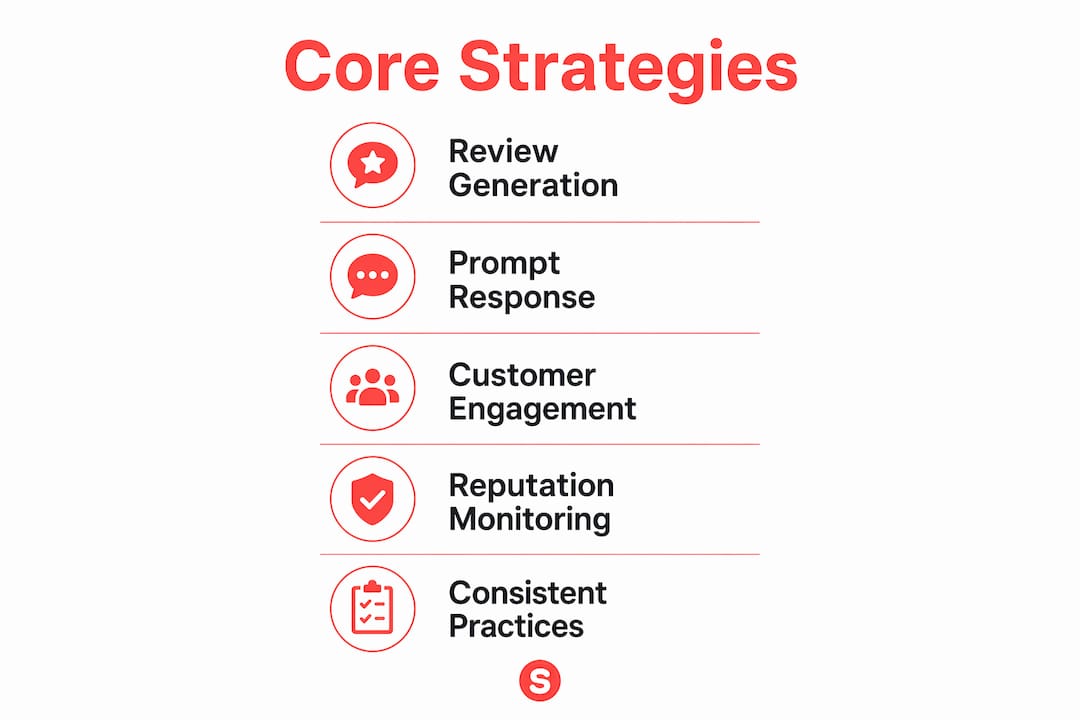
Proactive review solicitation means asking satisfied guests to leave a review on Google, Yelp, or Facebook before they leave the building or within 24 hours of their visit. Most guests who had a good experience will not review unless prompted. A simple text message or a card at the table with a QR code changes that behavior immediately.
Prompt, authentic responses to every review signal to both guests and search algorithms that your restaurant is actively managed. Research confirms that human-centric responses to feedback raise perceived brand quality and build accountability. Responding to a negative review within 24 hours, with a genuine acknowledgment and a path to resolution, often converts a critic into a loyal regular. Ignoring it compounds the damage.
Consistent positive content floods search results with accurate, favorable information about your restaurant. Deleting negative content rarely works. The more effective practice is generating verified listings, fresh photos, blog posts, and social media activity that push negatives further down the page. Active digital engagement combined with strong customer orientation produces better reputation outcomes for small businesses than any single defensive tactic.
- Claim and fully complete your Google Business Profile, Yelp listing, and Facebook page
- Set up alerts for new reviews across all platforms so nothing goes unanswered
- Train front-of-house staff to ask for reviews as part of the guest farewell
- Respond to every review, positive and negative, within 24 hours
- Publish fresh photos and updates at least twice per week to signal an active presence
Pro Tip: Use a review management checklist to build a weekly routine. Consistency beats intensity every time.
How does reputation affect pricing, hiring, and long-term resilience?
The impact of reputation on business extends well beyond the dining room. Restaurants with strong ratings gain real pricing power. A trusted reputation allows restaurants to charge higher prices while maintaining customer loyalty. Guests pay a premium for certainty. A four-and-a-half-star restaurant can price its tasting menu above a three-star competitor without losing bookings.
Hiring is the less obvious but equally costly dimension. Nearly 70% of professionals refuse job offers from companies with poor online reputations. In a restaurant industry already struggling with staffing, a weak reputation on Glassdoor or Google shrinks your applicant pool before a single interview happens. The best cooks and managers research employers the same way diners research restaurants.
“Proactive reputation building creates a reputational bank account, enabling resilience and faster recovery from crises.” — Status Labs
That concept of a reputational bank account is worth taking seriously. Restaurants that invest consistently in positive reviews, responsive communication, and authentic storytelling build a buffer. When a bad health inspection result or a viral complaint surfaces, a restaurant with 400 positive reviews absorbs the hit far better than one with 40. The role of authenticity in building trust with both guests and staff compounds this effect over time.
Key operational benefits of strong reputation management:
- Pricing premium over lower-rated competitors without sacrificing occupancy
- Lower customer acquisition costs because inbound leads arrive pre-sold
- Larger and higher-quality applicant pools for open positions
- Faster crisis recovery due to an established base of positive sentiment
How has reputation management changed with AI search in 2026?
AI assistants now shape restaurant discovery before a guest ever opens a browser. Reputation management now influences AI-generated recommendations from tools like ChatGPT and Gemini. When someone asks an AI assistant for the best Italian restaurant in their city, the answer is synthesized from reviews, social media posts, news mentions, and verified listings across the web. Your restaurant’s reputation is the raw material those systems use.
This changes the stakes. A restaurant that manages its reputation only on Yelp misses the broader digital footprint that AI systems read. Google reviews, TripAdvisor, local food blogs, Instagram mentions, and press coverage all feed into the picture. Managing reputation in 2026 means managing information across every touchpoint where your restaurant appears online.
| Digital touchpoint | Why it matters for AI visibility |
|---|---|
| Google Business Profile | Primary source for local AI recommendations |
| Yelp | High-authority review data used in AI synthesis |
| Social media mentions | Signals recency and community engagement |
| Local press and food blogs | Adds third-party credibility to AI-generated answers |
| TripAdvisor | Captures traveler intent and international visibility |
Pro Tip: Search your restaurant name in ChatGPT and Gemini monthly. The answer those tools generate is what out-of-town visitors and new residents see first. Gaps in that answer reveal gaps in your digital presence.
How can restaurants measure the ROI of reputation management?
Measuring the return on reputation work requires tracking the right metrics from the start. Without a baseline, you cannot prove progress or justify the time invested. The benefits of online reviews for restaurants show up in measurable ways across multiple business dimensions.
Metrics worth tracking monthly:
- Average star rating across Google, Yelp, and Facebook
- Review volume and the rate at which new reviews arrive
- Response rate and response time to all incoming reviews
- Reservation and walk-in conversion rates tied to review display on your website
- Cost per new customer as reputation improves and paid advertising becomes less necessary
The comparison below shows the difference between a restaurant that manages reputation actively versus one that does not:
| Metric | Active reputation management | No reputation management |
|---|---|---|
| Average star rating | 4.3–4.8 stars | 3.5–4.0 stars |
| Review response rate | 90%+ | Under 20% |
| New customer acquisition cost | Lower over time | Flat or rising |
| Crisis recovery time | Weeks | Months or permanent |
| Pricing flexibility | Higher | Constrained |
Reputation management also reduces advertising spend. A strong reputation lowers customer skepticism and decreases the amount of paid promotion needed to fill seats. Guests who arrive pre-sold by reviews require less convincing and spend more per visit.
Key Takeaways
Reputation management is the single highest-return marketing activity available to restaurant owners, directly affecting revenue, pricing, hiring, and long-term resilience.
| Point | Details |
|---|---|
| Revenue impact is measurable | A one-star Yelp rating increase drives 5–9% revenue gains for restaurants. |
| Negative results cost customers | One bad page-one result removes 22% of potential customers before they visit. |
| AI search raises the stakes | ChatGPT and Gemini now synthesize reviews and listings to recommend restaurants. |
| Reputation affects hiring | Nearly 70% of professionals avoid employers with poor online reputations. |
| Proactive management builds resilience | Consistent positive activity creates a buffer that speeds recovery from crises. |
The part most restaurant owners get wrong
Most restaurant owners I talk to treat reputation management as something they do after a problem appears. A bad review goes viral, a health score drops, a competitor starts outranking them on Google, and suddenly reputation becomes urgent. That reactive posture is the most expensive mistake in local marketing.
The restaurants that win on reputation treat it like payroll. It happens on a schedule, every week, without exception. They respond to reviews on Tuesday mornings. They post new photos on Thursday. They ask for reviews every Friday evening. That rhythm builds the reputational bank account that makes crises survivable.
The other thing I see consistently underestimated is the connection between reputation and pricing. Owners who struggle to raise menu prices often have a reputation problem they have not diagnosed. Guests pay more at restaurants they trust. Trust is built through reviews, responses, and consistency. Raise your reputation score and you raise your ceiling on what the market will pay.
The complete how-to guide for restaurant reputation management covers the mechanics in detail. But the mindset shift comes first. Reputation is not marketing. It is the foundation that makes all other marketing work.
— Barthelemy
How Sorbey supports your restaurant’s reputation
Restaurant owners who want to manage reputation without adding hours to their week use Sorbey’s all-in-one marketing platform built specifically for local restaurants.
Sorbey monitors reviews across Google, Yelp, and Facebook in one dashboard, flags new reviews for fast response, and tracks your rating trends over time. The platform connects reputation data to your broader marketing activity so you can see exactly how review improvements affect foot traffic and reservations. For restaurants ready to treat reputation as the revenue function it is, Sorbey’s restaurant marketing services provide the tools and structure to make that shift without adding complexity to your day.
FAQ
Why does reputation management matter for restaurants specifically?
Restaurants depend on local trust more than almost any other business. With 98% of consumers reading reviews before choosing where to eat, a restaurant’s online reputation directly determines how many new guests walk through the door each week.
How much revenue can a better Yelp rating actually generate?
A one-star increase on Yelp drives 5–9% revenue gains for restaurants, according to Harvard Business School research. For a restaurant generating $800,000 annually, that translates to $40,000 to $72,000 in additional sales.
What is the fastest way to improve an online reputation?
Respond to every existing review within 24 hours and start asking satisfied guests for reviews immediately after their visit. Consistent response and fresh review volume signal active management to both guests and search platforms.
Does reputation management affect who applies for jobs at my restaurant?
Nearly 70% of professionals decline job offers from employers with poor online reputations. A weak rating on Google or Glassdoor shrinks your applicant pool before a single interview takes place.
How does AI search change reputation management for restaurants?
AI tools like ChatGPT and Gemini now synthesize reviews, social posts, and listings to recommend restaurants directly. Managing your presence across all digital touchpoints, not just Yelp or Google, determines whether AI assistants recommend your restaurant or a competitor.
Recommended
- Review Management Checklist: Boost Restaurant Reputation | Sorbey Blog | Sorbey
- What Is Reputation Management for Your Business | Sorbey Blog | Sorbey
- Benefits of online reviews for restaurants in 2026 | Sorbey Blog | Sorbey
- Restaurant Reputation Management: A Complete How-To Guide | Sorbey Blog | Sorbey
You might also like

Best Restaurant Loyalty Programs 2026: ROI Guide
Discover the best restaurant loyalty programs 2026 that boost repeat visits. Learn how Sorbey’s platform can transform your guest data strategy!

Why Mobile Marketing Matters for Business Growth
Discover why mobile marketing matters for business growth. Learn how optimizing for mobile drives traffic, conversions, and customer retention.

SF Dim Sum Restaurant Marketing Checklist for 2026
Transform your SF dim sum with our 2026 marketing checklist. Optimize your profile, showcase dishes, and attract customers fast!