
Blog
Geo-Targeted Ads: Why Location Changes Everything
Discover why geo-targeted ads outperform broad campaigns by delivering relevant messages based on location, enhancing engagement and conversion.

Geo-Targeted Ads: Why Location Changes Everything
Why geo-targeted ads outperform broad campaigns
Geo-targeted advertising delivers ads to people based on where they actually are, not where a demographic model guesses they might be. Platforms like Google Ads and Facebook Ads use signals including GPS data, IP addresses, device settings, and browsing behavior to match ads with users by country, city, ZIP code, or a radius as tight as 1 km. The result is a message that lands in context, not in a vacuum.
Here is what that means in practice:
- Location precision: Target entire countries, individual cities, specific ZIP codes, or a custom radius around your business.
- Contextual relevance: Ads reflect local conditions like weather, store proximity, and neighborhood demand, not just broad demographics.
- Real-world outcomes: Location targeting connects digital impressions to physical actions, including store visits, phone calls, and in-person purchases.
- Platform reach: Both Google Ads and Facebook Ads support granular geographic controls, making location-based campaigns accessible across search, display, and social channels.
- ROI lift: Focusing spend on relevant geographies reduces wasted impressions and pushes budget toward audiences who can actually act on the ad.
The core logic is simple. An ad for a lunch special shown to someone two blocks away at 11:45 AM will always outperform the same ad shown to someone in another state. Geo-targeting makes that precision repeatable at scale.
How location-based ads improve performance and ROI
The performance gains from location-based advertising come from a few concrete mechanisms, not marketing theory.
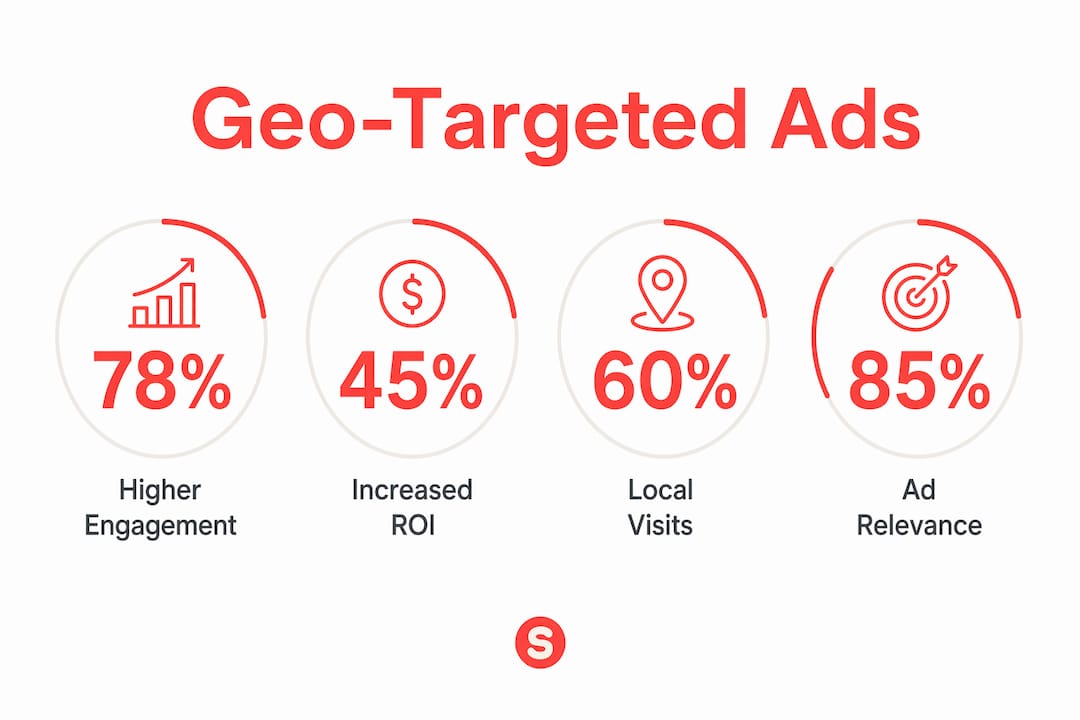
Relevance drives engagement. When someone sees an ad for a nearby restaurant during lunch hour or a retail promotion while they are already shopping in the area, they are far more likely to click. Location-aware ads feel timely rather than intrusive, and that distinction shows up in click-through rates and brand recall.

Proximity improves conversion. A person who sees your store’s promotion while they are already nearby is far more likely to walk in than someone who sees the same ad from across the country. That proximity factor cuts customer acquisition costs because you are reaching people who can convert immediately, not just someday.
Budget allocation gets sharper. For multi-location brands, shifting spend toward ZIP codes and cities with higher conversion potential reduces waste fast. Instead of spreading a fixed budget thin across every market, you concentrate it where the data says it works. Geographic performance data lets you see exactly which neighborhoods respond and which ones drain budget without return.
Location signals add context beyond demographics. Knowing someone is 35 years old tells you something. Knowing they commute through a specific corridor every morning, live near your store, and tend to visit coffee shops on weekdays tells you far more. Location enriches targeting by surfacing market moments, not just audience profiles.
- Higher click-through rates from contextually relevant ads
- Lower cost per acquisition from proximity-driven conversions
- Reduced wasted impressions through geographic budget focus
- Richer analytics showing performance by city, neighborhood, or DMA
- Better creative decisions informed by local demand and behavior patterns
Pro Tip: Use geographic performance reports in Google Ads to identify your top-converting ZIP codes, then reallocate budget from underperforming regions to those areas monthly. Even small shifts can meaningfully improve overall campaign ROI.
Which industries benefit most from geo-targeting?
Location-based targeting works best when a business’s revenue depends on physical proximity or localized demand. Several industries have built it into their core advertising approach.
Retail and quick-service restaurants (QSR) are the clearest fit. Store density, foot traffic corridors, and lunch-hour timing all make proximity the primary purchase driver. A QSR chain running ads to users within a close radius of each location during peak meal hours is doing something fundamentally different from a national brand campaign. The geo-targeting approach supports campaigns across QSRs and retail by reaching high-intent audiences at the moment they can act.
Automotive dealerships operate within defined service radiuses and dealer territories. Regional inventory differences, local incentives, and service area boundaries make geographic discipline essential. Geo-targeting also helps dealers separate brand-demand markets from deal-driven ones, which changes how they allocate creative and budget.
Local services including medical practices, law firms, home services, and salons depend almost entirely on customers who live or work nearby. Advertising to someone 40 miles away is rarely worth the spend. Geo-targeting keeps every dollar pointed at the realistic service area.
Multi-location brands use geographic targeting to manage budget allocation across markets, proving performance in high-conversion cities before scaling nationally. It also lets them test local messaging and offers without committing to a national rollout.
- Retail and QSR: timing and proximity drive visits
- Automotive: dealer territories and regional inventory require geographic precision
- Local services: service radius defines the entire viable audience
- Multi-location brands: market-by-market budget control and local testing
For restaurants specifically, location-based marketing that connects digital ads to foot traffic is one of the most direct paths from ad spend to table fills.
How does geo-targeting differ from geofencing?
These two terms get used interchangeably, but they describe different tools with different purposes.
Geo-targeting is a broader, strategic approach. It uses location combined with behavioral data, demographics, and interests to reach audiences over time. The goal is sustained brand relevance and building relationships with people in specific markets. A restaurant running geo-targeted ads to users within five miles who have shown interest in dining out is doing geo-targeting.
Geofencing is tactical and immediate. It draws a virtual perimeter around a specific location and triggers an ad or notification the moment a device enters that boundary. The goal is an instant call to action, usually a visit or a purchase right now. A retailer sending a discount notification to anyone who walks past their storefront is using geofencing.
The key distinction is scope and timing. Geo-targeting builds audiences and campaigns over days or weeks. Geofencing reacts in real time to physical presence.
- Geo-targeting: broader geography, layered data, brand building, sustained campaigns
- Geofencing: tight perimeter, real-time trigger, immediate conversion focus
- Timing: geo-targeting runs continuously; geofencing fires on entry
- Data used: geo-targeting adds behavior and demographics; geofencing relies primarily on location alone
- Best for: geo-targeting suits awareness and loyalty; geofencing suits flash promotions and foot traffic spikes
Pro Tip: Use geo-targeting as your always-on foundation and layer geofencing on top for specific events, promotions, or competitor conquesting. The two approaches reinforce each other when the campaign goals are clearly separated.
Best practices for running geo-targeted ad campaigns
Getting location targeting right takes more than drawing a circle on a map and pressing go.
Set location-specific objectives first. Vague goals produce vague results. Define whether you want store visits, online orders, phone calls, or brand awareness in a specific market before you build the campaign. The objective determines the radius, the creative, and the measurement approach.
Choose your geographic granularity carefully. A national radius wastes budget. A radius that is too tight misses nearby customers. Google Ads location targeting uses multiple signals including physical location and location of interest, so a 1-mile radius may still reach users who are not physically present but have shown intent in your area. Match the radius to your actual service area, not to an aspirational one.

Layer behavioral and demographic data. Location alone is a starting point. Adding behavioral signals like dining habits, purchase history, or commute patterns sharpens the audience considerably. Personalization is what separates a geo-targeted ad that feels relevant from one that just happens to appear nearby.
Manage supply path quality. Good location data paired with low-quality ad inventory underperforms. Controlling where ads actually appear, especially in connected TV and programmatic display, matters as much as the targeting parameters themselves.
Measure with geographic rigor. Compare performance by city, ZIP code, or DMA. Identify which markets drive incremental results versus which ones simply have higher baseline demand. Analytics-driven decisions separate campaigns that scale from ones that plateau.
- Define location-specific KPIs before launch
- Match radius to your real service area, not your ideal one
- Layer behavior and interest data on top of location signals
- Control ad inventory quality, especially in programmatic channels
- Review geographic performance data regularly and reallocate budget accordingly
Pro Tip: Build an omnichannel geo-strategy by aligning your social, search, and display campaigns to the same geographic tiers. When a potential customer sees consistent messaging across Google Ads, Facebook Ads, and local display in the same market, conversion rates tend to climb faster than any single-channel push.
How local marketing platforms sharpen geo-targeted efforts
Running geo-targeted campaigns manually across multiple platforms is manageable for a single location. For a restaurant group or any business with several locations, it gets complicated fast.
Platforms built specifically for local business marketing, like Sorbey, address that complexity by combining location data, campaign automation, and analytics in one place. Rather than toggling between Google Ads, Facebook Ads, and a separate analytics tool, local marketing platforms centralize the work and align it to the specific needs of businesses that depend on foot traffic.
Sorbey’s restaurant marketing tools are built around the reality that a restaurant’s best customer is usually within a few miles of the front door. The platform integrates geo-targeting with local messaging, making it straightforward to run location-specific promotions, track which ads drive actual visits, and adjust spend based on real performance data.
- Integrated geo-targeting: location data and ad delivery managed in one platform, not across disconnected tools
- Automation: campaign scheduling and budget adjustments based on performance without manual intervention
- Local messaging alignment: creative and offers matched to neighborhood-level context and events
- Foot traffic measurement: connecting ad exposure to in-store visits rather than relying on clicks alone
- Accessible reporting: geographic performance data presented clearly so business owners can act on it without a data team
For restaurants specifically, pairing geo-targeted ads with local diner engagement strategies creates a compounding effect: ads bring new customers in, and loyalty tactics keep them coming back. Local SEO also reinforces this approach, since local search visibility and geo-targeted paid ads work toward the same goal from different angles.

Sorbey handles the technical side of geo-targeted advertising so local business owners can focus on running their business. If you want location-based campaigns that actually connect ad spend to foot traffic, explore Sorbey’s services and see what a purpose-built local marketing platform looks like in practice.
Key Takeaways
Geo-targeted advertising outperforms broad campaigns because it matches ad delivery to location, behavior, and intent, concentrating budget where conversion is most likely.
| Point | Details |
|---|---|
| Location drives relevance | Ads matched to a user’s physical location or area of interest produce higher engagement than broad demographic targeting. |
| Budget efficiency improves | Focusing spend on high-converting ZIP codes and cities reduces wasted impressions and lowers cost per acquisition. |
| Geo-targeting vs. geofencing | Geo-targeting builds sustained audiences over time; geofencing triggers real-time actions within a tight perimeter. |
| Signal quality matters | Effective campaigns require strong location data, controlled ad inventory, and outcome-based measurement, not just a well-drawn radius. |
| Local platforms simplify execution | Tools like Sorbey integrate geo-targeting, automation, and analytics to connect ad spend directly to foot traffic for local businesses. |
Recommended
También te puede interesar

Best Restaurant Loyalty Programs 2026: ROI Guide
Discover the best restaurant loyalty programs 2026 that boost repeat visits. Learn how Sorbey’s platform can transform your guest data strategy!

Why Mobile Marketing Matters for Business Growth
Discover why mobile marketing matters for business growth. Learn how optimizing for mobile drives traffic, conversions, and customer retention.

SF Dim Sum Restaurant Marketing Checklist for 2026
Transform your SF dim sum with our 2026 marketing checklist. Optimize your profile, showcase dishes, and attract customers fast!