
Blog
Social media marketing for local restaurants: boost revenue
Discover why use social media marketing for your local restaurant. Learn proven strategies to boost revenue and transform your online presence into profits.
Social media marketing for local restaurants: boost revenue
TL;DR:
- Focused social media campaigns can generate high ROI, exemplified by a 5x return in Atlanta.
- Authentic, consistent content builds trust, community, and drives immediate customer actions.
- Combining paid and organic strategies with local targeting maximizes restaurant growth and visibility.
A local Atlanta restaurant campaign called “Eats Local” spent $15,000 on social media ads and pulled in $75,000 in revenue, delivering a 5x return on ad spend. That is not a fluke. It is a blueprint. Most local restaurant owners in cities like Chicago, Houston, Miami, and Los Angeles are leaving serious money on the table by treating social media as an afterthought rather than a sales engine. This guide breaks down the real evidence, the exact strategies, and the step-by-step actions you can take to transform your restaurant’s social presence into a reliable revenue driver.
Table of Contents
- The impact of social media marketing on restaurant growth
- Understanding why social media works for local restaurants
- How to apply social media marketing in your restaurant
- Overcoming common challenges and mistakes
- Why most restaurants underestimate social media, and how to get ahead
- Next steps: Make your restaurant stand out with expert help
- Frequently asked questions
Key Takeaways
| Point | Details |
|---|---|
| Proven campaign ROI | The Atlanta ‘Eats Local’ campaign returned 5x revenue on social ad spend, demonstrating clear financial gain. |
| Engagement drives sales | Social media creates awareness, loyalty, and repeat foot traffic when paired with strong local content. |
| Execution beats theory | Applying practical steps and avoiding common pitfalls ensures your marketing actually works. |
| Expert guidance matters | Strategic help can help restaurants outperform competition and adapt to the ever-changing digital landscape. |
The impact of social media marketing on restaurant growth
Let’s start with the numbers, because the numbers make the case better than anything else. The Atlanta “Eats Local” campaign is a benchmark example of what focused, community-driven social media marketing can do for a local restaurant. With a modest budget and sharp targeting, local restaurants in that campaign generated measurable, trackable revenue that far exceeded the investment.
Here is a breakdown of the campaign’s core performance data:
| Metric | Result |
|---|---|
| Total ad spend | $15,000 |
| Total revenue generated | $75,000 |
| Return on ad spend (ROAS) | 5x |
| Primary platform used | Instagram and Facebook |
| Key content type | Visual menus, local community stories |
What makes this remarkable is not just the numbers. It is the repeatability. The Atlanta campaign succeeded because it combined geo-targeted paid ads with organic community storytelling, which is a formula any local restaurant can replicate with the right setup. Your local advertising strategy does not need a massive budget. It needs precision.
“A $15k investment generated $75k in revenue for Atlanta-area restaurants using social media, proving that local campaigns with strong community framing consistently outperform generic advertising.” — Atlanta ‘Eats Local’ Campaign Results
Real-time offers and visual menus are two of the highest-performing content types for food businesses on social media. When a restaurant posts a limited-time dish with a strong photo at 11 AM, it directly influences lunchtime foot traffic. That is not brand building in the abstract. That is a customer walking through your door within the hour.
Key benefits local restaurants see from consistent social media marketing include:
- Increased brand awareness among neighborhood residents and office workers nearby
- Stronger customer loyalty through behind-the-scenes content and staff spotlights
- Direct foot traffic growth from time-sensitive offers and geo-targeted promotions
- Higher reservation rates when paired with online booking links in posts
- Community goodwill from community impact campaigns that highlight sourcing, values, and local partnerships
Using a solid restaurant digital marketing checklist helps you make sure none of these levers go untouched. The restaurants that win on social media are not the ones with the biggest budgets. They are the ones that show up consistently with content that actually means something to their local audience.
Understanding why social media works for local restaurants
The question is not whether social media works for restaurants. It does. The real question is why it works so reliably for local food businesses when other advertising channels often fall flat.
The answer comes down to three things: proximity, trust, and visual appetite. People eat with their eyes before they eat with their mouths. A beautifully shot plate of tacos on Instagram triggers a craving response that a radio ad or a coupon mailer simply cannot replicate. And when that post comes from a restaurant three blocks away, the barrier between desire and action nearly disappears.
Here is how organic and paid social media compare for local restaurants:
| Type | Strengths | Weaknesses |
|---|---|---|
| Organic social | Builds trust, no direct cost, shows authenticity | Slow reach growth, algorithm dependent |
| Paid social | Fast reach, precise targeting, measurable ROI | Requires budget, needs testing to optimize |
| Combined approach | Amplifies both, best long-term results | Requires more planning and coordination |
The 5x ROAS achieved in Atlanta came from a combined approach. Organic content built trust and community recognition, while paid ads accelerated reach and drove conversions. Neither alone would have hit those numbers.
The content formats that consistently drive the highest engagement for restaurants are:
- Behind-the-scenes videos showing your kitchen, prep process, or team culture
- Instagram Stories with countdown timers tied to limited-time offers
- User-generated content reposts from happy customers tagging your location
- Staff spotlight posts that humanize the brand and build emotional connection
- Poll and quiz content asking followers about preferences, new menu items, or flavor votes
Pro Tip: Avoid generic stock photos and scripted captions. Restaurants that show their real staff, real food, and real neighborhood consistently outperform those that post polished but hollow content. Authenticity is not a trend. It is the foundation of local trust, much like ethical food brand advantages that come from being genuine about your sourcing and values.
For practical execution, the marketing types for restaurants that deliver the best results always include a social media component, whether that is organic storytelling, paid campaigns, or influencer partnerships. Your restaurant advertising guide should map out which formats you will use each week and for what goal.
How to apply social media marketing in your restaurant
Ready to try these strategies? Here is a step-by-step application guide built specifically for local restaurants in major U.S. cities.
Step 1: Define your audience clearly. In a city like New York or Los Angeles, you are not marketing to everyone. You are marketing to people within a five-mile radius, possibly a specific neighborhood. Know their age range, dining habits, and what they care about in a local restaurant.
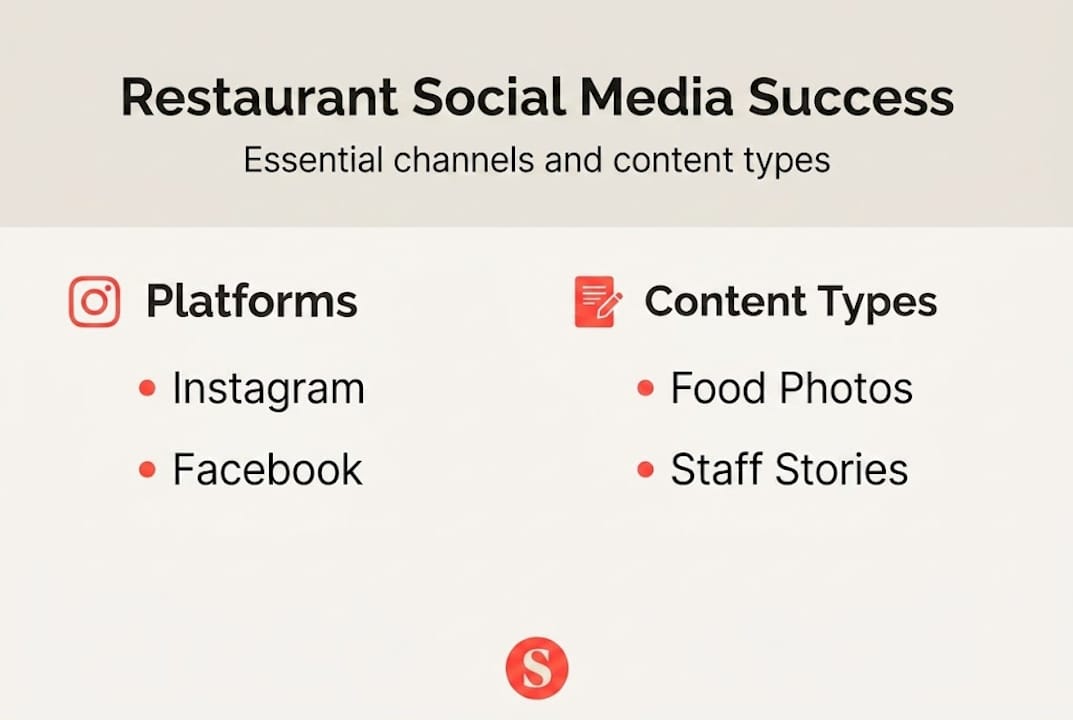
Step 2: Choose your primary platforms. Instagram and Facebook are non-negotiable for most restaurants. TikTok is gaining ground fast, especially for restaurants targeting diners under 35. Start with two platforms before spreading thin across five.
Step 3: Set up a content calendar. Plan posts at least two weeks in advance. A simple spreadsheet works. Assign content themes to each day: Monday for menu highlights, Wednesday for staff features, Friday for weekend specials, and so on.
Step 4: Launch a geo-targeted paid campaign. The Atlanta campaign’s success was partly rooted in tight geographic targeting. Spend your ad budget on people within your delivery zone or a walkable distance from your location.
Step 5: Engage actively in the first 60 minutes after posting. Responding to comments and shares immediately after publishing tells the algorithm your content is worth showing to more people. This is free amplification and most restaurant owners skip it.
Step 6: Measure, adjust, and repeat. Pull your metrics weekly. Look at reach, engagement rate, and whether posts correlate with busier shifts or more online orders. Use tools like Meta Business Suite or Later for scheduling and analytics.
Pro Tip: In major cities, local hashtags are powerful. In Chicago, tags like #chicagoeats or #chicagofoodie can surface your posts to thousands of locals who are actively searching for dining options. Research the top 10 local food hashtags in your city and rotate them consistently. Pair this with restaurant remarketing tips to bring back past customers who engaged with your posts but did not convert.
Must-have platforms and content priorities for local restaurant marketing:
- Instagram: Food photography, Stories, Reels for menu reveals and behind-the-scenes
- Facebook: Event listings, paid ads, community group engagement
- Google Business Profile: Not social media, but works hand-in-hand with your social strategy
- TikTok: Short cooking videos, day-in-the-life content, trending sound overlays
For restaurants considering paid search alongside social, PPC for restaurants can complement your social campaigns by capturing high-intent searches like “best Italian restaurant near me” that social alone cannot catch. Staying current with sustainability trends in food marketing also helps you build content that resonates with today’s values-conscious diners.
Overcoming common challenges and mistakes
Applying social media is powerful, but only if you steer clear of what trips up most local restaurants.
The most common pitfalls that kill restaurant social media campaigns before they gain traction include:
- Inconsistent posting schedules that confuse followers and tank algorithmic reach
- Ignoring comments and DMs which signals low trust to both followers and the platform
- Posting only promotional content without offering entertainment, education, or community value
- Using poor-quality photos taken under bad lighting, which undercuts the appetite appeal of your food
- Failing to track any metrics and therefore repeating what does not work while abandoning what does
- Copying national chain content styles instead of leaning into the local, personal story that only you can tell
The fix for most of these is not more budget. It is more structure. A content calendar removes the guesswork and prevents the “we forgot to post this week” problem that derails so many local restaurant accounts. Assign a social media champion on your team, even if it is just one person doing two to three posts a week. Consistency beats frequency every time.
“When local restaurants in the Atlanta ‘Eats Local’ campaign committed to a structured posting schedule and community-first messaging, they achieved 5x ROAS results that generic sporadic posting had never come close to delivering.”
Pro Tip: Build a simple content bank. Set aside 30 minutes each week to photograph dishes, capture a quick video of your team, or screenshot a positive customer review. Store everything in a shared Google Drive folder. When you sit down to post, you will never be staring at an empty phone wondering what to create.
For restaurants with limited staff and time, the digital marketing tips that matter most are the ones that reduce friction. Use scheduling tools to automate posting. Use templates for your captions so you are not starting from scratch each time. Think of social media the way smart restaurants think about circular economy benefits for coffee shops: nothing goes to waste, every piece of content serves multiple purposes across multiple channels.
Resource-limited owners can also repurpose one piece of content across multiple platforms. A 30-second video of your chef plating a signature dish works on Instagram Reels, Facebook, TikTok, and as a thumbnail on your Google Business Profile. You create it once and distribute it everywhere. That is smart, not lazy.
Why most restaurants underestimate social media, and how to get ahead
Here is an honest observation from working with local restaurants across competitive U.S. markets: most owners think of social media as a megaphone when they should be thinking of it as a handshake.
The restaurants that dominate on social are not the ones broadcasting the most promotions. They are the ones building actual relationships. They reply to every comment. They repost customer photos. They name-check loyal regulars. They show up as a real part of the neighborhood, not just a business chasing sales.
The uncomfortable truth is that sporadic posting with no strategy wastes more time than doing nothing at all, because it creates the illusion of effort without delivering results. Real strategic local ads combine community storytelling with precise targeting, and that combination builds the kind of reputation that keeps a restaurant thriving even when a new competitor opens across the street.
The restaurants that win long-term treat consistency and authenticity as their competitive advantages. That is something no national chain can copy from you.
Next steps: Make your restaurant stand out with expert help
You now have the evidence, the strategies, and the playbook. The next challenge is execution, and that is where most owners hit a wall. Running a restaurant is already a full-time job. Building a social media presence that actually drives revenue requires planning, creative assets, analytics, and ongoing optimization.
You do not have to figure this out alone. Our restaurant marketing services are built specifically for local restaurants in competitive U.S. markets. From social media campaign management to geo-targeted paid ads and remarketing, we handle the strategy and execution so you can focus on running your kitchen. Whether you want to replicate a campaign like Atlanta’s “Eats Local” or build a long-term local presence, we can help you get there with a plan that fits your budget and your goals.
Frequently asked questions
How quickly can social media marketing impact my restaurant sales?
Restaurants can start seeing engagement and revenue improvement within just a few weeks, especially when running paid geo-targeted campaigns, as demonstrated by the Atlanta ‘Eats Local’ results where significant returns appeared rapidly after launch.
What platforms work best for local restaurants?
Instagram and Facebook consistently deliver the highest engagement and conversion rates for food businesses targeting local audiences, with TikTok growing quickly for restaurants reaching younger diners.
Can small restaurants compete with big chains using social media marketing?
Absolutely. Local restaurants actually have a built-in advantage because community authenticity and genuine neighborhood connection resonate more deeply with local audiences than anything a national chain’s corporate account can produce.
Is it necessary to use paid ads, or can organic content succeed?
Organic content builds loyalty and long-term visibility, but paid ads significantly accelerate reach and conversions. The Atlanta campaign proved that combining both produces far stronger results than relying on either approach alone.
How do I measure success in social media marketing for my restaurant?
Focus on ROAS for paid campaigns, engagement rate for organic content, and reservation or order conversions tied to specific posts or promotions. These three metrics give you a clear, honest picture of what is working and what needs to change.
Recommended
Potrebbe interessarti anche
Best Restaurant Loyalty Programs 2026: ROI Guide
Discover the best restaurant loyalty programs 2026 that boost repeat visits. Learn how Sorbey’s platform can transform your guest data strategy!
Why Mobile Marketing Matters for Business Growth
Discover why mobile marketing matters for business growth. Learn how optimizing for mobile drives traffic, conversions, and customer retention.
SF Dim Sum Restaurant Marketing Checklist for 2026
Transform your SF dim sum with our 2026 marketing checklist. Optimize your profile, showcase dishes, and attract customers fast!