
Blog
Restaurant remarketing explained: boost repeat visits
Learn proven restaurant remarketing strategies to bring back past customers. Discover budget frameworks, targeting tactics, and ROI optimization for urban markets.

Restaurant remarketing explained: boost repeat visits
Restaurant remarketing sounds complicated, but it’s actually one of the most straightforward ways to bring customers back through your doors. Many restaurant owners struggle to understand how digital ads can reconnect with past diners, yet this tactic consistently delivers measurable results when executed correctly. In competitive urban markets, remarketing helps you stay visible to people who’ve already shown interest in your menu. This guide breaks down practical strategies, budget frameworks, and data-driven tactics to help you launch effective campaigns that drive repeat visits and increase revenue.
Table of Contents
- Key takeaways
- Understanding restaurant remarketing and why it matters
- Core strategies for effective restaurant remarketing campaigns
- Advanced remarketing techniques in competitive urban markets
- Measuring success and scaling your restaurant remarketing efforts
- Explore Sorbey’s restaurant marketing solutions
- FAQ
Key Takeaways
| Point | Details |
|---|---|
| Budget testing | Start with monthly budgets between 100 and 500 to test high intent remarketing lists before scaling. |
| First party data | Build robust audiences by combining CRM data with WiFi login captures to reduce reliance on third party cookies. |
| Dynamic ads | Use dynamic ads to show dishes or menu items the customer viewed to reinforce interest and boost conversions. |
| ROAS driven scaling | Increase budgets only after ROAS reaches five times or more to ensure scalable, profitable growth. |
Understanding restaurant remarketing and why it matters
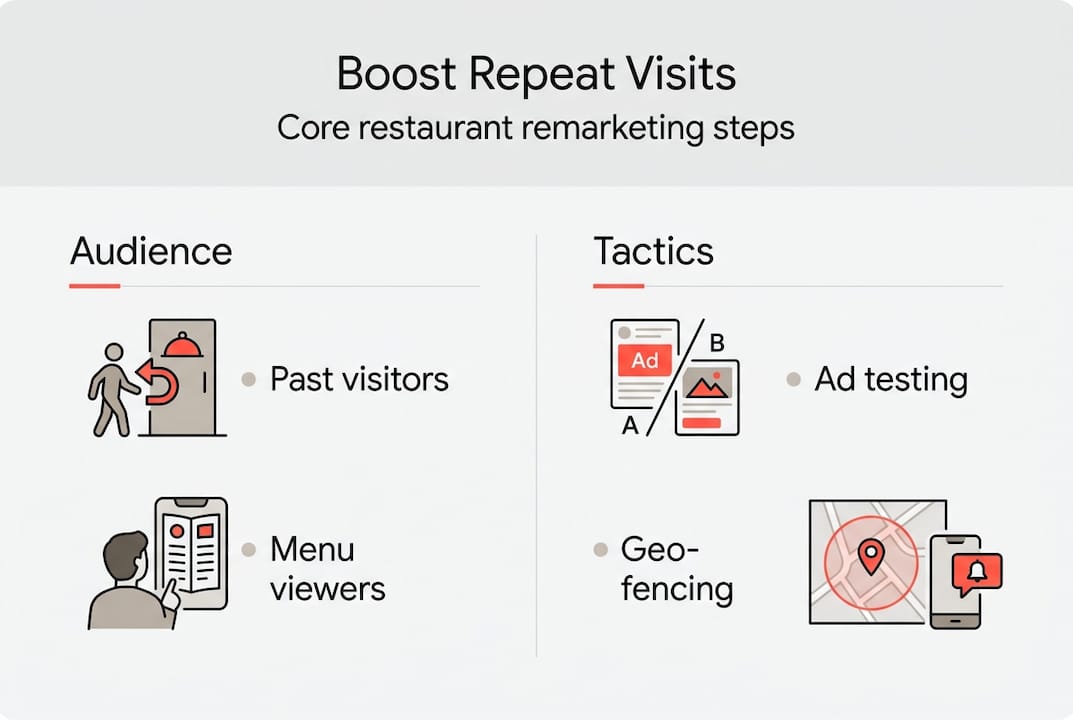
Remarketing targets people who’ve already visited your website, viewed your menu, or interacted with your restaurant online. Instead of casting a wide net to strangers, you focus ad spend on warm prospects who know your brand. This approach works because these individuals have demonstrated interest, making them far more likely to convert than cold audiences.
In competitive restaurant markets, especially urban centers with dozens of dining options within blocks, staying top of mind matters enormously. A diner might browse your menu on Monday but choose a competitor by Friday simply because they forgot about you. Remarketing solves this by keeping your restaurant visible across their digital journey.
The shift away from cookie-based tracking makes first-party data collection critical. Starting budgets between $100-$500 monthly let you test high-intent customer lists effectively, then scale to 3-6% of digital revenue when return on ad spend exceeds 5x. Combine CRM data with WiFi login captures to build robust audience segments that don’t rely on third-party cookies.
Key benefits of restaurant remarketing include:
- Lower cost per acquisition compared to cold traffic campaigns
- Higher conversion rates from audiences familiar with your brand
- Ability to personalize messaging based on browsing behavior
- Measurable ROI that justifies scaling marketing budgets
- Competitive advantage in saturated local markets
Small budgets can test remarketing effectiveness quickly. Even $100 monthly focused on website visitors from the past 30 days often generates positive returns. When campaigns perform well, restaurants can scale budgets to capture more repeat business systematically.
Core strategies for effective restaurant remarketing campaigns
Successful remarketing starts with audience segmentation. Group visitors by behavior and intent using signals from your website and CRM. Create separate lists for menu browsers, reservation starters, and past customers who haven’t returned recently. Each segment responds to different messaging, so tailored ads outperform generic approaches.
Begin with modest budgets focused on high-intent groups. Initial spending of $100-$500 monthly lets you test which audiences convert best without risking significant capital. Track return on ad spend closely, and only increase budgets when ROAS exceeds 5x consistently. This disciplined approach prevents wasted spend on underperforming campaigns.

First-party data collection becomes essential as browsers phase out third-party cookies. Implement WiFi login systems that capture email addresses when guests connect to your network. Integrate this data with your CRM to build remarketing lists that remain effective regardless of tracking changes. Restaurants with robust first-party data gain competitive advantages as cookie deprecation accelerates.
Dynamic ads display specific dishes customers viewed on your website, creating personalized experiences that drive conversions. Even without ecommerce carts, you can show images of appetizers or entrees someone browsed, reminding them why they were interested initially. This tactic works particularly well for restaurants with extensive menus or specialty items.
Follow these steps to launch your first campaign:
- Install tracking pixels on your website to capture visitor data
- Create audience segments based on behavior like menu views or reservation abandonment
- Design ad creative featuring your most popular dishes with clear calls to action
- Set initial budgets at $100-$500 monthly focused on highest-intent segments
- Monitor ROAS daily and adjust bids based on performance data
- Scale budgets incrementally when campaigns consistently exceed 5x return
Pro Tip: Use your marketing budget calculator to determine optimal remarketing spend based on current revenue and growth targets, ensuring budgets align with business objectives.
Test different ad formats to identify what resonates with your audience. Static image ads work well for showcasing signature dishes, while carousel ads let you display multiple menu items in one placement. Video ads showing kitchen preparation or dining atmosphere can build emotional connections that drive reservations. Run A/B tests comparing headlines, images, and offers to continuously improve performance.
Integrate remarketing with other restaurant marketing solutions for maximum impact. Coordinate ad messaging with email campaigns and social media content to create cohesive customer experiences. When prospects see consistent branding across channels, they’re more likely to trust your restaurant and make reservations.
Advanced remarketing techniques in competitive urban markets
Geo-fencing targets customers within specific geographic boundaries, typically 5-10 miles from your restaurant location. In competitive U.S. cities, this tactic ensures ad spend reaches people who can actually visit your establishment. Set tighter radiuses in dense urban areas where diners have numerous options within walking distance. Expand boundaries in suburban markets where customers travel farther for dining experiences.
Bid strategies should prioritize high-intent actions. Increase bids on customers who started but didn’t complete online reservations, as they demonstrated clear purchase intent. Similarly, target people who viewed your menu multiple times or spent significant time on your website. These behaviors signal strong interest, making higher bids worthwhile for conversion potential.
Dynamic remarketing adapts creative based on user behavior, showing dishes someone viewed previously. For restaurants without ecommerce carts, this means displaying images of specific menu items a visitor browsed. Someone who spent time on your seafood page sees ads featuring salmon or shrimp dishes, while another visitor who viewed desserts sees cake or pastry promotions. This personalization significantly improves click-through and conversion rates.
| Feature | Standard remarketing | Dynamic remarketing |
|---|---|---|
| Creative | Static ads shown to all audiences | Personalized ads based on browsing behavior |
| Setup complexity | Simple, quick implementation | Requires product feed and additional configuration |
| Performance | Good for brand awareness | Superior for conversion-focused campaigns |
| Best use case | Small menus or single-location restaurants | Multi-location chains or extensive menu offerings |
Fine-tune bids based on device, time of day, and day of week. Mobile users searching during lunch hours represent different intent than desktop users browsing at midnight. Increase bids for high-conversion windows and reduce spend during low-performance periods. This optimization maximizes return from limited budgets.
Pro Tip: Layer audience segments with geographic and demographic targeting to create hyper-focused campaigns that outperform broad approaches in saturated markets.
Competitive urban environments demand constant testing and refinement. What works in your market today may lose effectiveness as competitors adjust their strategies. Monitor campaign performance weekly and experiment with new ad formats, messaging angles, and targeting parameters. Restaurants that iterate quickly maintain advantages over slower-moving competitors.
Consider these advanced tactics for urban markets:
- Dayparting to show breakfast ads in morning hours and dinner promotions in evenings
- Competitor conquesting to target searches for nearby restaurants
- Event-based remarketing around local happenings that drive foot traffic
- Weather-triggered ads promoting comfort food during cold snaps or patio dining in nice weather
Integrate remarketing with website best practices to create seamless user experiences. Fast-loading pages with clear calls to action convert remarketing traffic more effectively than slow or confusing websites. Ensure mobile optimization since most restaurant searches happen on smartphones. When ads drive traffic to well-designed landing pages, conversion rates improve dramatically.
Measuring success and scaling your restaurant remarketing efforts
Return on ad spend (ROAS) serves as the primary metric for remarketing success. Calculate ROAS by dividing revenue generated from campaigns by total ad spend. A 5x return means every dollar spent produces five dollars in revenue, indicating healthy performance worth scaling. Track ROAS at the campaign level to identify which audiences and tactics deliver best results.
Click-through rates reveal how compelling your ads are to target audiences. Low CTR suggests creative needs improvement or targeting is too broad. Conversion rates measure how many clicks result in desired actions like reservations or orders. Together, these metrics paint a complete picture of campaign health from impression to transaction.
Track conversions from ads to actual customer visits and repeat orders. Implement conversion tracking that connects online ad clicks to in-store purchases or reservation completions. This closed-loop measurement proves remarketing impact and justifies continued investment. Without proper tracking, you’re flying blind and can’t optimize effectively.
Scale budgets incrementally when performance justifies expansion. If ROAS consistently exceeds 5x over multiple weeks, increase spending by 20-30% and monitor whether performance holds. Gradual scaling prevents sudden drops in efficiency that occur when budgets jump too quickly. Aim for remarketing to represent 3-6% of digital revenue at maturity.
Use these tools to calculate and track performance:
- Marketing ROI calculator for profitability analysis across channels
- Marketing budget calculator to plan optimal spend allocation
- Platform analytics dashboards for real-time performance monitoring
- CRM integration to track customer lifetime value from remarketing campaigns
Ongoing testing maintains campaign performance as market conditions evolve. Run experiments comparing different ad formats, targeting parameters, and bidding strategies. Small improvements compound over time, turning good campaigns into great ones. Restaurants that commit to continuous optimization outperform competitors who set campaigns and forget them.
Establish review cadences to evaluate remarketing performance systematically. Weekly check-ins identify issues quickly, while monthly deep dives assess strategic direction. Quarterly reviews determine whether remarketing deserves increased budget allocation or needs strategic pivots. Regular analysis ensures resources flow to highest-performing tactics.
Explore Sorbey’s restaurant marketing solutions
Implementing effective remarketing requires both strategy and execution expertise. Sorbey specializes in helping restaurants maximize digital marketing ROI through tailored campaigns that leverage first-party data and dynamic creative. Our team understands the unique challenges urban restaurants face and builds remarketing programs designed for competitive environments.
Explore Sorbey’s free marketing calculators to plan budgets and forecast returns before launching campaigns. These tools help you make data-driven decisions about remarketing investments and set realistic performance expectations. Calculate optimal spend levels based on your current revenue and growth objectives.
Our restaurant marketing services combine technology platforms with hands-on support to simplify campaign management. We handle technical setup, creative development, and ongoing optimization so you can focus on running your restaurant. Whether you’re launching your first remarketing campaign or scaling existing efforts, Sorbey provides the expertise and tools to succeed. Contact us to discuss how remarketing can drive more repeat visits and boost your bottom line.
FAQ
What is restaurant remarketing and how does it work?
Restaurant remarketing uses digital ads to reconnect with people who previously visited your website or interacted with your brand online. It works by placing tracking pixels on your site that identify visitors, then showing them targeted ads across platforms like Google, Facebook, and Instagram. This keeps your restaurant visible as they browse other websites or social media, encouraging them to return and make a reservation or order.
How much should I budget for restaurant remarketing campaigns?
Initial budgets typically range $100-$500 monthly for testing high-intent customer lists. Start small to identify which audiences convert best, then scale spending when return on ad spend consistently exceeds 5x. Use a marketing budget calculator to determine appropriate investment levels based on your revenue and growth targets. Well-executed remarketing can eventually represent 3-6% of your digital revenue.
What are the best remarketing tactics for restaurants in major cities?
Geo-fence within a 5-10 mile radius to focus on customers who can realistically visit your location. Increase bids on people who abandon online reservations or spend significant time viewing your menu, as these behaviors indicate strong purchase intent. Test dynamic ads that show specific dishes customers previously viewed, creating personalized experiences even without ecommerce carts. These tactics help you compete effectively in saturated urban markets where diners have countless options.
How can I measure the success of my restaurant remarketing campaigns?
Focus on return on ad spend (ROAS) as your primary success metric, tracking revenue generated per dollar spent on ads. Monitor conversion rates to see how many ad clicks result in reservations or orders. Scale budgets when ROAS exceeds 5x and digital revenue from remarketing reaches 3-6% of total sales. Use a marketing ROI calculator to track profitability across campaigns and ensure remarketing delivers positive returns that justify continued investment.
Recommended
You might also like

Best Restaurant Loyalty Programs 2026: ROI Guide
Discover the best restaurant loyalty programs 2026 that boost repeat visits. Learn how Sorbey’s platform can transform your guest data strategy!

Why Mobile Marketing Matters for Business Growth
Discover why mobile marketing matters for business growth. Learn how optimizing for mobile drives traffic, conversions, and customer retention.

SF Dim Sum Restaurant Marketing Checklist for 2026
Transform your SF dim sum with our 2026 marketing checklist. Optimize your profile, showcase dishes, and attract customers fast!