
Blog
Why Remarketing Is Important for Restaurants
Discover why remarketing is important for restaurants. Learn how to transform one-time visitors into loyal customers and boost your ROI!

Why Remarketing Is Important for Restaurants
TL;DR:
- Remarketing involves targeting previous visitors with ads to encourage conversions and build loyalty. It significantly increases return rates and reduces cost per acquisition for restaurants by re-engaging interested audiences. Effective strategies include personalized messaging, audience segmentation, and careful frequency management to maximize ROI.
Remarketing is defined as the practice of serving targeted ads to people who have already visited your website or engaged with your brand, with the goal of bringing them back to convert. For restaurant owners and marketing managers, understanding why remarketing is important is the difference between a one-time visitor and a loyal regular. Retail and restaurant remarketing rates remain higher in 2026, proving this strategy holds real ROI even as privacy rules and ad platforms shift. The core principle is simple: most people who find your restaurant online do not book or order on their first visit. Remarketing gives you a second, third, and fourth chance to win them over.
Why remarketing is important for restaurant conversion rates
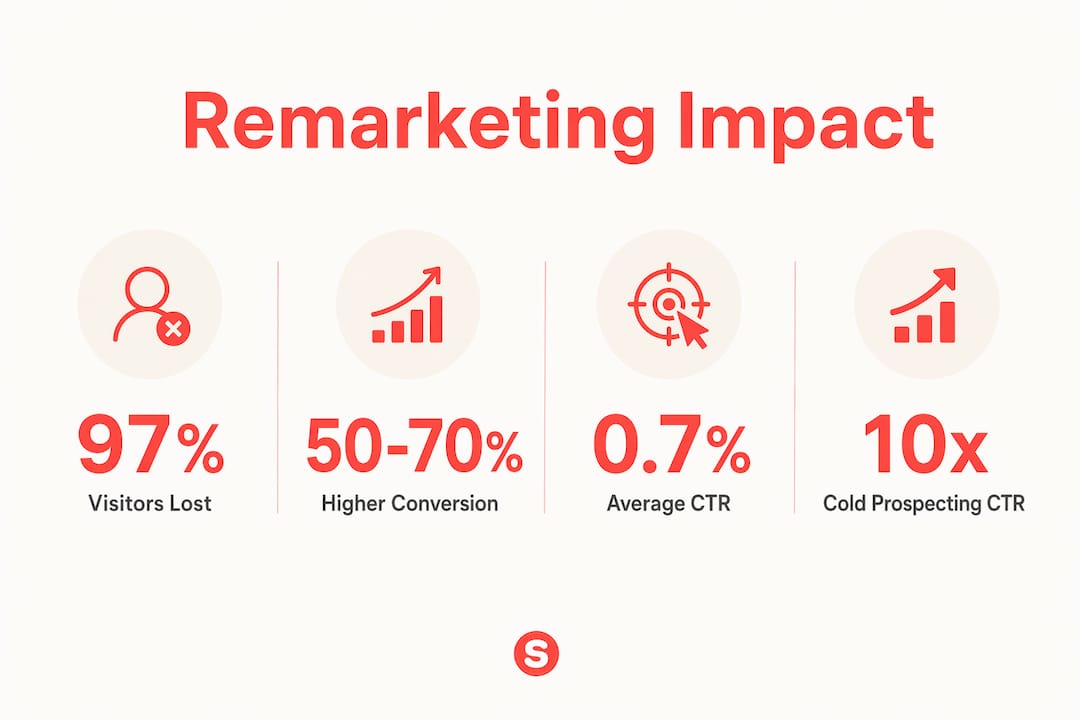
The single most important reason to use remarketing is that 97–98% of first-time visitors leave your website without taking any action. That means nearly every person who discovers your restaurant online walks away before making a reservation or placing an order. Remarketing targets exactly this group, keeping your brand visible until they are ready to act.

The payoff is measurable. Returning visitors convert 50–70% more often than first-time visitors. That gap exists because a returning visitor already knows your name, has seen your menu, and is further along in their decision. You are not starting from zero.
The numbers get even more specific when you look at restaurants running paid search. Restaurants using remarketing for search ads see a 5.2% click-through rate versus 3.8% for standard search ads, a 37% uplift, plus 15–22% lower cost per click. Lower cost per click with a higher conversion rate means your ad budget goes significantly further. That is the core financial case for remarketing in the restaurant industry.
Display ads tell a similar story. Retargeted display ads average a 0.7% CTR, which is ten times higher than cold-prospecting display ads at 0.07%. Remarketing also reduces cost per acquisition by 30–70% compared to standard display ads. For a restaurant with a tight marketing budget, that efficiency matters enormously.
Pro Tip: Segment your remarketing audiences by visit behavior before you set bids. Visitors who viewed your online ordering page deserve a higher bid than those who only landed on your homepage. This single adjustment can cut wasted spend by a significant margin. Learn more about restaurant PPC strategy to pair this with your broader paid search setup.
Does personalized messaging actually make remarketing work?
Generic ads are the fastest way to waste your remarketing budget. The effectiveness of remarketing depends almost entirely on matching your message to what the visitor actually did on your site. A person who browsed your catering menu needs a different ad than someone who abandoned a reservation form two steps from completion.
This is where the mere exposure effect becomes a real business asset. Consumers develop a preference for brands they see repeatedly. For restaurants, consistent and relevant visibility builds the kind of low-level trust that tips someone toward booking your table over a competitor they have never seen before.
Effective audience segmentation for restaurants typically breaks down like this:
- Menu browsers: Show your most popular dishes or a current promotion. The goal is to rekindle appetite and curiosity.
- Reservation abandoners: Serve an ad that addresses friction directly. A simple “Still thinking about dinner?” message with a one-click booking link works well.
- Past customers: Offer a loyalty incentive or highlight a new menu item. These people already like you. Give them a reason to return sooner.
- Event page visitors: Promote your upcoming events or private dining options. Their intent is specific, so your message should be too.
Ad fatigue and wasted spend happen when frequency and creative rotation are mismanaged. Showing the same ad to the same person fifteen times in a week does not increase conversions. It increases annoyance.
Pro Tip: Set a frequency cap of 5–7 impressions per user per week across Google Ads and Meta. Rotate at least two or three creative variations per audience segment. When one creative has run for three weeks, swap it out entirely.
One often-overlooked tactic is exclusion. Exclusion rules remove users who completed actions like bookings from your remarketing lists. Continuing to show reservation ads to someone who already booked is a waste of money and a poor customer experience. Set these exclusions from day one.
Remarketing vs. other marketing tactics: how does it compare?
Remarketing does not replace your other marketing efforts. It makes them more efficient. To understand where it fits, it helps to compare it directly against the alternatives.
| Marketing Tactic | Audience Warmth | Average CTR | Cost Per Acquisition | Best Use Case |
|---|---|---|---|---|
| Cold prospecting display | Cold | 0.07% | High | Brand awareness, new reach |
| Standard search ads | Warm | 3.8% | Moderate | Capturing active intent |
| Remarketing display | Warm to hot | 0.7% | 30–70% lower | Re-engaging past visitors |
| Remarketing search | Hot | 5.2% | 15–22% lower CPC | Converting high-intent returners |
| Email marketing | Warm | Varies | Low (owned channel) | Loyalty and repeat visits |
Cold prospecting through display ads builds awareness, but it targets people who have never heard of you. The conversion path is long and expensive. Remarketing outperforms cold prospecting by targeting warm audiences with higher intent, leading to shorter sales cycles and lower cost per acquisition.
The practical implication for restaurants is this: use awareness campaigns on Meta and Google to fill the top of your funnel with new visitors. Then use remarketing to convert the ones who showed interest but did not act. The two tactics work together, not against each other. Your restaurant marketing mix should treat remarketing as the conversion layer that sits on top of every awareness effort you run.
One important caveat: remarketing only works if you have enough traffic to build meaningful audience segments. A restaurant website with fewer than 500 monthly visitors will struggle to generate audiences large enough to run effective campaigns on Google Ads or Meta. In that case, building traffic through local SEO and social content should come first.
How to build a remarketing strategy that actually works
A working remarketing strategy for a restaurant follows a clear sequence. The setup is not complicated, but the details matter.
-
Install your tracking pixels. Place the Google Ads remarketing tag and the Meta Pixel on every page of your website. Without these, you cannot build audiences. Verify both are firing correctly using Google Tag Assistant and Meta’s Pixel Helper browser extensions.
-
Define your audience segments. Build separate lists for homepage visitors, menu page visitors, reservation page visitors, and past converters. Each list should have a different membership duration. Menu browsers might stay on a list for 30 days. Past customers might stay for 90 days for a loyalty-focused campaign.
-
Build your creative sequences. Creative sequencing that introduces value first, handles objections second, and offers a time-sensitive incentive third is the most effective structure for restaurant remarketing. Ad one might show your best dish. Ad two might highlight your reviews or a press mention. Ad three might offer a 10% discount on a first online order.
-
Use dynamic remarketing for menu items. Dynamic remarketing delivers ads based on prior visitor behavior, showing the specific dishes or promotions a visitor viewed. Google Ads and Meta both support this through product feeds. For restaurants, this means a visitor who spent time on your pasta section sees pasta in their next ad, not a generic brand image.
-
Set frequency caps and exclusions. Cap impressions at 5–7 per user per week. Exclude anyone who completed a booking or order in the last 14 days. Add your email list as a custom audience exclusion to avoid paying to reach people you already have a direct line to.
-
Measure incrementality, not just ROAS. Incrementality testing checks whether remarketing ads truly caused conversions or whether customers would have returned anyway. Run a holdout test by excluding a small percentage of your remarketing audience and comparing their conversion rate to those who saw ads. This tells you the real value of your spend.
Pro Tip: Start with a 30-day audience window for your first remarketing campaign. Once you have conversion data, test a 7-day window for your highest-intent segments like reservation abandoners. Shorter windows often produce better results because the intent is fresher. Pair this with insights from restaurant remarketing explained to refine your approach.
Key takeaways
Remarketing is the highest-ROI conversion tactic available to restaurants because it targets visitors who already showed intent, at a fraction of the cost of reaching cold audiences.
| Point | Details |
|---|---|
| Most visitors need a second touch | 97–98% of first-time visitors leave without converting, making remarketing the primary recovery tool. |
| Personalization drives results | Segment audiences by behavior and match creative to intent to avoid ad fatigue and wasted spend. |
| Remarketing beats cold prospecting on cost | Retargeted campaigns reduce cost per acquisition by 30–70% compared to standard display ads. |
| Exclusions protect budget and experience | Remove converted users from active remarketing lists from day one to avoid irritating loyal customers. |
| Measure incrementality, not just clicks | Use holdout tests to confirm your ads caused conversions rather than taking credit for natural returns. |
What i’ve learned after years of restaurant remarketing
Most restaurant owners I talk to treat remarketing as an afterthought. They run a Facebook awareness campaign, see decent reach numbers, and assume the work is done. The conversions that come in get credited to the awareness campaign. The remarketing layer that actually closed those customers goes unnoticed and underfunded.
The biggest mistake I see is running one generic ad to every past visitor. A person who looked at your happy hour menu three weeks ago is not the same as someone who abandoned a reservation form yesterday. Treating them identically is like a server giving the same pitch to every table regardless of what they ordered last time.
The second mistake is ignoring first-party data. Your reservation system, your email list, and your loyalty program are goldmines for remarketing. Uploading your customer list to Meta or Google Ads as a custom audience lets you run retention campaigns to people you already know. That is a fundamentally different and more powerful signal than a pixel-based audience built from anonymous website visits.
My honest recommendation: treat remarketing as an audience strategy first and an ad strategy second. The creative matters, but the audience definition and exclusion logic matter more. Get those right, and even a modest ad budget produces results that justify the investment. Ignore them, and you will spend money showing the wrong message to the wrong people at the wrong time.
— Barthelemy
How Sorbey helps restaurants run smarter remarketing
Running effective remarketing campaigns requires the right setup, the right audience segments, and consistent creative management. Most restaurant owners do not have time to manage all of that alongside daily operations.
Sorbey is built specifically for local restaurants that want professional-grade digital marketing without hiring an agency. From pixel setup and audience segmentation to full-service restaurant marketing solutions, Sorbey handles the technical and creative work so you can focus on your kitchen. If you want to turn more website visitors into paying customers and keep your regulars coming back, Sorbey gives you the tools and the expertise to make that happen. Explore customer engagement strategies to see how remarketing fits into a broader retention plan.
FAQ
What is remarketing in simple terms?
Remarketing is the practice of showing ads to people who have already visited your website or interacted with your brand. The goal is to bring them back and convert them into paying customers.
How does remarketing work for restaurants?
Restaurants install tracking pixels from Google Ads or Meta on their website. These pixels build audience lists based on visitor behavior, which are then used to serve targeted ads across search, social, and display networks.
Why use remarketing instead of regular display ads?
Remarketing targets warm audiences who already know your brand, producing click-through rates up to ten times higher and cost-per-acquisition rates 30–70% lower than standard cold-prospecting display ads.
How often should remarketing ads be shown to the same person?
A frequency cap of 5–7 impressions per user per week is the standard best practice. Exceeding this threshold increases ad fatigue without meaningfully improving conversion rates.
Does remarketing work for small restaurants with low website traffic?
Remarketing requires a minimum audience size to run effectively on platforms like Google Ads and Meta. Restaurants with fewer than 500 monthly website visitors should prioritize building traffic through local SEO before investing heavily in remarketing campaigns.
Recommended
You might also like

Best Restaurant Loyalty Programs 2026: ROI Guide
Discover the best restaurant loyalty programs 2026 that boost repeat visits. Learn how Sorbey’s platform can transform your guest data strategy!

Why Mobile Marketing Matters for Business Growth
Discover why mobile marketing matters for business growth. Learn how optimizing for mobile drives traffic, conversions, and customer retention.

SF Dim Sum Restaurant Marketing Checklist for 2026
Transform your SF dim sum with our 2026 marketing checklist. Optimize your profile, showcase dishes, and attract customers fast!